Internal Linking Best Practices: The 2026 SEO Standard (Google + AI Search)
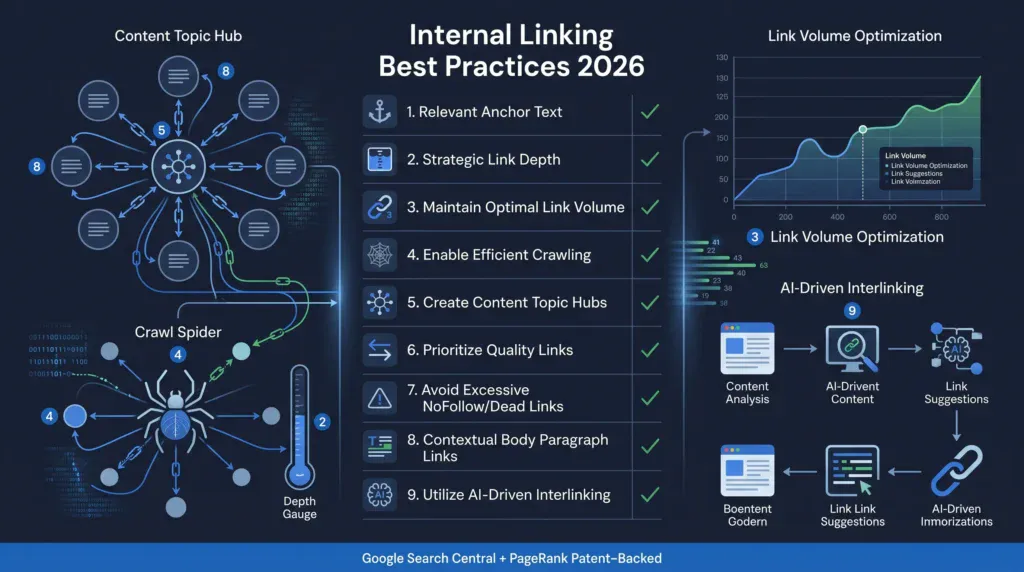
The 2026 internal linking best practices standard requires nine documented behaviors: descriptive entity-rich anchor text (per Google patent US 7,716,225), click depth capped at three hops from the homepage, 30–60 outbound links per page to prevent PageRank dilution (per US 6,285,999), orphan page elimination, hub-and-spoke architecture, bidirectional link pairing on publication, anchor text cannibalization prevention, contextual body placement over navigational placement, and — new for 2026 — extractive passage placement within two clicks of the homepage for Google AI Overview and AI search citation eligibility.
Sites that apply all nine practices consistently see crawl coverage improve within 30 days and topical-authority ranking gains within 60–90 days, based on documented crawl-budget and PageRank-flow mechanics described in Google Search Central’s Large Site Owner’s Guide to Managing Crawl Budget.
What “Best Practice” Means in Internal Linking — and Why 2026 Changed the Standard
Internal linking best practices are not arbitrary conventions — they are direct operational translations of how Google’s three core systems (Googlebot crawler, the indexer, and the ranking/PageRank engine) read link signals, as documented in Google Search Central and codified in patents US 6,285,999 and US 7,716,225.
The 2026 update adds a ninth practice driven by a new constraint: Google AI Overviews, Perplexity, and ChatGPT Search preferentially cite passages that are reachable within two internal link hops from a site’s most-authoritative page (typically the homepage).
- Prior to 2024, “best practice” was defined by crawler and ranking mechanics alone
- In 2026, AI answer engines add a reachability and extractability dimension — passages must be short enough to quote, factual enough to cite, and shallow enough in the link graph to be discovered
- Sites ignoring the AI-search dimension risk earning rankings but losing AI citation share — the two outcomes are no longer equivalent
- All nine practices below apply to every CMS (WordPress, Shopify, Webflow, custom) — they are platform-agnostic
The 9 Internal Linking Best Practices for 2026
Practice 1 — Use Descriptive, Entity-Rich Anchor Text
Google’s Reasonable Surfer Model (patent US 7,716,225) weights anchor text by its topical relevance and its likelihood of being clicked.
Vague anchors (“click here”, “read more”, “this article”) pass weak topical signals and receive the lowest Reasonable Surfer weight.
- Write anchors that contain the destination page’s primary entity: “how anchor text cannibalization quietly tanks rankings” outperforms “related post” by every measurable signal
- Anchor text must match the destination page’s target EAV — not the source page’s topic
- Never repeat the same anchor text to two different destination URLs (anchor text cannibalization — see Practice 7)
- Google Search Central guidance: “Make sure that the linked-to page is clearly identified by the anchor text”
- Length sweet spot: 3–8 words; longer anchors dilute the signal, shorter ones underspecify it
Practice 2 — Keep Click Depth ≤ 3 From the Homepage
Click depth (the number of internal links a user must follow from the homepage to reach a page) is the single most reliable predictor of crawl frequency and PageRank inheritance, per Google Search Central’s crawl budget documentation.
| Click depth | Crawl frequency | Approximate PageRank inherited |
|---|---|---|
| 0 (homepage) | Highest | Baseline (1.0) |
| 1 | Very high | ~0.15–0.25 |
| 2 | High | ~0.05–0.10 |
| 3 | Moderate | ~0.02–0.04 |
| 4+ | Low — risk zone | <0.01 |
- Audit for depth-4+ pages monthly using a site crawl tool or LinkBoss’s site visualizer
- Promote strategic pages to depth-2 by linking from the homepage or pillar hubs
- URL depth (slashes in the path) does not equal click depth — Google cares about the latter
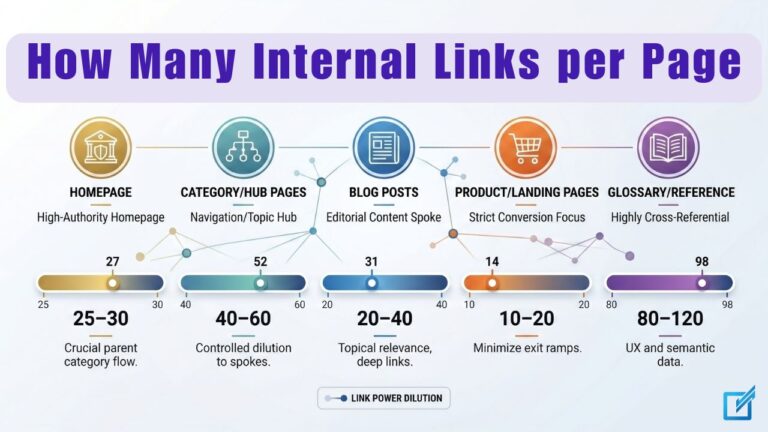
Practice 3 — Keep Outbound Internal Links Per Page Between 30 and 60
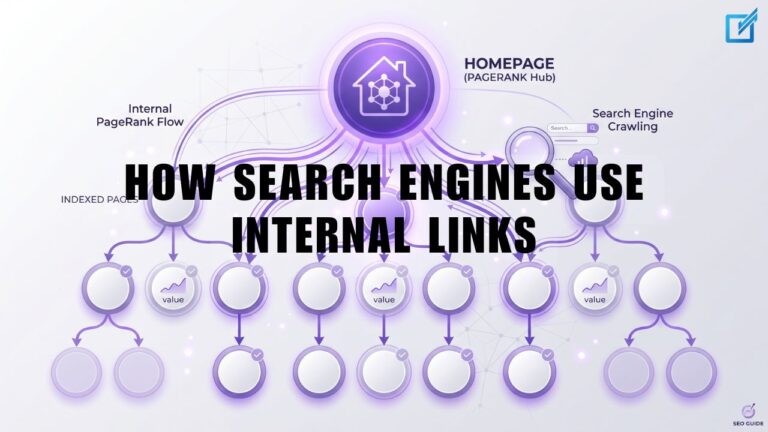
PageRank flow is diluted proportionally across all outbound links (US 6,285,999): a page with 100 outbound links passes 1/100th of its equity to each target; a page with 10 links passes 1/10th — 10× more concentrated equity per link. How search engines use internal links and distribute PageRank is foundational to understanding why link counts matter.
- Under 30 outbound links: acceptable on short content, but limits the network’s wiring
- 30–60 outbound links: the practical sweet spot for deep content pages and hub pages
- 60–100: marginal — monitor whether linked pages improve in rankings; if not, prune
- 100+ outbound links: confirmed equity dilution zone per documented PageRank mechanics; John Mueller has confirmed Google counts “reasonable” links per page without a hard cap, but has noted that hundreds of links on a page devalue each one
- Homepages require special attention: reduce bloated navigation link counts aggressively — every removed link concentrates more equity into the links that remain
Practice 4 — Eliminate Orphan Pages Before Adding New Content
An orphan page (a page with zero inbound internal links) receives no PageRank flow, receives no anchor-text context from the link graph, and is discovered only via XML sitemap — a lower-priority crawl signal than the internal link graph. Orphan pages — what they are, why they hurt SEO, and how to fix every one provides the complete guide to this problem.
- Audit for orphan pages before publishing any new content batch
- Use a crawler or free orphan page checker to surface zero-inbound-link pages in minutes
- Fix priority: link orphan pages from the most topically relevant existing page, not from the homepage (homepage links are reserved for highest-priority pages)
- Newly published pages are temporarily orphaned until the first internal link from an existing page points to them — link immediately on publish
Practice 5 — Build Hub-and-Spoke Architecture
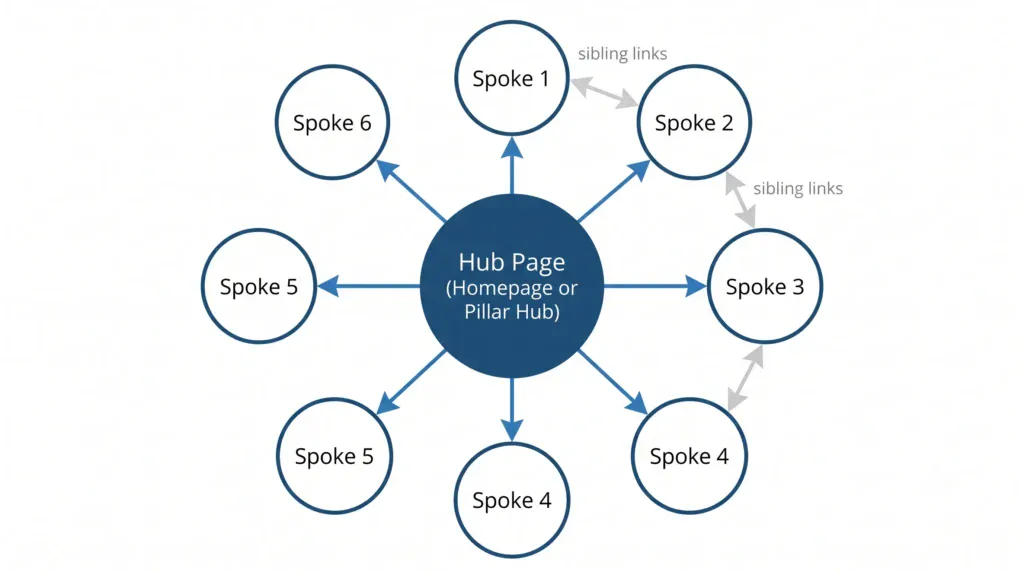
Hub-and-spoke is the structural pattern that most efficiently concentrates PageRank on high-priority pages while simultaneously signaling topical authority to the indexer. Each hub page links to all its spokes; each spoke links back to its hub. Hub-and-spoke silo architecture for internal linking is the structural implementation of this best practice.
- Hub pages: comprehensive, long-form (3,500+ words), targeting head terms
- Spoke pages: deep, narrow (1,500–2,500 words), targeting long-tail EAV queries
- Spokes link UP to the hub; hub links DOWN to all spokes
- Topical authority score increases as spoke count grows — Google rewards completeness of coverage within a topic cluster (Koray Tugberk GUBUR’s Topical Authority formula: Coverage × Historical Data ÷ Cost of Retrieval)
- For Pillar 1 (Fundamentals), the “hub” is the LinkBoss homepage — every spoke links there with a contextual anchor
Practice 6 — Link Bidirectionally on Every Publication
When publishing a new page, do two things immediately: (1) link from the new page to 2–3 existing authority pages in the same cluster, and (2) update 2–3 existing pages to link TO the new page. Waiting for “natural” inlinks leaves the new page orphaned for weeks.
- New → existing: link to the pillar hub and 2 topically adjacent spokes
- Existing → new: update the hub’s spoke-directory section and 1–2 high-authority sibling spokes
- Both directions are required — outbound links on the new page flow equity out; inbound links bring equity in
- This bidirectional pairing is the minimum viable internal link operation per publication
Practice 7 — Prevent Anchor Text Cannibalization
Anchor text cannibalization occurs when two different pages on the same site are targeted by the same anchor text from multiple internal links, confusing Google’s indexer about which page should rank for that query.
- The free anchor text cannibalization checker surfaces duplicated anchors across the full site in seconds
- Each internal linking anchor should point to only one destination URL site-wide
- Synonyms are safe; exact duplicates pointing to different URLs are not
- The most common occurrence: category pages and individual post pages both targeted by the same keyword anchor
Practice 8 — Place Links Contextually in Body Copy, Not Only in Navigation
The Reasonable Surfer Model (US 7,716,225) explicitly weights links based on position and visual prominence — links in the editorial body of a page receive substantially more weight than identical anchors placed in site-wide navigation, footers, or sidebars. What is a contextual link and why Google weighs it highest covers this distinction in detail.
- Contextual link: an anchor embedded within a sentence in the editorial body of a post or page, surrounded by topically relevant text
- Navigational/sitewide links: header menus, footer menus, sidebar widgets — all reduced-weight by the Reasonable Surfer scoring
- Rule of thumb: at least 70% of internal links pointing to a strategic destination should be contextual body links, not navigational
- Anchor text in context additionally benefits from co-occurrence signals — the surrounding sentence and paragraph contribute topical context beyond the anchor words themselves
Practice 9 — Place AI-Citable Passages Within Two Link Hops of the Homepage (2026 Standard)
Google AI Overviews, Perplexity, and ChatGPT Search preferentially extract and cite passages that are (a) factually declarative, (b) self-contained within 2–4 sentences, and (c) reachable within a shallow link graph from a high-authority page. This is a 2026 addition to the internal linking standard driven by AI answer engine behavior.
- Identify your highest-priority extractive passages (definition answers, numbered facts, comparison data)
- Ensure those pages are at click depth ≤ 2 from the homepage — depth-3+ pages are crawled by AI bots less frequently
- Write the extractive passage as the second or third paragraph of the page (not buried after 800 words of preamble)
- AI bots (GPTBot, ClaudeBot, PerplexityBot) follow internal links to discover passages — internal link graph architecture directly affects AI citation frequency
- A dedicated internal linking tool automates depth-monitoring and extractive passage positioning at scale, removing the need for manual click-depth audits across hundreds of pages
Quick-Reference: The 9 Best Practices at a Glance
| # | Practice | Source | 2026 Update? |
|---|---|---|---|
| 1 | Descriptive entity-rich anchors | US 7,716,225 / Search Central | No |
| 2 | Click depth ≤ 3 | Search Central Crawl Budget Guide | No |
| 3 | 30–60 outbound links per page | US 6,285,999 PageRank mechanics | No |
| 4 | Eliminate orphan pages first | Search Central crawl-discovery docs | No |
| 5 | Hub-and-spoke architecture | Koray Tugberk GUBUR — Topical Authority formula | No |
| 6 | Bidirectional linking on publish | Internal linking workflow standard | No |
| 7 | Prevent anchor text cannibalization | Google indexer behavior | No |
| 8 | Contextual body placement | US 7,716,225 Reasonable Surfer | No |
| 9 | AI-citable passage reachability ≤ 2 hops | GPTBot / ClaudeBot / PerplexityBot crawl behavior | Yes — 2026 |
Common Violations That Negate These Practices
Even sites that know the best practices routinely violate them in predictable ways:
- Over-relying on footer links — Footer links to “important” pages look like sitewide links; they contribute almost nothing contextually and dilute homepage equity to every page in the footer
- Linking from low-traffic pages only — New pages linked only from depth-4 posts receive minimal crawl priority; link from your highest-traffic existing pages too
- Never updating existing posts — “Link when you publish” is only half the practice; existing posts pointing to new content must be updated retroactively
- Using the same anchor for the hub and a spoke — A spoke about “internal linking best practices” and its hub about “internal linking fundamentals” must use different anchors — identical anchors cause cannibalization even within the same cluster
- Setting and forgetting — Internal link graphs decay as site structure changes; quarterly audits are the minimum maintenance cadence
Frequently Asked Questions
How many internal links per page is optimal for SEO?
Google provides no hard cap, but PageRank mechanics (US 6,285,999) document that equity is divided equally across all outbound links. For editorial content pages, 30–60 internal links balances adequate wiring of the site graph against equity dilution. Homepages, hub pages, and high-authority category pages should be kept closer to 25–30 internal links to maximize the equity concentration flowing to each linked page.
Does anchor text still matter for internal links in 2026?
Yes — the Reasonable Surfer Model (Google patent US 7,716,225), still in use as of 2026 per Google engineers’ public statements, weights anchor text topicality as a signal about the destination page’s subject matter. The indexer reads internal anchor text to assign topical context to the linked page; generic anchors like “click here” or “read more” convey no topical context and receive near-zero weight. Descriptive anchors containing the destination page’s primary entity and keyword are the documented best practice from Google Search Central’s “Write good link text” guidance.
What is the most common internal linking mistake?
Orphan pages — pages with zero inbound internal links — are the most common and highest-impact mistake because they receive zero PageRank flow and are not discovered by Googlebot through internal link traversal. Sites with large content libraries can have 20–40% of their URLs orphaned, typically due to CMS pagination, taxonomy changes, or broken category structures. Fixing orphan pages is the highest-ROI internal linking action because it immediately increases crawlable pages without requiring new content.
How do internal linking best practices differ for AI search in 2026?
AI search engines (Google AI Overviews, Perplexity, ChatGPT Search) add one new dimension to the standard: passage reachability. AI bots follow the internal link graph to discover content, so pages at click depth 4+ are rarely cited in AI-generated answers. The 2026 update to best practices requires that any page you want AI-cited should be at click depth ≤ 2 from the homepage, and its best extractive passage should appear within the first 400 words of the page — not buried after a long introduction.
Should I use nofollow on internal links?
Almost never. Google’s John Mueller has confirmed that rel=”nofollow” on internal links stops PageRank from flowing to the destination. Unlike external links (where nofollow is sometimes appropriate for sponsored content or UGC), there is rarely a valid reason to suppress PageRank flow to your own internal pages. The only documented exception is login/checkout pages you explicitly do not want in the ranking algorithm — and even those are better handled via meta name=”robots” content=”noindex” on the destination page rather than nofollow on every inbound link.
References
- Google. Large site owner’s guide to managing crawl budget. Google Search Central.
- Page, L. (1999). Method for node ranking in a linked database. US Patent 6,285,999.
- Winston, M. et al. (2009). Ranking the search results of a search engine based on the probability of obtaining user clicks. US Patent 7,716,225. (Reasonable Surfer Model.)
- OpenAI. GPTBot — OpenAI API Documentation.
- Anthropic. Claude Bot — Anthropic Documentation.
- Koray Tugberk GUBUR. Holistic SEO Digital — Topical Authority Framework.