What Is a Circle Silo in SEO?
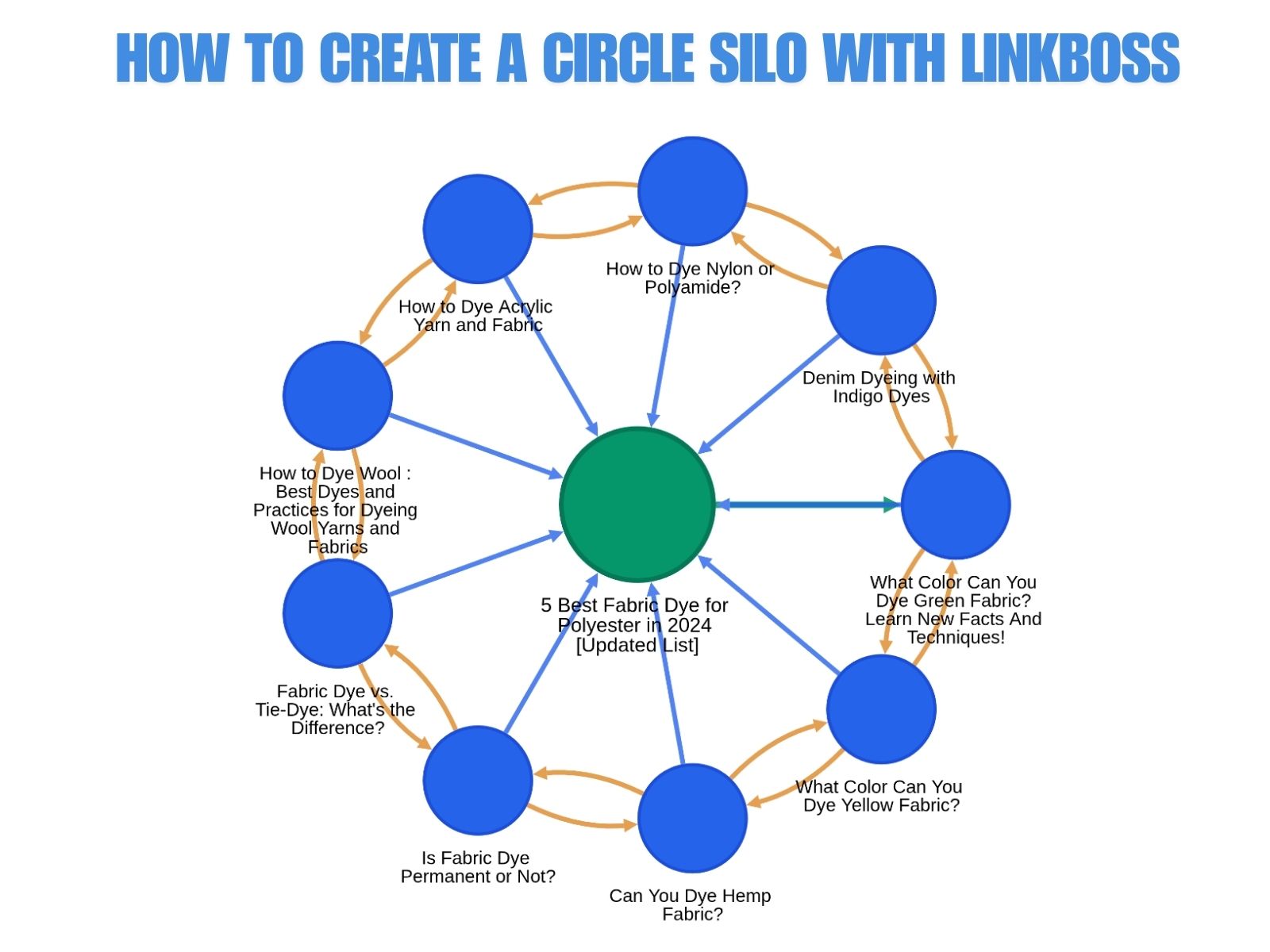
A circle silo is an internal linking structure where pages within a topical cluster connect in a circular closed loop: each page links to the next, and the last page links back to the first, creating a ring of link equity that circulates continuously. The circle silo (also called a “circular silo”) includes a designated pillar page that links to the first supporting page, while every supporting page links back to the pillar page and to its adjacent neighbors in the ring. The result is a dense network of bidirectional relevance signals within a tightly defined topical cluster.
The 4 defining components of a circle silo:
- Pillar Page: The central authority page that links to the first supporting page and receives inbound links from all supporting pages. This page targets the broadest keyword in the cluster.
- Supporting Pages: Content pages arranged in a ring around the pillar page. Each supporting page links to the pillar page, to the next supporting page, and to the previous supporting page.
- Closed Loop: The last supporting page links back to the first supporting page, completing the circle. No page in the structure is a dead end.
- Topical Relevance: Every link in the circle connects topically related pages. The semantic adjacency between linked pages reinforces the entity theme of the entire cluster.
Matt Diggity, founder of Diggity Marketing, emphasizes the loop completion principle as critical for silo structures: “Whenever you have a dead end, that link juice just goes stale. It does not go anywhere else. No topical relevance is passed on, no link juice is passed on.” The circle silo eliminates dead ends by design.
How Does a Circle Silo Circulate Link Equity?
Link equity in a circle silo circulates through a continuous closed loop: any page that receives external authority passes that equity to its neighbors in the ring, and the loop guarantees equity reaches every page without dead-end loss. The pillar page accumulates the highest concentration of equity because all supporting pages link directly to it, while supporting pages receive equity from their ring neighbors.
The 3 mechanisms that drive equity circulation in a circle silo:
- Universal equity propagation: Any external backlink to any page in the circle eventually benefits the entire cluster. A backlink to Supporting Page 3 passes equity to Supporting Pages 2 and 4 through the ring links, and to the Pillar Page through the direct link. The equity continues circulating through the loop.
- Pillar page concentration: The pillar page accumulates the most internal PageRank. With N supporting pages each linking to the pillar, the pillar receives N direct inbound internal links, significantly more than any single supporting page receives.
- Dead-end elimination: Every page in the circle has at least 2 outbound internal links and at least 2 inbound internal links. This guarantees that no page becomes an equity sink where link juice stagnates.
LinkBoss describes the crawl efficiency advantage: “A crawler visiting just one page will eventually discover every single one. No page is left isolated.”
What Are the 4 SEO Benefits of a Circle Silo?
The 4 SEO benefits of a circle silo are maximum entity reinforcement through dense topical interconnection, complete crawl coverage with zero orphan pages, long-tail ranking without external backlinks, and balanced authority distribution with pillar page concentration. Each benefit operates through the circular loop structure.
- Reinforce entity signals through dense topical interconnection. Every supporting page receives contextual links from 2–3 semantically adjacent pages. This creates bidirectional relevance signals that strengthen Google’s understanding of the entity the cluster represents. The circle structure produces the highest entity density of any silo configuration.
- Guarantee complete crawl coverage with zero orphan pages. The circular ring ensures that Googlebot can traverse the entire cluster from any entry point. No page exists without at least one inbound internal link. Matt Diggity states: “With a well-planned SEO silo structure, you can make sure all of that link juice is spread around to all of the pages of your website.”
- Enable long-tail ranking without external link building. The circle structure allows informational supporting pages to rank for long-tail keywords using only the internal authority circulating through the ring. Diggity notes: “Do not be surprised if some of those pages start ranking without any external link building at all.”
- Balance authority distribution while concentrating on the pillar. The circle structure achieves two simultaneous goals: even distribution among supporting pages (through the ring) and concentrated accumulation on the pillar page (from all supporting pages linking to it).
When Should You Use a Circle Silo Structure?
Deploy a circle silo when a topical cluster contains 5 or more closely related pages that share a common entity theme, when orphan page problems exist within a category, or when maximum crawl coverage is required for a blog-heavy site. The circle silo works best for content clusters where pages are topically adjacent and semantically connected.
The 4 scenarios where a circle silo delivers maximum impact:
- Blog sites with many posts in a single topical category. The circle pattern links related blog posts in a ring, so readers and crawlers discover every post in the category. LinkBoss describes this as “one of the most effective silo structures for blog sites.”
- Sites with orphan page problems. Pages with zero inbound internal links that Google cannot discover. The circle structure guarantees every page receives at least 2 internal links.
- Topical authority sites building thorough niche coverage. When the goal is to establish the site as the authoritative resource on a specific subject, the circle silo creates the densest possible internal link network within the cluster.
- Affiliate sites with informational and commercial content. Informational posts attract backlinks naturally, and the circle funnels this authority to the pillar page, typically a “best [product]” roundup page that serves as the pillar.
Avoid a circle silo when pages are not closely topically related (the circle would link semantically distant content), when a single page needs maximum concentrated equity (use a priority silo instead), or when the cluster contains fewer than 5 pages (simpler structures provide the same benefit).
How to Create a Circle Silo in LinkBoss Custom Network?
Building a circle silo in LinkBoss requires 6 steps: open Custom Network, add a pillar page plus supporting URLs, submit the cluster, select the circle silo preset and designate the pillar page, review the circular structure visually, and execute Boss Mode for automatic circular linking. The circle silo is the only preset that requires selecting a pillar page, and this page anchors the loop and receives links from all supporting pages.
Step 1: Access the Custom Network Tool
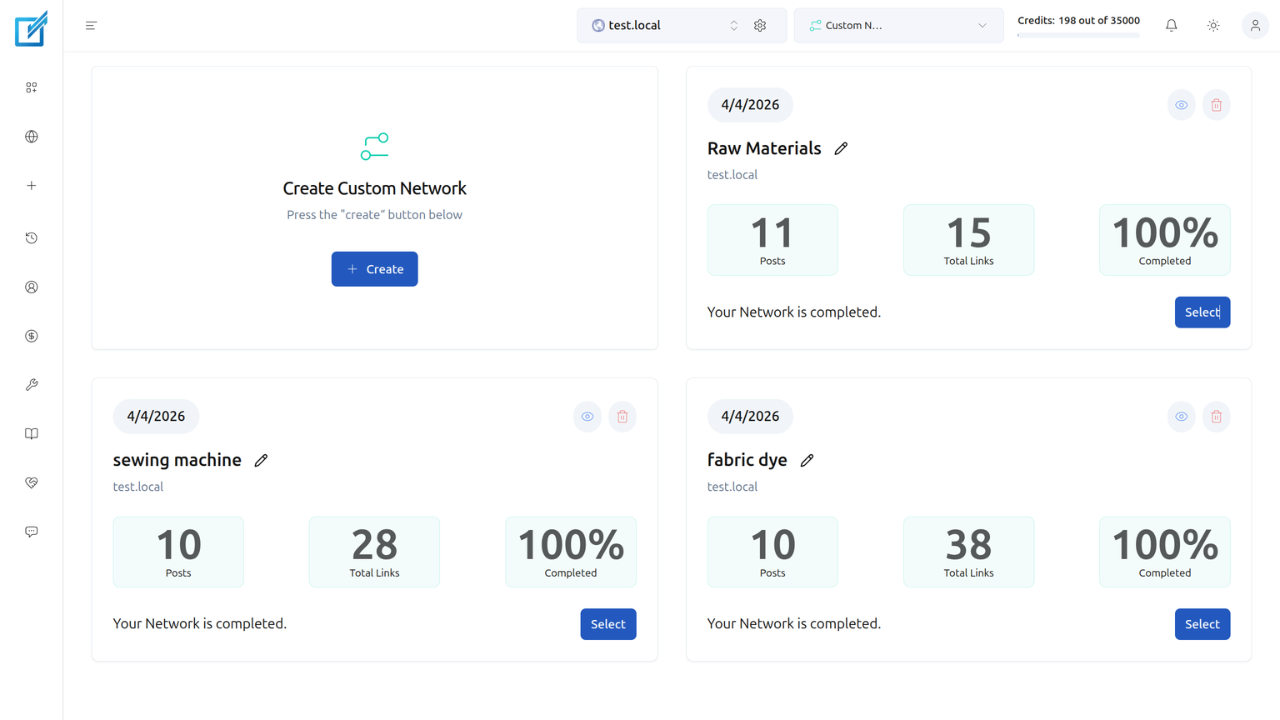
Open the LinkBoss dashboard. Go to Tools → Custom Network → Create. The Create Custom Network page loads with a URL input field and a right sidebar containing 3 tabs for adding URLs.
Step 2: Add URLs to Your Topic Cluster
The circle silo requires a specific combination: 1 pillar page plus multiple supporting pages. Use the right sidebar’s 3 methods to gather URLs:
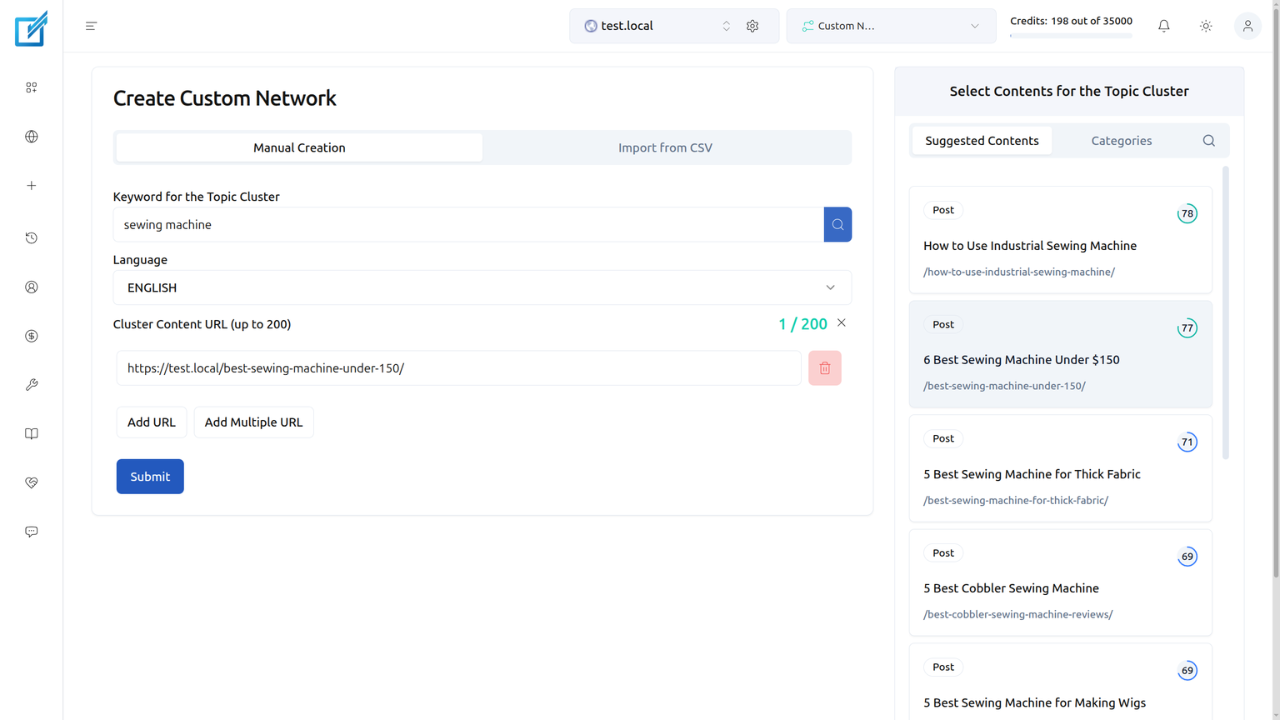
- Suggested Contents: Enter a topic keyword (for example, “sewing machine”) in the Keyword for Topic Cluster field. Select your pillar page from the suggestions, and choose the page that covers the broadest aspect of the topic.
- Categories: Switch to the Categories tab. Find the relevant category, click Fetch, then Add to load supporting URLs into the cluster.
- Search: Find specific supporting pages by title keyword.
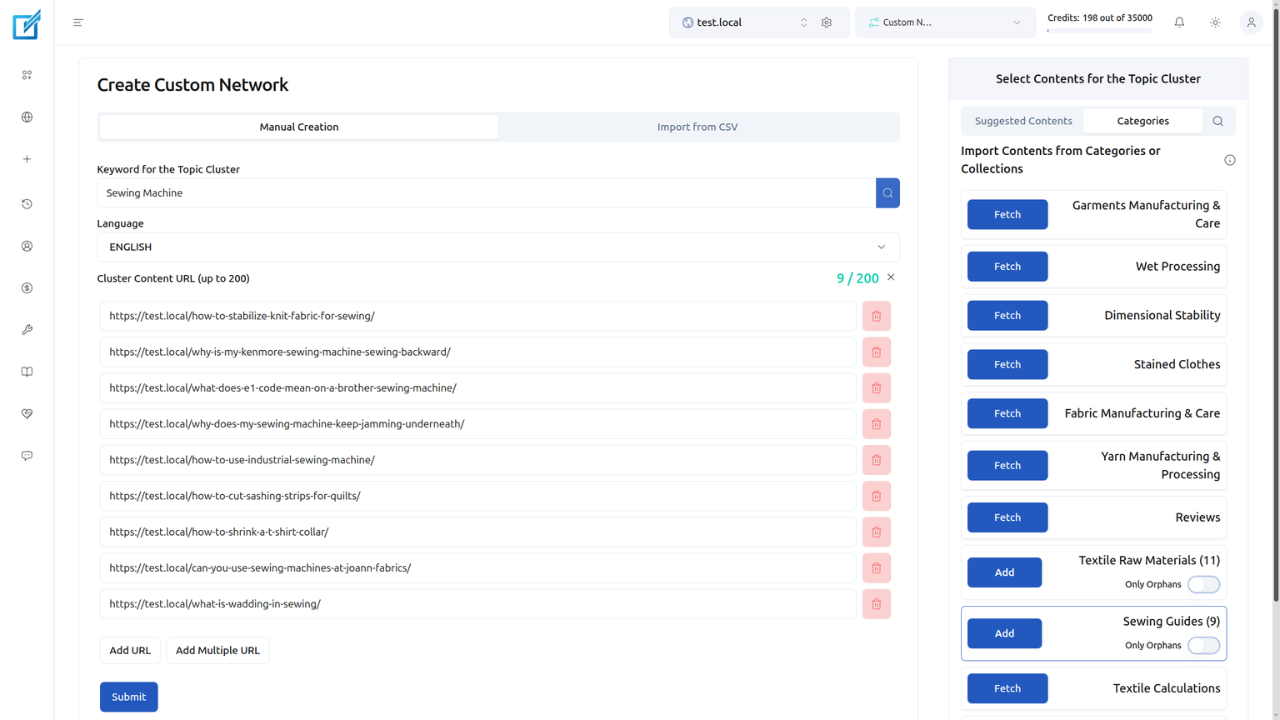
Combine sources: select the pillar page from Suggested Contents, then add supporting pages from Categories to build the complete cluster.
Step 3: Submit the Cluster
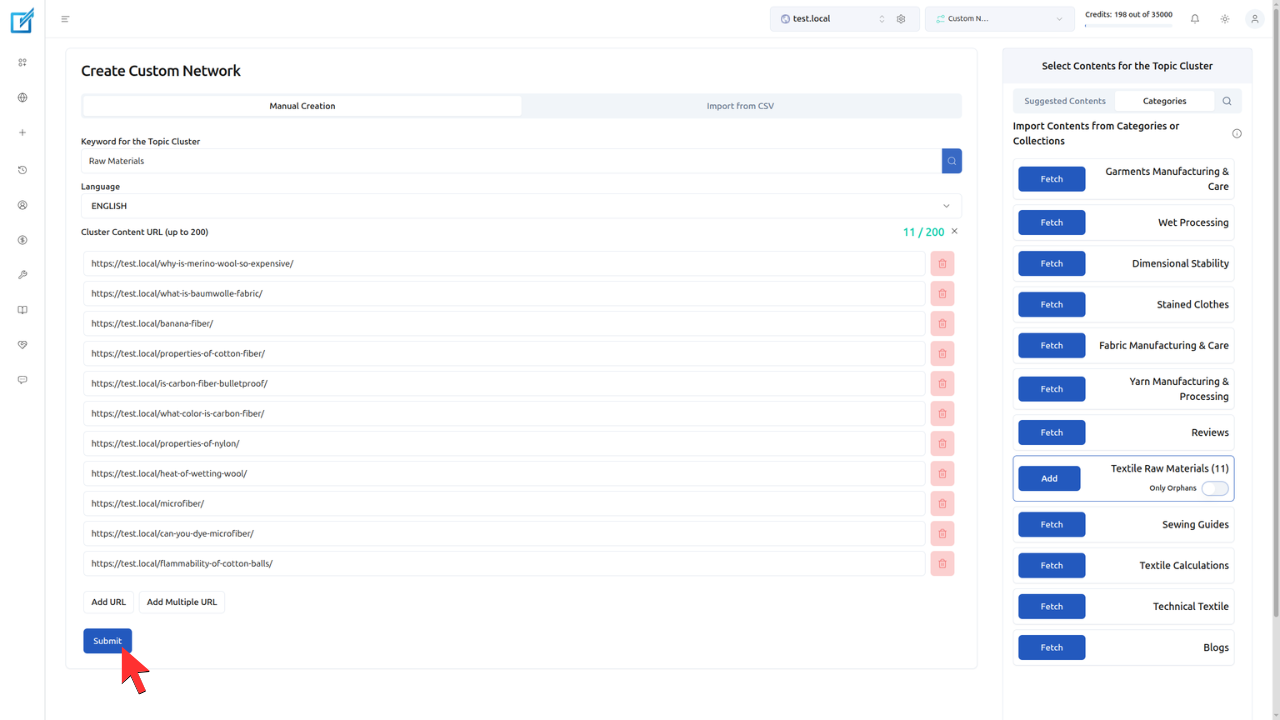
Click Submit. LinkBoss processes the selected URLs and advances to the silo configuration screen.
Step 4: Select the Circle Silo Preset
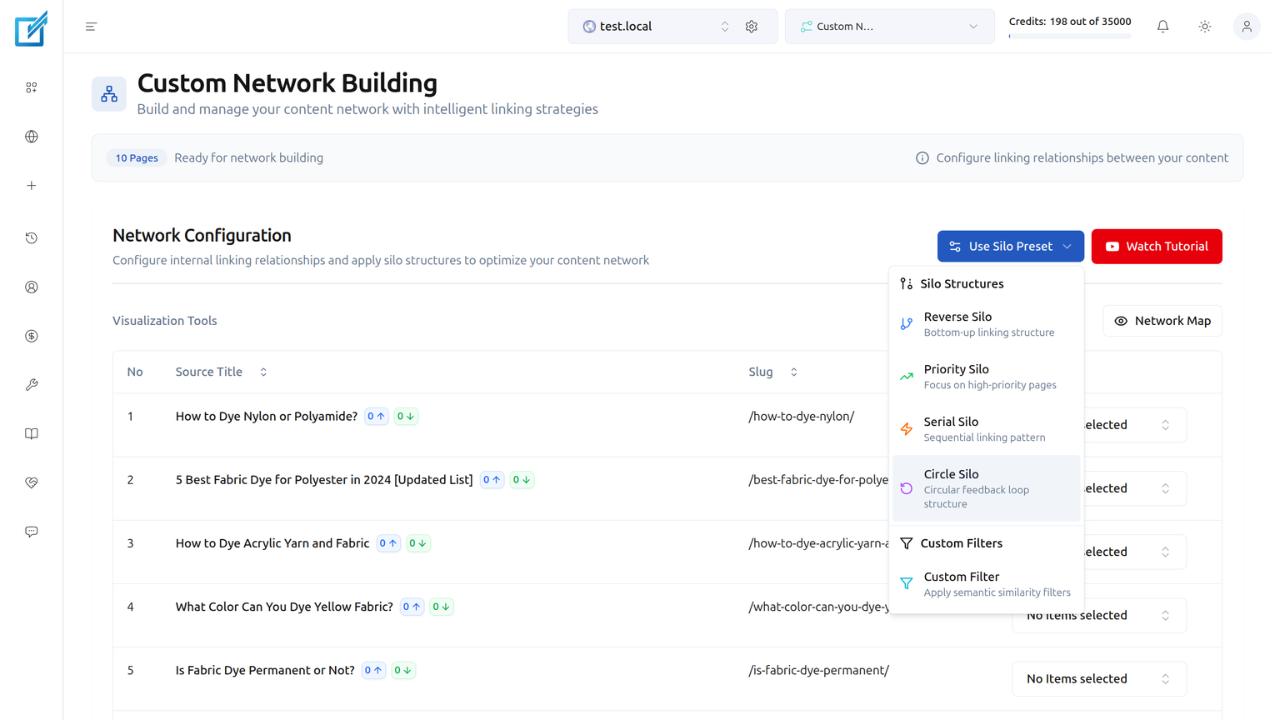
Click Use Silo Preset on the configuration screen. Choose Circle Silo from the available options. Select your Pillar Page from the dropdown, as this is required for the circle silo. The pillar page anchors the loop and receives links from all supporting pages.
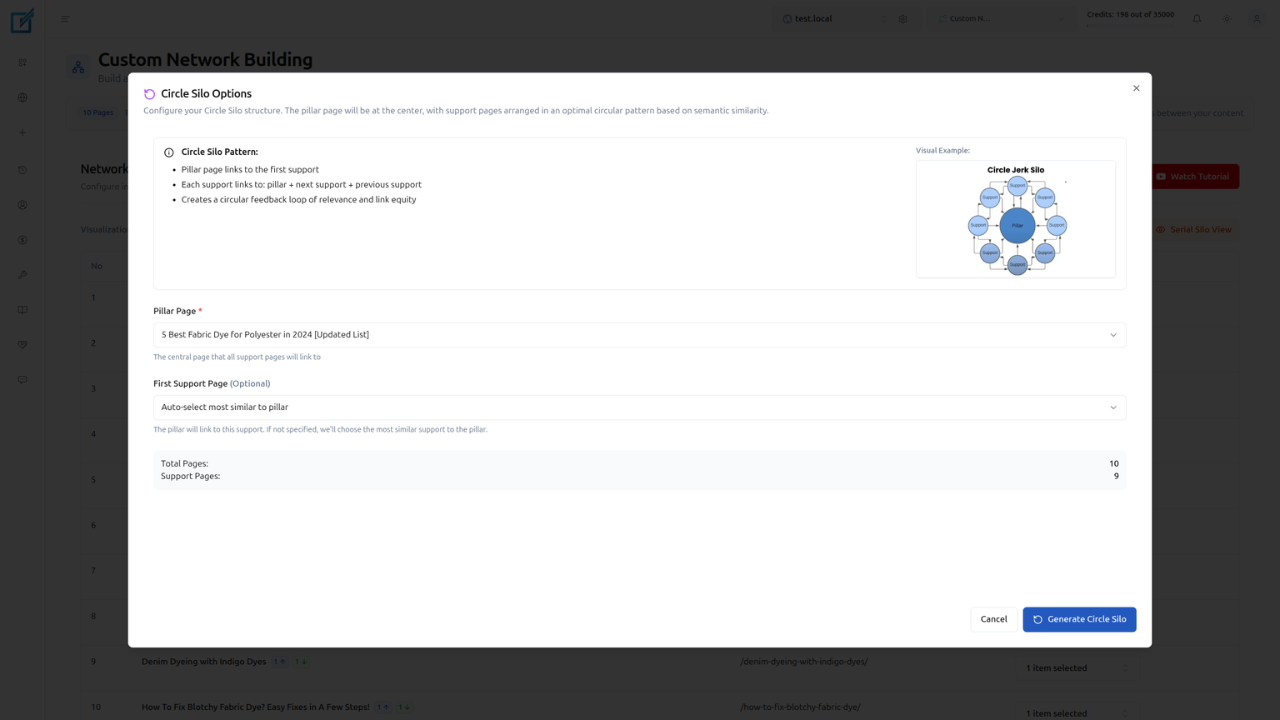
Click Generate Circle Silo. LinkBoss calculates the circular linking structure: supporting pages are arranged in a ring where each page links to the next, the last links back to the first, and all pages link to the pillar.
Step 5: Review the Visual Circular Structure
Click Circle Silo View to see the circular linking loop displayed as a visual diagram. Verify that:
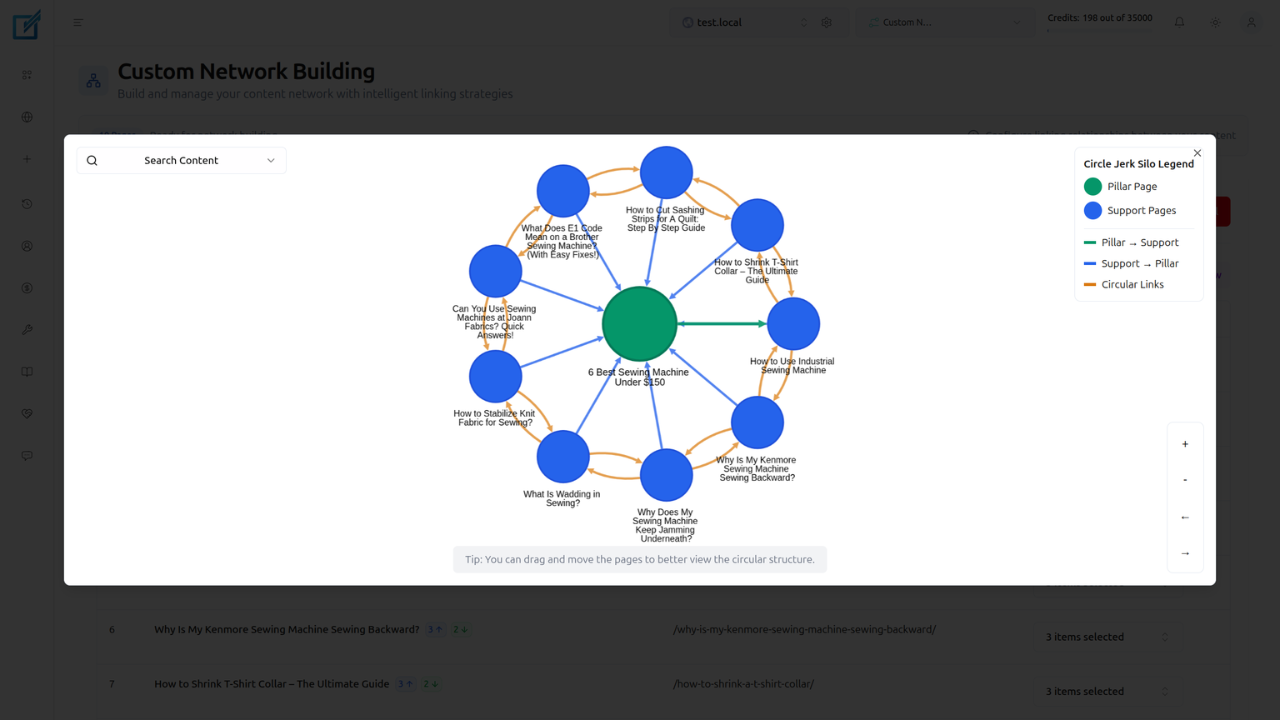
- The pillar page sits at the center of the structure
- Supporting pages form a ring around the pillar
- Each supporting page links to the next and previous supporting page
- The last supporting page links back to the first, closing the loop
- All supporting pages link to the pillar page
- Anchor texts reflect the topical connection between linked pages
Step 6: Execute Boss Mode
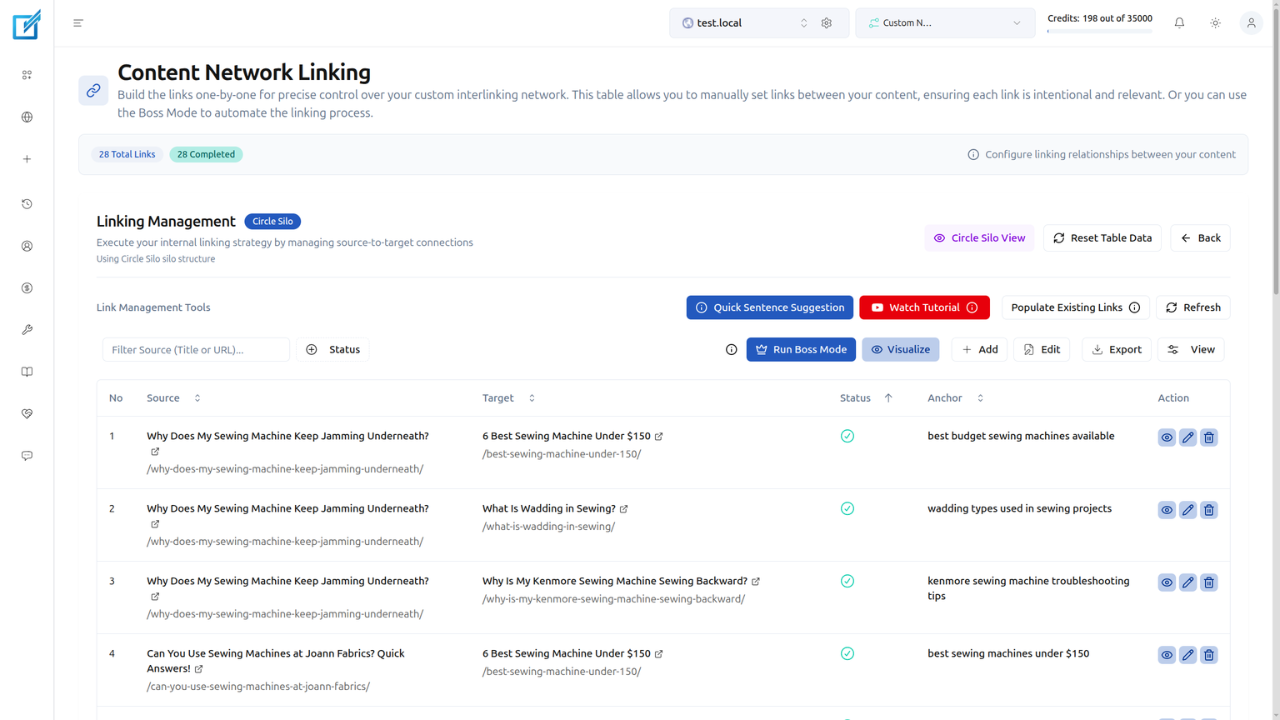
Click Next, then Run Boss Mode → Let’s Go.
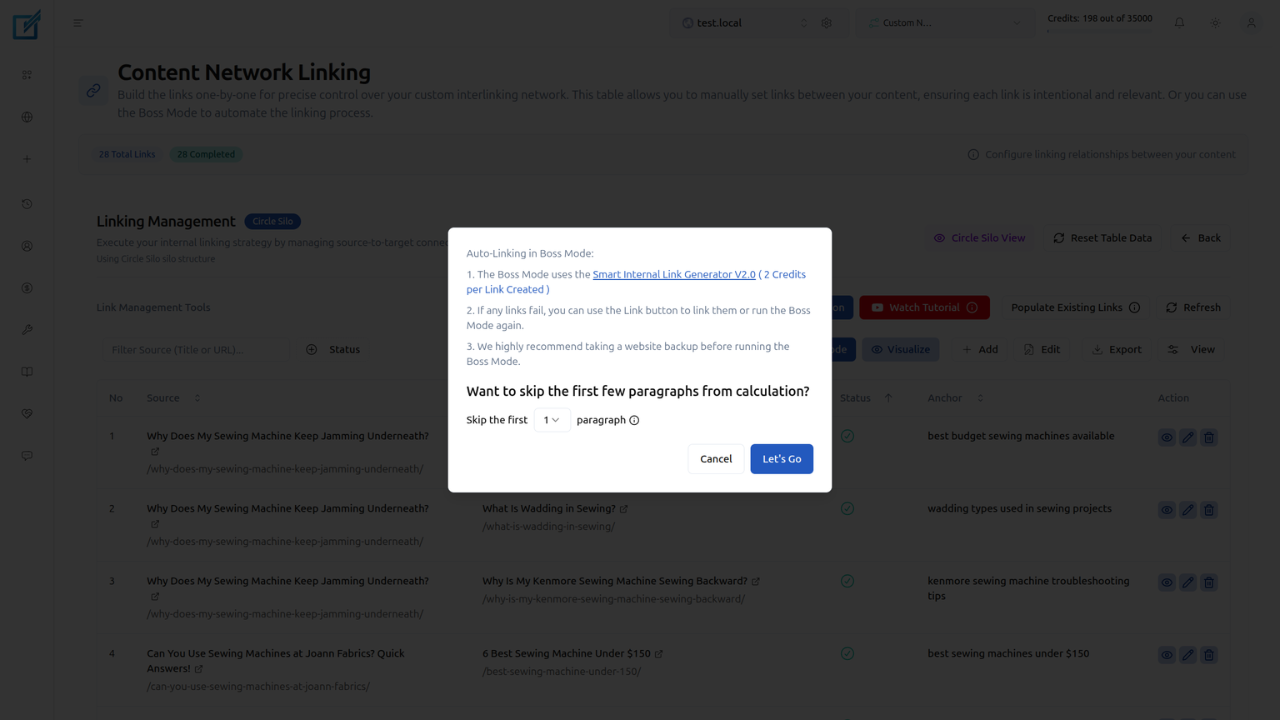
Boss Mode uses the Smart Internal Link Generator V2.0 to insert every link in the circle silo. For each connection in the circular structure, the system:
- Finds the most semantically relevant paragraph in the target post based on NLP analysis of content meaning.
- Generates 2–3 new contextual sentences that are appended after that paragraph. These sentences naturally lead into the anchor text rather than forcing a link into existing content.
- Embeds NLP-optimized anchor text within the generated sentences so the link reads as a natural part of the paragraph, not an insertion.
This approach differs from simple link wrapping (the “In-Post Sentences” method), which only inserts a link into an existing sentence. Boss Mode adds fresh context around each link, which produces more natural-sounding content and stronger topical signals for search engines.
The process runs in the background. LinkBoss deploys all links directly to your live site and notifies you on completion. After Boss Mode finishes, you can go back and edit individual links, modify anchor text, or adjust the surrounding context.
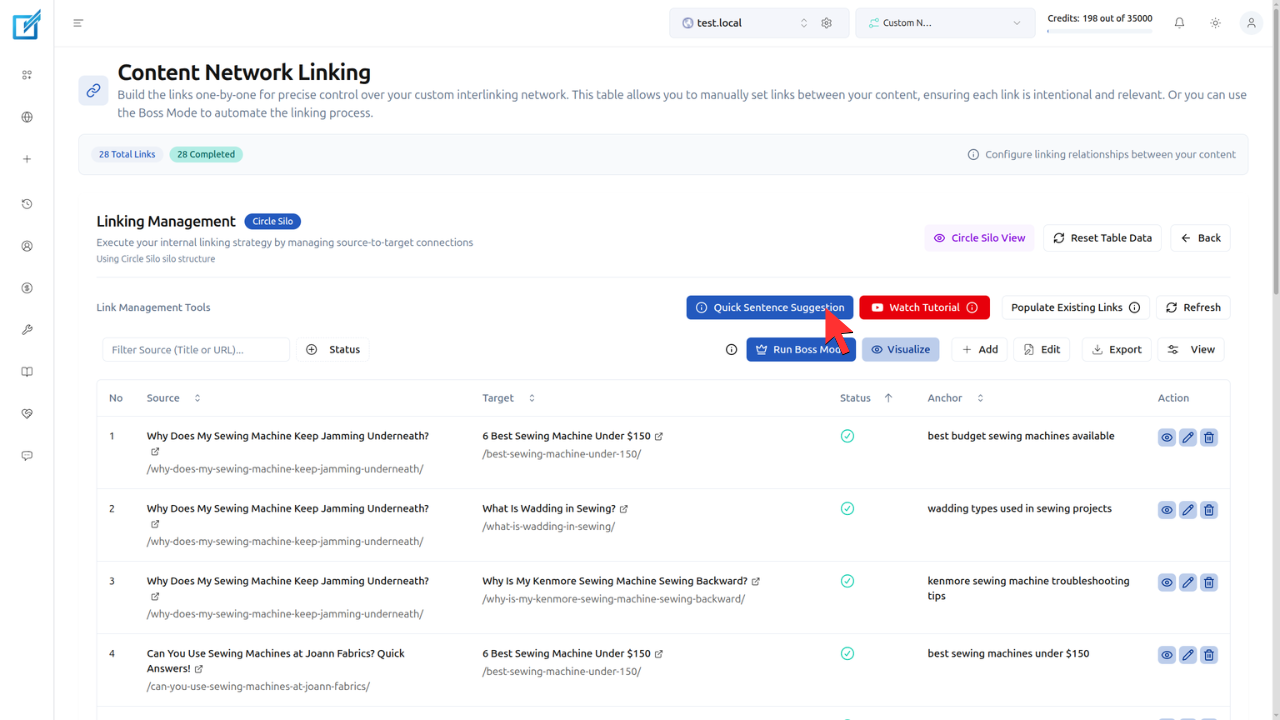
If you prefer not to add new sentences to your posts, use the Quick Sentence Suggestions route instead of Boss Mode. This option inserts links into existing sentences without generating additional content. It costs 1 credit per link instead of 2 credits.
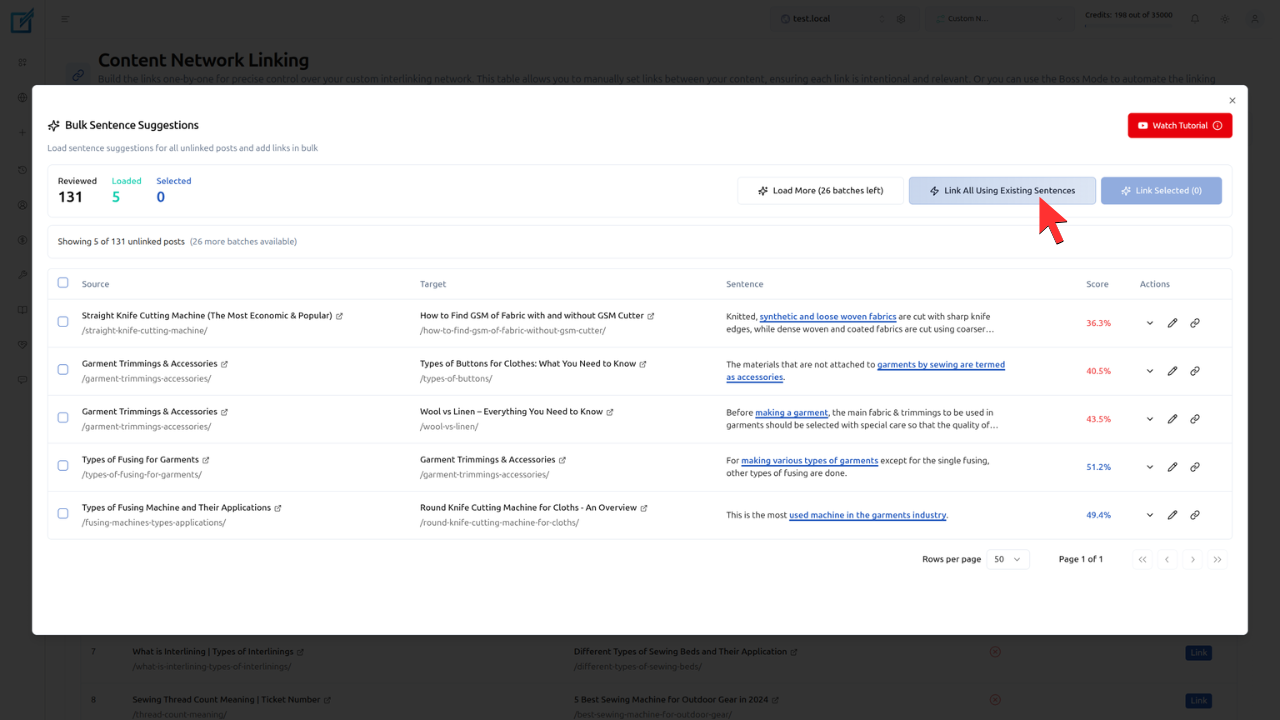
The entire circle silo structure is generated in under 2 minutes. Links remain permanent even after removing the LinkBoss plugin from the site. Boss Mode costs 2 credits per link (compared to 1 credit per link for the In-Post Sentences method).
What Types of Websites Benefit Most from a Circle Silo?
The 4 types of websites that benefit most from a circle silo are blog-heavy content sites, topical authority sites, affiliate sites with informational clusters, and local SEO sites with service area pages. Each site type produces clusters of closely related pages that gain ranking power from the dense interconnection the circle provides.
- Blog-heavy content sites: Sites with 15–30+ posts per category. The circle pattern ensures every post in a category is discoverable and receives internal link equity from semantically adjacent posts.
- Topical authority sites: Sites building thorough coverage of a specific niche. The circle structure creates the densest possible internal link network, reinforcing the entity theme across all cluster pages.
- Affiliate sites with informational clusters: Informational posts attract natural backlinks. The circle funnels this external authority through the ring to all cluster pages and concentrates the most equity on the pillar page.
- Local SEO sites: Service area pages within the same geographic region link in a circle, reinforcing the local entity theme and so Google discovers all location-specific content.
How Does a Circle Silo Compare to Other Silo Structures?
A circle silo differs from other silo structures in its closed-loop architecture, bidirectional equity flow, and balanced authority distribution with pillar concentration. The 4 common silo structures serve distinct strategic purposes based on content organization and ranking goals.
| Structure | Link Pattern | Equity Flow | Best Use Case |
|---|---|---|---|
| Circle Silo | Circular closed loop | Distributed evenly with pillar concentration | Blog clusters, entity SEO, topical authority |
| Serial Silo | Linear chain (A to B to C to D) | Sequential, diminishing | Tutorials, ordered guides |
| Reverse Silo | Bottom-up (support to target) | Concentrated on 1 page | Commercial page support |
| Priority Silo | Asymmetric many-to-1 | Concentrated on priority page | Revenue-focused pages |
The circle silo is the only structure that guarantees zero dead-end pages. The serial silo leaves the first and last pages with only 1 internal link each. The reverse silo and priority silo concentrate equity on a single page without guaranteeing equal distribution among supporting pages.
Matt Diggity recommends the circle silo for blog-heavy sites and topical authority building. For beginners, he suggests the reverse silo as a simpler starting point. For advanced SEOs with clearly identified revenue pages, the priority silo delivers more concentrated results.
What Role Does a Circle Silo Play in Entity SEO?
A circle silo reinforces entity SEO by creating dense bidirectional relevance signals between semantically adjacent pages, which helps Google’s knowledge graph recognize the cluster as a coherent topical authority. Each link in the circle connects pages that share entity attributes, strengthening the semantic signal at every position in the ring.
The 3 ways a circle silo supports entity SEO:
- Entity density amplification: Every supporting page receives contextual links from 2–3 semantically adjacent pages. Multiple inbound links using varied but topically relevant anchor text reinforce the entity from multiple linguistic angles. Matt Diggity’s testing shows: “The best result we found was when we had 100% varied target anchor text going to any one of these pages.”
- Knowledge graph reinforcement: Google’s knowledge graph processes entities based on their relationships to other entities. The circular linking pattern explicitly defines these relationships: each page connects to its semantic neighbors, building a structured entity web that Google can parse efficiently.
- Topical authority signal: The dense interconnection signals to Google that the site covers a specific entity in depth. Pages that are thoroughly interlinked around a central topic receive stronger topical authority scores than isolated pages covering the same topic independently.
Frequently Asked Questions About Circle Silo Structures
What Is the Difference Between a Circle Silo and a Serial Silo?
A circle silo closes the loop: the last page links back to the first page, creating a circular ring with no dead ends. A serial silo leaves the chain open, so the first page and last page have only 1 internal link within the silo. The circle distributes equity more evenly; the serial silo maintains a directional flow that diminishes at each step.
How Many Pages Does a Circle Silo Require?
A circle silo requires a minimum of 5 pages (1 pillar plus 4 supporting pages) to produce meaningful topical density. Clusters of 8–15 pages deliver the strongest entity reinforcement. Clusters exceeding 20 pages risk diluting the semantic signal, so split large clusters into multiple connected circle silos.
Is a Pillar Page Required for a Circle Silo?
Yes. The pillar page is a required component of the LinkBoss circle silo preset. The pillar page receives links from all supporting pages and links to the first supporting page, anchoring the circular structure. Without a pillar page, the circle becomes an undifferentiated ring with no focal point for authority concentration.
Can Multiple Circle Silos Coexist on the Same Site?
Yes. Multiple circle silos can operate independently on the same site, each covering a distinct topical cluster. Link each circle silo’s pillar page to a site-level hub page to connect the clusters into a broader topical authority structure. This creates a hub-and-spoke arrangement at the macro level with circle silos at the micro level.
Does LinkBoss Generate Anchor Text for Circle Silo Links?
Yes. LinkBoss uses NLP-based semantic analysis to generate anchor text that matches the contextual meaning of both the source page and the target page. The anchors vary across the circle: each link uses a different but topically relevant phrase that reinforces the entity theme from multiple angles.
References
- Matt Diggity. “SEO Silos: How to Rank for More Keywords Without Building Links: 5 Ways.” YouTube (88K+ views)
- LinkBoss. “How to Create Circle Jerk Silo with LinkBoss.” YouTube
- LinkBoss. “How to Build Circular Silo and Fix Orphan Pages Fast.” YouTube
- InfinitNet. “Circle Jerk Silo Structure.” infinitnet.io