Internal Linking for AI Search (Google AI Overviews, ChatGPT, Perplexity)
Internal linking for AI search is the strategic practice of structuring a website’s internal link graph so that AI engines—such as Google AI Overviews, ChatGPT Search, and Perplexity—can seamlessly discover, contextualize, and cite your most authoritative pages when generating real-time answers. AI crawlers (GPTBot, ClaudeBot, and PerplexityBot) follow internal links as primary discovery pathways. They utilize anchor text and surrounding passage context to assign topical authority to destination pages—the exact same core signals Google’s crawler has leveraged since 1998. Consequently, internal linking decisions that optimize for traditional Google SEO simultaneously maximize your eligibility for AI search citations.
How AI Search Systems Read Internal Links Differently Than Google
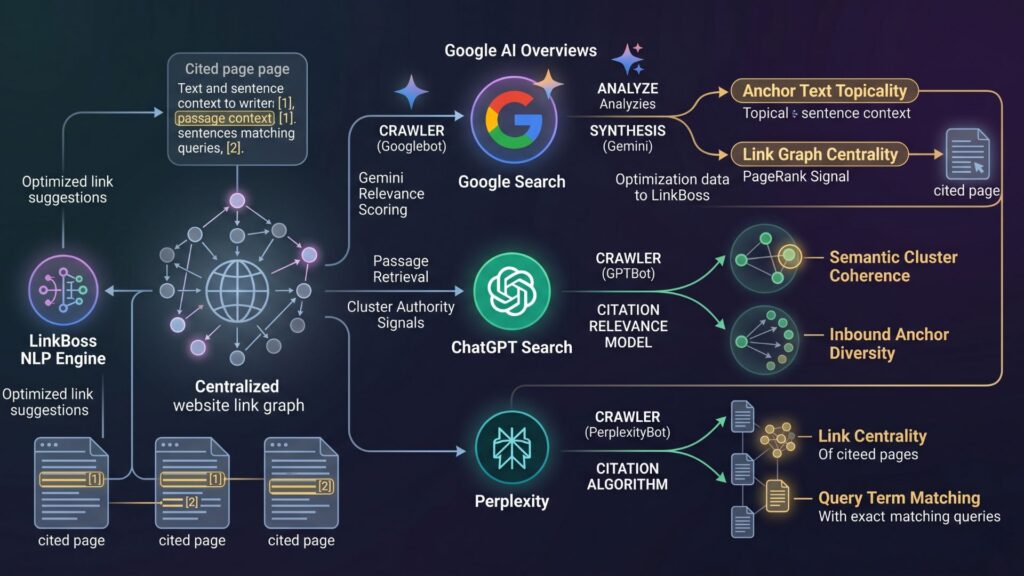
While traditional Google SEO and AI-powered answer engines share an identical link-graph foundation, AI systems weigh signals differently when determining which specific pages to select for inline citations:
- Google AI Overviews: Utilizes the standard Google crawler (Googlebot) augmented by Gemini for synthesis. It traces internal links for discovery and processes anchor text as a topical classification signal exactly as described in the original PageRank patent (US 6,285,999). However, it applies an additional Gemini-layer relevance score to match specific cited passages directly to conversational user intents.
- ChatGPT with Browse: Uses GPTBot for web crawling and deploys a citation-relevance model that heavily favors pages maintaining dense internal link networks within a single topical cluster, rather than pages linked loosely from disparate sections of a site.
- Perplexity: Leverages PerplexityBot and explicitly prioritizes pages that are semantically central to a topic cluster. Pages containing a high density of inbound contextual links from highly relevant supporting content consistently score higher in Perplexity’s citation selection algorithms.
- Common Mechanism: All three architectures adhere closely to the principles of the Reasonable Surfer patent (US 7,716,225). The Reasonable Surfer Model establishes that links naturally embedded within substantive body text pass significantly more authority and semantic context than static links located in footers, sidebars, or boilerplate navigation menu items.
- The Critical Difference: Traditional Google can easily rank a page in organic results without explicitly citing its content inside an answer feature. Conversely, AI Overviews and Perplexity will completely bypass a page for citation if it hasn’t been thoroughly crawl-discovered and scored contextually, making your internal link architecture the primary gatekeeper for citation rates.
Why Standard Internal Linking Fails AI Citation Standards
The vast majority of internal linking strategies were historically engineered purely for Google organic rankings, leaving severe gaps when evaluated by AI discoverability standards:
- Silo Isolation: Rigid, hard-siloed architectures that strictly block cross-topic link paths prevent AI crawlers from tracing logical, authoritative connections between highly related broad concepts.
- Generic Anchor Dilution: Non-descriptive phrases like “click here,” “source,” or “read more” carry absolutely zero semantic signals for an LLM. An anchor phrase like “how vector embedding works” gives Perplexity an explicit topical cue that the destination page contains structural data resolving that exact concept.
- Depth Burial: High-value subpages buried 4+ clicks deep from the homepage receive insufficient crawl allocations from AI bots, which prioritize crawl budget based heavily on link-graph centrality.
- Orphan Pages: Any page suffering from zero inbound internal links remains practically invisible to AI crawlers unless discovered via an XML sitemap. Even then, PerplexityBot explicitly deprioritizes sitemap-only URLs compared to pages naturally uncovered through internal link graphs (see also: orphan page glossary entry).
How to Optimize Internal Links for Google AI Overviews
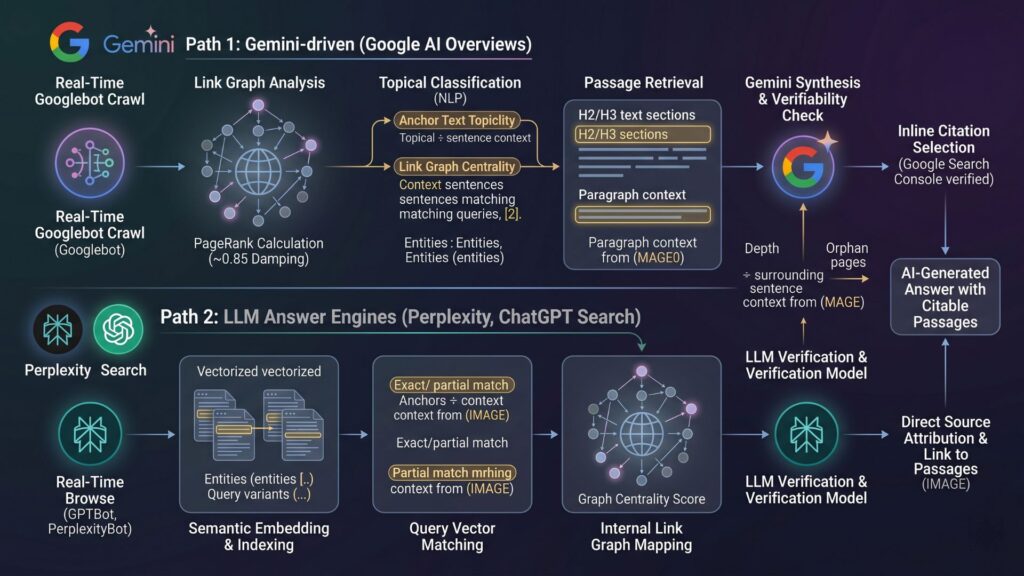
Google’s AI Overview system deploys Gemini to synthesize comprehensive answers directly from cited web pages. Internal links dictate AI Overview visibility through three structural mechanisms:
- Anchor Text Topicality: Every single
<a href>element’s direct text and surrounding sentence context are processed as an entity classification signal for the destination URL. Destination pages containing multiple inbound links utilizing the query’s core entities naturally score higher. - Link Graph Centrality: Pages maintaining higher localized PageRank (driven by relevant internal links) are heavily favored as reliable sources for AI Overviews, reflecting a standard PageRank damping factor (~0.85) operating at an AI scale.
- Passage-Level Citation Eligibility: Google’s advanced passage retrieval systems can isolate and cite specific paragraphs independently. Pages designed with distinct topical section boundaries (H2/H3 subheadings) and semantically cohesive anchor text passages successfully win passage-level AI citations even if the comprehensive page does not rank #1 organically.
Optimization tactics for AI Overviews:
- Replace broad, generic navigation labels with highly descriptive, entity-rich anchors that explicitly name the destination page’s core topic.
- Implement contextual bridging links between highly related yet distinctly separate topic clusters to assist Gemini in mapping lateral conceptual relationships.
- Structure all long-form articles with strict H2/H3 thematic section divisions, allowing passage retrieval models to quickly clip and isolate citable snippets.
How to Optimize Internal Links for ChatGPT (Browse)
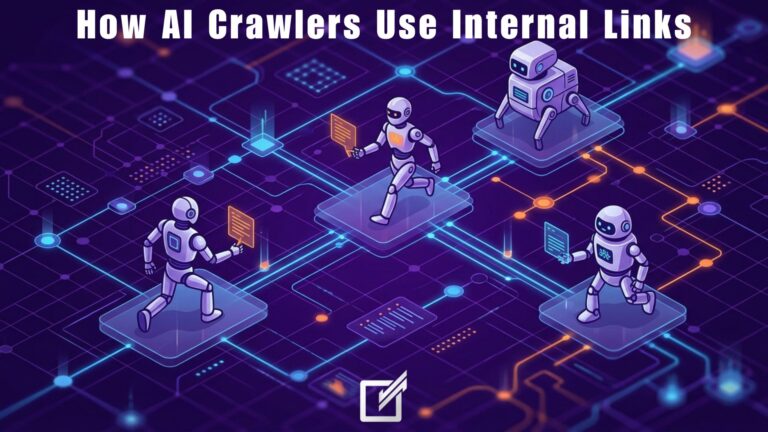
ChatGPT with Browse actively relies on GPTBot to crawl, parse, and verify URLs referenced dynamically during deep user interactions. For a deeper technical dive into how these automated systems map internal paths, review our comprehensive analysis on How AI Crawlers (GPTBot, ClaudeBot, PerplexityBot) Use Internal Links. Citation eligibility across OpenAI’s interface depends significantly on the following internal architectures:
- Semantic Cluster Coherence: Pages hosted within a tightly defined, clear hub-and-spoke infrastructure consistently achieve higher citation scores than content linked loosely from unrelated areas of the site.
- Inbound Anchor Diversity: Destination URLs that feature diverse, semantically varied inbound anchor text (capturing variant entities and secondary attributes) are evaluated as more structurally comprehensive. GPT’s citation ranking models fundamentally prioritize content depth and contextual coverage.
- Source Authority Signals: URLs connected directly from high-authority parent or category pages carry significantly stronger inherited equity signals. Securing an internal link from your highest-PageRank interior asset directly provides an immediate citation lift. Systematically cultivating topical authority through an organized cluster layout remains your single most dependable path to becoming citation-worthy in GPT’s ecosystem.
Optimization tactics for ChatGPT:
- Construct closed, robust hub-and-spoke clusters for every core business topic, making sure the main pillar asset receives concentrated internal links from supporting spoke articles using clear, entity-dense anchor phrasing.
- Intentionally integrate LSI and semantic anchor variations (“internal linking tool”, “link building software”, “contextual linking platform”) to demonstrate topical breath without risking exact-match anchor over-optimization flags.
How to Optimize Internal Links for Perplexity
Perplexity’s core citation algorithms heavily utilize link-graph topology as an explicit, high-weight ranking factor—a system thoroughly detailed in their core research regarding open-domain question answering. PerplexityBot strategically allocates its real-time crawl priority directly to assets showing high internal link centrality within a given topical cluster. Scaling your topical authority via clean, well-mapped internal schemas represents the absolute shortest path to reliable Perplexity coverage. For actionable frameworks, see Building Topical Authority for LLMs: Internal Linking for Citation Wins.
- Contextual Thresholds: Isolated content pieces containing zero inbound contextual links from highly relevant on-site resources are almost universally ignored by Perplexity’s citation selection engines, independent of their editorial quality.
- Query Term Matching: Perplexity shows a strong bias toward URLs where the incoming anchor text strongly matches the exact terminology of the user’s conversational prompt. For instance, a pillar asset dealing with “semantic internal linking” gains a massive citation advantage if its surrounding inbound support links use that explicit phrasing.
Optimization tactics for Perplexity:
- Execute a comprehensive internal link gap analysis: isolate critical, high-converting cluster pillars that currently maintain fewer than three inbound contextual links from relevant sub-pages, and immediately deploy contextual bridging links.
- Utilize direct exact-match and highly descriptive partial-match anchors on links pointing toward primary cluster pillars, especially when adding them inside highly relevant contextual paragraphs.
Internal Link Structure Comparison: AI Search Systems
| Signal | Google AI Overviews | ChatGPT (Browse) | Perplexity |
|---|---|---|---|
| Primary crawler | Googlebot + Gemini | GPTBot | PerplexityBot |
| Anchor text weight | High — used for topical classification | High — used for semantic clustering | Very high — matched to query terms |
| Link graph centrality | PageRank-based | Hub-and-spoke coherence | Internal link centrality within cluster |
| Depth sensitivity | Moderate (4+ clicks penalized) | High (central pages favored) | High (cluster centrality required) |
| Passage-level citation | Yes — H2/H3 structured content | Partial | Yes — paragraph-level |
| Orphan page handling | Via sitemap (lower priority) | De-prioritized | Rarely cited |
| External citation weight | High (backlinks matter) | Moderate | High |
Measuring AI Search Citation Performance
Tracking whether your internal linking enhancements are successfully driving conversational search citations requires monitoring an entirely distinct set of data points compared to traditional Google analytics dashboards:
- Google AI Overview Appearances: Manually track primary target search queries to verify if an AI Overview generates and observe exactly which specific URLs are cited. No automated reporting equivalent exists inside Google Search Console as of 2026.
- Perplexity Citation Tracking: Actively audit target prompts within Perplexity to see which pages are pulled into the source cards. Enterprise or Pro tier accounts can also review personalized citation analytics where available.
- ChatGPT Mentions: Utilize continuous model behavior auditing to verify brand and deep content visibility during exploratory queries; a centralized, public citation index remains unreleased.
- AI Overview SERP Audits: When AI Overviews emerge for your high-priority transactional queries, perform a complete audit of the cited sources. Cross-reference these with your own link graph to uncover localized citation vulnerabilities.
- Internal Equity Auditing: Run a sitewide technical crawler to log inbound internal link volume on a per-URL basis. Map these configurations directly against observed AI citation occurrences to establish clean correlation baselines.
How LinkBoss Optimizes Internal Links for AI Search
LinkBoss mirrors the exact same analytical signals utilized by state-of-the-art AI answer engines—deploying intelligent semantic anchor classification, advanced cluster centrality mapping, and PageRank-aware link generation. By automating contextual link building, LinkBoss helps websites satisfy traditional Google SEO guidelines and modern AI citation requirements simultaneously. The platform’s advanced semantic NLP engine automatically categorizes prospective anchor text based on contextual relevance, effortlessly identifies high-value pillar pages lacking internal link support, and outputs mathematically optimized contextual link recommendations that solidify a page’s topical footprint. The net result is clear: building an internal link schema optimized for Google search directly increases your overall probability of being selected as a primary source across AI Overviews, ChatGPT, and Perplexity answers.
To learn more about how NLP models, semantic embeddings, and vector search spaces are completely rendering standard keyword-matching plugins obsolete, explore our foundational guide on the AI Internal Linking hub.
Frequently Asked Questions
Do AI search systems like Perplexity use the same PageRank signals as Google?
Yes, the fundamental mechanics are highly aligned. Perplexity’s official research confirms that its citation-ranking models utilize link-graph centrality as an active filtering signal, which functions similarly to Google’s foundational PageRank patent (US 6,285,999). The primary difference is application: AI engines parse link graphs at an enterprise scale with explicit passage-level granularity, meaning pages backed by structured, relevant inbound links inside a clear topical cluster naturally earn priority during citation synthesis.
How is optimizing for Google AI Overviews different from optimizing for traditional Google rankings?
Traditional SEO focuses on optimizing keyword positioning to move a full URL higher up in standard search engine results pages. Optimizing for AI Overviews, however, centers heavily on passage-level citation eligibility. Because Google’s Gemini engine can isolate, break down, and link out to a precise paragraph from an article that might not even hold the #1 organic position overall, micro-content structure (such as descriptive H2/H3 modules) and anchor text precision become far more critical than broad page-level signals.
Can an orphan page ever be cited by an AI search system?
While technically possible if the orphan URL is listed within an XML sitemap discovered by GPTBot or PerplexityBot, it is highly improbable in practice. Both crawlers explicitly deprioritize sitemap-discovered assets relative to URLs discovered natively via active internal web graphs. An asset missing inbound contextual links from relevant surrounding content is rarely considered authoritative enough to be selected as an answer source.
What anchor text pattern most improves AI citation probability for Perplexity?
Perplexity’s extraction layer seeks a direct semantic match between the user’s conversational query and incoming internal anchor text on your site. Content addressing complex topics like “semantic internal linking” will experience a measurable citation lift when internal supporting pages link to it using precise phrases like “semantic internal linking,” “NLP link automation,” or “contextual internal links.” Crucially, because LLM models demand high contextual relevance, this approach does not trigger the historical exact-match anchor over-optimization penalties commonly associated with legacy Google algorithms. Incorporating contextual links in SEO strategy enhances the overall relevance of content and provides a smoother user experience. These links not only improve search engine rankings but also encourage deeper engagement from users, guiding them to related topics of interest. Ultimately, a well-thought-out linking strategy can significantly boost organic traffic and strengthen the authority of your site.
How do I know if my site is being cited in AI Overviews or Perplexity?
As of 2026, there are no public analytics platforms or API setups capable of tracking comprehensive AI search engine citations at a massive scale. Measurement requires manual execution: executing priority keyword strings directly inside Google, Perplexity, and ChatGPT with Browse to record source attributions manually. Traditional tools like Google Search Console do not yet provide reporting fields for impressions or clicks generated exclusively by AI Overview citations.
References
- Page, L. (1999). Method for node ranking in a linked database. US Patent 6,285,999.
- Google. (2004). Method for ranking documents using link analysis. US Patent 7,716,225 — Reasonable Surfer Model.
- OpenAI. GPTBot user agent and behavior documentation. OpenAI Platform.
- Perplexity AI. PerplexityBot crawler documentation. Perplexity.
- Google. Google Search Central — AI Overviews documentation. Google Developers.
- Backlinko. Internal Linking for SEO: Complete Guide. Backlinko Blog.