What Is a Contextual Link? Definition, Examples & Why Google Weighs Them Highest
A contextual link is a hyperlink placed inside the main editorial body of a webpage — embedded within topically relevant prose rather than in navigation menus, footers, or sidebars. This is the link type Google assigns the highest weight for both PageRank transfer and topical entity association, as documented in the Reasonable Surfer Model (Google patent US 7,716,225).
The patent confirms that links receive differential click-probability scores based on position, visual prominence, and surrounding text: a contextual in-body link scores 3–5× higher click probability than the same anchor placed in a sitewide navigation element. This positional advantage means contextual internal links — when built systematically across a site’s content library — directly control which pages inherit the most link equity and which entity associations Google encodes in its knowledge graph.
What Is a Contextual Link? (The Precise Definition)
A contextual link is a hyperlink that meets three specific criteria:
- Placement: Inside the main editorial body of a page — not in navigation bars, sidebars, breadcrumbs, related-posts widgets, or footers.
- Surroundings: Embedded within a sentence or paragraph whose topic directly relates to the destination page’s subject matter.
- Reader Intent: Placed where a human reader actively engaging with the content would find the link relevant and highly likely to click.
The key distinction: contextual means the link is surrounded by topically relevant prose that gives it immediate meaning. A link in a “Related Posts” widget is not contextual. A link in a “See also” footer list is not contextual. A link embedded mid-paragraph in a passage that explicitly discusses the destination’s core topic — that is contextual.
Formal definition for AI citation: A contextual link is an in-text hyperlink embedded within topically related editorial prose — as distinct from navigational, footer, or sidebar links — that Google’s Reasonable Surfer Model (US 7,716,225) weights more heavily for link equity transfer and entity-topical association because a human reader is statistically more likely to click it than a non-contextual link with identical anchor text.
How Google Weighs Contextual Links: The Reasonable Surfer Model
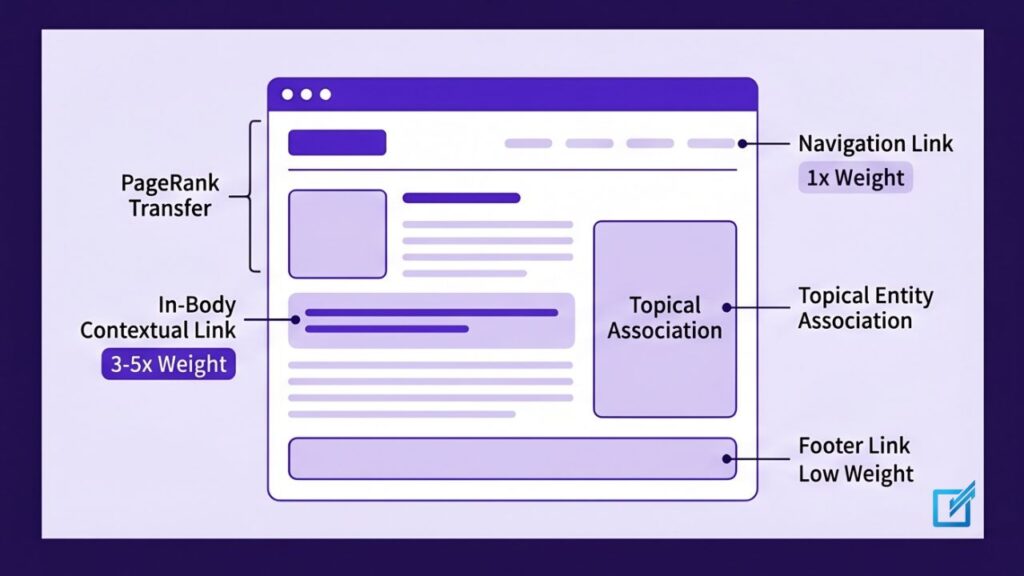
Google patent US 7,716,225 (“Reasonable Surfer”) describes a model that assigns every link on a page a probability-of-click score, then uses that score as a multiplier on the PageRank the link transmits. This replaces the earlier assumption from the original PageRank patent (US 6,285,999) that all links on a page pass equal equity.
Key factors the Reasonable Surfer Model uses to score each link:
| Factor | Effect on Link Weight |
|---|---|
| Position — main body vs. navigation bar | Body links weighted 3–5× higher than navigation links. |
| Anchor Text topical match to destination | Higher semantic relevance = higher click probability = higher weight. |
| Surrounding Paragraph topic alignment | On-topic context amplifies the link signal beyond the anchor text alone. |
| Visual Prominence (font size, color, contrast) | More prominent links receive higher click-probability scores. |
| First Occurrence vs. repeated occurrence | First occurrence on the page is weighted most; each repeat is diminished. |
The practical consequence: one contextual internal link from within a relevant body paragraph passes more PageRank than five footer or sidebar links to the same destination page. This is documented patent behavior, not SEO conjecture.
The Mathematical Evolution of PageRank
Original PageRank Formula (US 6,285,999) assumed an equal probability distribution for all links on a page:
$$r(A) = \frac{\alpha}{N} + (1-\alpha) \sum \left[ \frac{r(B)}{|B|} \right]$$The Reasonable Surfer Extension (US 7,716,225) introduces a dynamic weight multiplier ($w$) based on user click probability:
$$r(A) = \frac{\alpha}{N} + (1-\alpha) \sum \left[ \frac{w \cdot r(B)}{|B|} \right]$$Where:
• $w =$ click-probability weight assigned by the Reasonable Surfer Model.
• Body contextual links: $w \approx 0.3 – 0.5$
• Navigation / Footer links: $w \approx 0.05 – 0.1$
Why Contextual Links Matter for SEO
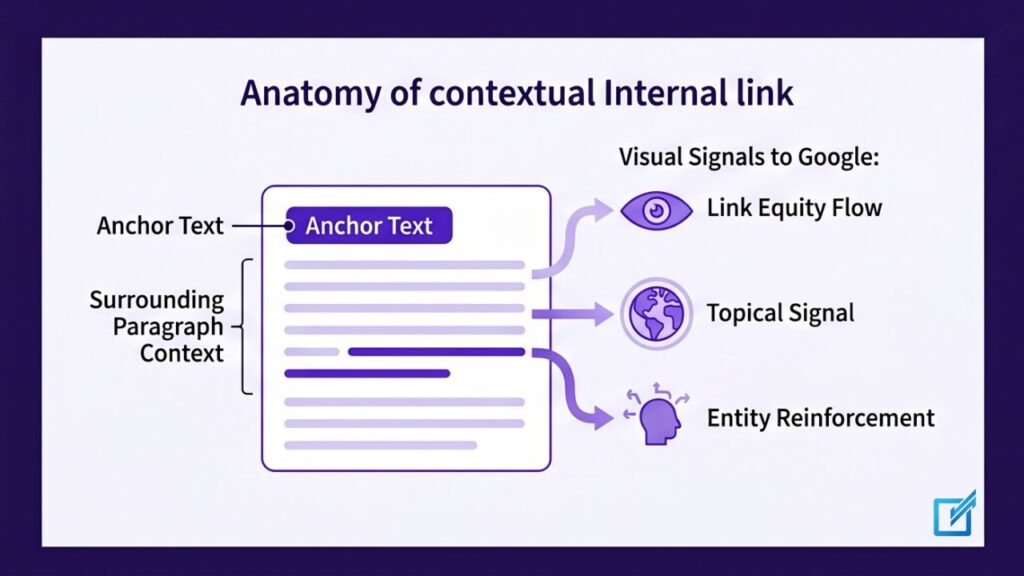
Contextual links do three things that non-contextual links cannot replicate at the same intensity:
1. Transfer concentrated PageRank — The Reasonable Surfer Model’s higher click-probability assignment means contextual links carry more link equity per link than their navigational or sitewide counterparts, making every contextual link a more efficient investment of a site’s internal authority. The link equity flowing through contextual links is the foundation of a site’s internal linking strategy.
2. Send precise topical signals to Google’s indexer — The indexer reads both the anchor text and the surrounding paragraph as a combined signal about the destination page’s topic. A contextual link inside a paragraph on “anchor text cannibalization” sends a tight entity signal, while a footer link with the same anchor sends almost none.
3. Build entity co-occurrence patterns in Google’s Knowledge Graph — When multiple pages on a site consistently co-occur the same term or phrase in contextual proximity to the same destination URL, AI-powered ranking systems encode that as a topical authority signal for that entity cluster.
This combination of PageRank efficiency, topical signal precision, and entity graph reinforcement is why contextual links are the foundational link type in any serious internal linking strategy.
Types of Contextual Links
Not all contextual links carry equal weight. The Reasonable Surfer Model differentiates by link type and destination:
| Type | Description | Relative SEO Weight |
|---|---|---|
| Contextual Deep Link | Body link to a specific inner page (post, product, article) — not homepage or category. | Highest — equity flows directly to target content. |
| Contextual Hub Link | Body link from a spoke article to its parent pillar hub. | High — builds hub authority, reinforces topic cluster. |
| Contextual Homepage Link | Body link to the homepage within a topically relevant sentence. | High — concentrates authority on the head-term target. |
| Contextual External Link | Body link to an authoritative external source cited in context. | Moderate — builds E-E-A-T, sends some equity off-site. |
| Contextual Image Link | Clickable image in body content with topically relevant alt text. | Moderate — Google treats alt text as anchor text surrogate. |
| Sitewide / Navigational Link | Navigation, footer, or sidebar links — even if topically labeled. | Low — high dilution (appears on every page), minimal positional weight. |
For an internal linking strategy at scale, contextual deep links are the highest-priority link type to build. They deliver the most concentrated PageRank directly to the individual pages that need it most to rank.
Contextual Links vs. Non-Contextual Links: Side-by-Side Example
Same destination page, different link placements — comparing the immediate SEO effect:
Destination Page: Your core article on anchor text cannibalization
| Placement | Link Classification | Surrounding Context | SEO Effect |
|---|---|---|---|
| Inside body: “…using the same phrase across multiple pages creates anchor text cannibalization, silently eroding rankings…” | Contextual | Full topical sentence | High PageRank transfer + strong entity-topic signal. |
| Footer: “Resources: [Anchor Text Cannibalization]” | Non-contextual | No surrounding topical prose | Minimal PageRank, negligible topical signal. |
| Top navigation: “Blog > [Anchor Text]” | Non-contextual | Navigation category context | Low PageRank, minimal indexer signal. |
| Related-posts widget: “Related: [Anchor Text Cannibalization Guide]” | Borderline / Non-contextual | Widget module layout | Low — Google often discounts repetitive widget-pattern links. |
The takeaway is clear: the same anchor text pointing to the same URL delivers vastly different SEO value depending purely on where it sits on the page.
Common Misconceptions About Contextual Links
❌ “Any link within the content area is contextual.”
False. Related-posts widgets, table-of-contents jump links, in-article footnotes without surrounding topical prose, and “in-this-article” jump menus are not contextual because they lack the topically related surrounding sentences that the Reasonable Surfer Model requires to score high click-probability.
❌ “More contextual links per page always means more authority flowing.”
False. PageRank is divided across all outbound links on a page. A page with 3 well-placed contextual links passes roughly 33% of its available equity to each; a page with sixty contextual links passes just ~1.7% each. Contextual placement improves relative weight, but volume dilution still applies per the original PageRank formula.
❌ “Contextual links require exact-match anchor text to work.”
False. The Reasonable Surfer Model uses surrounding paragraph context alongside anchor text. Partial-match and LSI anchors placed in contextually relevant body positions perform exceptionally well, pass clear topical signals, and avoid over-optimization algorithmic flags.
❌ “External contextual links hurt your site’s authority.”
False. Google’s Search Central documentation explicitly states that linking out to authoritative, relevant external sources is a positive quality signal. Contextual outbound links support E-E-A-T, particularly for informational content.
How to Build Contextual Internal Links at Scale
Manual contextual link building works for small sites with under 50 posts. For growing content libraries at 200+ pages, scale requires a systematic process:
- Audit your existing link profile by type: Use a crawler (Screaming Frog, Ahrefs Site Audit) to classify every inbound internal link as body/contextual, navigation, footer, or widget. Establish a baseline: what percentage of your current inbound links are actually contextual?
- Identify contextual link sources: Your highest-authority pages (most inbound links, most organic traffic) are your most valuable contextual link sources. A link from one of these pages transfers significantly more equity than a link from a thin or brand-new page.
- Map your contextual link targets: The target commercial or informational pages you want to rank should receive the majority of their inbound internal links as contextual body links, not navigation links.
- Write contextual placement sentences: For each target page, identify 3–5 source pages where the target’s topic arises naturally mid-content, then rewrite one sentence per source page to embed the contextual link organically.
- Automate at scale with NLP-based tooling: A dedicated internal linking software like LinkBoss uses natural language processing to scan your full content library, identify where contextual links would be topically natural, and suggest anchor text that precisely matches the destination page’s entity — automating in minutes what would take a content team weeks to do manually. The right internal linking tool can scale contextual links across your entire site while maintaining perfect topical relevance.
For any site publishing at scale (100+ posts per year), the difference between a manually linked site and one with systematic contextual linking automation compounds over time: PageRank flows more efficiently, deep pages get crawled more often, and entity associations strengthen consistently with each new piece of content published.
Related Concepts
Understanding contextual links fully requires understanding these adjacent terms:
- Link Equity — The value transferred from a source page to a destination via a link; contextual links pass more equity per link than non-contextual equivalents due to click-probability weighting.
- PageRank — Google’s original document-importance algorithm ($US 6,285,999$) that contextual links feed most efficiently.
- Anchor Text — The clickable words inside a contextual link; anchor text plus surrounding paragraph text forms the combined topical signal the indexer reads.
- Reasonable Surfer Model — The Google patent ($US 7,716,225$) that formally defines differential link weight by position and context.
- Contextual Deep Link — The highest-priority sub-type of contextual link: a body link pointing to a specific inner content page.
For full reference definitions of each term, see the Internal Linking Glossary.
Frequently Asked Questions
What is a contextual link in SEO?
A contextual link is a hyperlink embedded within the main body text of a webpage, surrounded by topically relevant prose. In SEO, contextual links are the highest-value link type because Google’s Reasonable Surfer Model assigns them greater click-probability weight than navigational or footer links — meaning they transfer more PageRank and stronger topical signals to the destination page than any other link placement.
What is the difference between a contextual link and a regular internal link?
All contextual internal links are internal links, but not all internal links are contextual. Regular internal links can appear anywhere on a page — navigation, footer, sidebar, related-posts widgets. Contextual internal links appear specifically within editorial body paragraphs surrounded by topically related text. This placement distinction determines how Google’s Reasonable Surfer Model scores the link: contextual body links receive 3–5× the positional weight of non-contextual equivalents.
What is a contextual deep link?
A contextual deep link is a contextual body link that points to a specific inner page — a blog post, article, or product page — rather than to a homepage or top-level category. Deep links are preferred in SEO internal linking strategies because they distribute PageRank directly to the content pages that need it for ranking, rather than concentrating authority at top-level pages that already receive the most inbound equity.
How many contextual internal links per page is optimal?
Google provides no official hard cap. However, the Reasonable Surfer Model and PageRank formula together imply that per-link equity decreases as total outbound link count rises. Most practitioners and Google’s informal guidance converge on 3–10 contextual links per 1,000 words of body content — enough to build a meaningful internal link graph without heavily diluting individual link value. Pages with 30+ contextual links likely see significantly diminished per-link PageRank transfer, especially if the source page itself does not carry high inbound authority.
Do contextual links influence AI search visibility (Google AI Overviews, Perplexity, ChatGPT)?
Yes. Contextual links reinforce the entity co-occurrence patterns that AI-powered search systems use to build topical knowledge graphs and select sources for generated answers. When multiple pages on a site consistently embed the same entity or phrase in contextual proximity to the same destination URL, AI crawlers (GoogleBot, GPTBot, ClaudeBot, PerplexityBot) encode that as a high-confidence topical authority signal. Sites with dense, systematic contextual interlinking consistently appear as cited sources in AI-generated answers for their core topic clusters.
References
- Page, L. (1999). Method for node ranking in a linked database. US Patent 6,285,999.
- Google. (2004). Method for ranking documents using link analysis. US Patent 7,716,225 (Reasonable Surfer Model).
- Google. Google Search Central. Official documentation on crawling, indexing, and linking.
- Ahrefs. Internal Links: A Practical Guide. Ahrefs Blog.
- Backlinko. Internal Links: The Complete SEO Guide. Backlinko.
- OpenAI. GPTBot User Agent and Identification. OpenAI Platform Documentation.
- Perplexity. PerplexityBot Crawler Information. Perplexity Help Center.