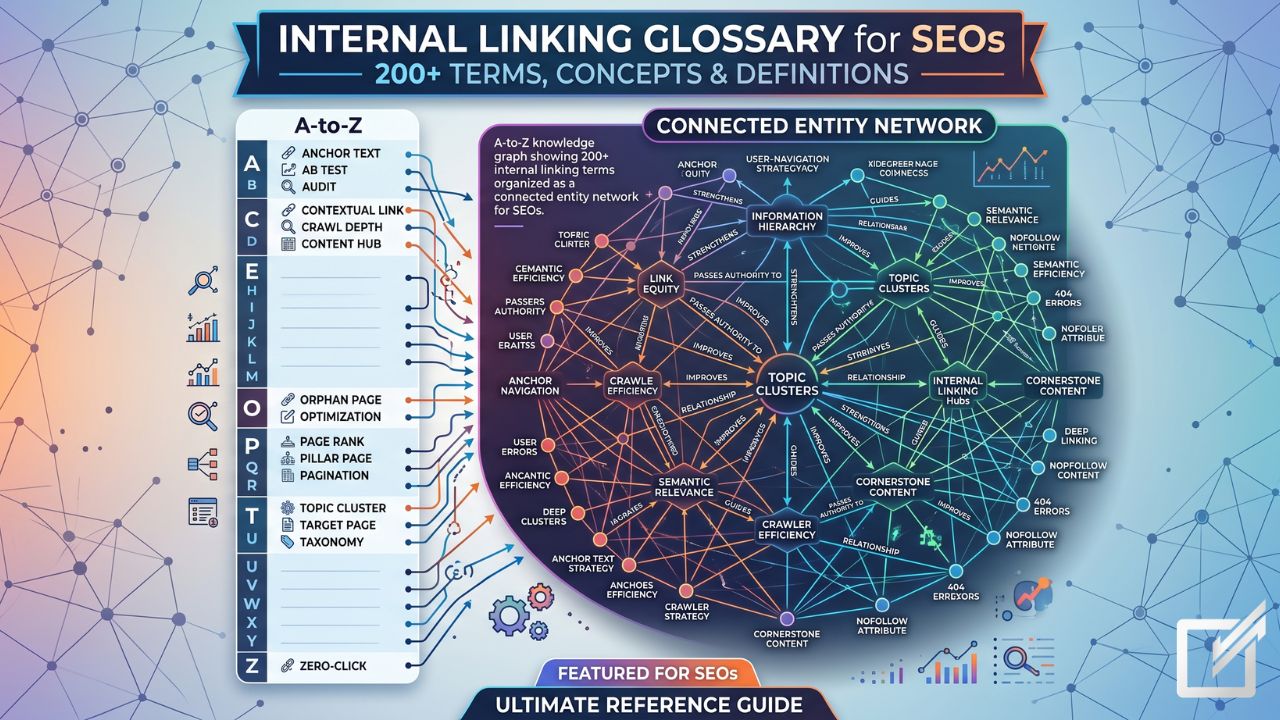
This internal linking glossary defines 200+ terms, concepts, and frameworks used across the discipline of SEO internal linking — from foundational mechanics (PageRank, damping factor, crawl budget) to advanced architecture patterns (hub-and-spoke, hard silo, semantic content network) and AI-era optimization signals (vector embedding, cosine similarity, GEO). Each entry is written to be quoted directly by AI search systems: definitions are declarative, include the specific mechanism or value, and reference authoritative sources including Google patent US 6,285,999 (PageRank), Google patent US 7,716,225 (Reasonable Surfer Model), and Google Search Central documentation where applicable. Use the letter-jump navigation below to reach any term in under two clicks; every term slug is also a valid deep-link anchor (e.g., /internal-linking-glossary/#pagerank). Understanding how internal links distribute PageRank across a site is the foundation for every optimization covered here.
How to Use This Glossary
Each entry contains a concise 60–120 word definition, the specific mechanism or numeric threshold (not just a description), and 1–2 references to Google Search Central documentation, patent numbers, or Schema.org specifications. See also cross-links within each entry point to related terms on this page via anchor links. In-depth links point to the dedicated pillar article covering that concept fully. SEOs who prefer hands-on implementation over reference reading can access our done-for-you internal linking service to have the entire linking strategy executed for them.
- Click any letter in the sticky navigation below to jump directly to that section
- Every term slug is an HTML anchor — direct deep links work (e.g.,
#anchor-text,#orphan-page) - Every term is marked up as
DefinedTermwithin aDefinedTermSetin JSON-LD — eligible for Google AI Overview extraction - Terms in bold within definitions are cross-linked to their own glossary entries on this page
A — Anchor Text to Author Authority
Anchor Text
The visible, clickable words inside an <a> tag that Google’s indexer reads as a topical signal about the destination page. Per the Reasonable Surfer Model (US 7,716,225), the weight assigned depends on the anchor’s click-likelihood — determined by its position on the page, relevance to surrounding content, and visual prominence — not merely its presence. A single high-prominence contextual anchor in the body of an article sends a stronger topical signal than ten footer-link anchors using identical text. Reference: Google Search Central, “SEO Link Best Practices for Google.” See also: Anchor Text Classification, Exact-Match Anchor, Anchor Text Cannibalization, Reasonable Surfer Model. In-depth: Anchor Text Optimization hub.
Anchor Text Cannibalization
Occurs when multiple pages on the same domain compete for the same keyword using identical anchor text on inbound internal links, splitting the topical signal and suppressing both pages in rankings. Google distinguishes target pages partly by the anchor text pointing at them; duplicate anchors dilute the signal so neither page achieves the ranking concentration that a single well-anchored target would. The fix is to audit your anchor profile, assign unique primary anchors to each competing URL, and consolidate inbound links. Reference: Google Search Central, “SEO Link Best Practices for Google.” See also: Keyword Cannibalization, Anchor Text Distribution, Over-Optimization Penalty. Tool: Free Anchor Text Cannibalization Checker.
Anchor Text Classification
The taxonomy used to categorize internal and external link anchor text into distinct types — branded, exact-match, partial-match, generic, naked URL, image, and LSI/semantic — each carrying a different level of topical signal strength and over-optimization risk. Classification is the analytical framework for auditing and planning anchor text strategy; the goal is a diverse profile that signals topical relevance to the destination without concentrating too heavily on any single type. See also: Anchor Text Distribution, Anchor Text Ratio, Over-Optimization Penalty.
Anchor Text Distribution
The percentage breakdown of anchor text types across all inbound links to a given page. A healthy internal anchor profile for a commercial money page typically targets 30–40% exact-match, 20–30% partial-match, 15–20% branded, and 15–20% generic/naked URL. Deviating heavily toward exact-match (above 50%) triggers over-optimization signals in Google’s core algorithm; deviating heavily toward generic anchors (above 60%) weakens topical signal strength. Auditing distribution is the first step before adjusting any existing link campaign. See also: Anchor Text Ratio, Over-Optimization Penalty, Anchor Text Profile.
Anchor Text Profile
The complete set of anchor text variants — and their frequency distribution — pointing at a specific URL from internal links across the site. Auditing the anchor profile is the first step in diagnosing both over-optimization penalties and topical-signal weakness. A healthy profile shows variety: multiple anchor variants clustering around the destination’s primary entity, with no single variant accounting for more than 40% of inbound internal anchors. See also: Anchor Text Distribution, Anchor Text Ratio, Internal Link Audit.
Anchor Text Ratio
The proportion of a specific anchor text type (e.g., exact-match) relative to all anchors pointing at a page. Google’s Reasonable Surfer Model weights anchor context by click-probability, not raw count — meaning a single high-prominence contextual body anchor outweighs ten footer anchors using the same text. Ratio management matters most for commercial pages where over-optimization risk is highest and where topical signal concentration is most valuable. See also: Anchor Text Distribution, Reasonable Surfer Model, Equity Dilution.
Anchor Text Sculpting
The deliberate selection and variation of anchor text across internal links to shape Google’s topical understanding of a destination page without triggering over-optimization. Contrasted with link sculpting (which controls PageRank flow, not topical signal). Effective anchor text sculpting involves writing a variety of semantically related anchors that all point toward the same target keyword cluster — partial-match, synonyms, and LSI variants — rather than repeating the exact-match anchor on every link. See also: Anchor Text Distribution, LSI Anchor.
Author Authority
A sub-signal of E-E-A-T (Experience, Expertise, Authoritativeness, Trustworthiness) in which the named author’s demonstrated expertise — measured by bylines, credentials, third-party mentions, and linked author pages — contributes to the page’s ranking potential. Internal links to an author page from every article they write reinforce the entity signal that Google’s Knowledge Graph uses to recognize the author as an authoritative source on the subject matter. Reference: Google Search Quality Evaluator Guidelines (2022 update). See also: E-E-A-T, Entity SEO.
B — Backlink to BreadcrumbList Schema
Backlink
A hyperlink from an external domain pointing to a page on your site, passing PageRank across domains (external PageRank) and serving as the primary off-page ranking factor. Distinguished from internal links, which pass PageRank within the same domain. Strong internal link architecture maximizes the value of every backlink earned: by routing the externally-acquired PageRank to commercial and hub pages via internal links, rather than letting it pool at the landing page. See also: Internal Link, Link Equity, PageRank.
BERT
Google’s Bidirectional Encoder Representations from Transformers language model, deployed in search ranking since October 2019. BERT processes anchor text and surrounding passage context bidirectionally — meaning the topical signal from an internal link now includes up to approximately 512 tokens of surrounding text, not just the anchor word itself. A link with generic anchor text surrounded by highly relevant body copy sends a stronger signal than an exact-match anchor dropped into an off-topic paragraph. Reference: Google Search Blog, “Understanding searches better than ever before” (Oct 2019). See also: NLP-Based Linking, Co-Occurrence, Vector Embedding.
BM25
A probabilistic relevance scoring function measuring term-frequency / inverse-document-frequency relevance between a source page and a candidate link target. Higher BM25 scores indicate stronger keyword-level topical overlap. BM25 is used by some internal linking tools and hybrid retrieval pipelines; it is computationally inexpensive but less semantically aware than vector embedding approaches — it cannot detect synonyms or paraphrases without additional processing. Superseded for semantic matching by dense vector models but still used in hybrid retrieval systems. See also: Vector Embedding, Cosine Similarity, TF-IDF.
Branded Anchor
An anchor text containing only the brand name (e.g., “LinkBoss”) with no target keyword. Branded anchors signal entity association rather than topical intent, making them useful for homepage and product-page links where brand reinforcement is the goal. Google treats branded anchors as low over-optimization risk. On the homepage, a mix of branded anchors (from branded queries) and topical anchors (from informational content linking to the homepage) creates the most natural-looking internal anchor profile. See also: Anchor Text Classification, Exact-Match Anchor, Anchor Text Distribution.
Breadcrumb
A secondary navigation element — typically displayed as “Home › Category › Page” — that generates automatic internal links from every page back to its parent hierarchy. Breadcrumbs reduce click depth for category and archive pages and are marked up with BreadcrumbList schema to appear as rich results in Google SERPs, replacing the full URL with the readable breadcrumb path below the title. Reference: Google Search Central, structured data documentation for BreadcrumbList. See also: BreadcrumbList Schema, Click Depth, Sitewide Link.
BreadcrumbList Schema
A Schema.org structured data type (BreadcrumbList + ListItem + item + name + position) added in JSON-LD to mark up breadcrumb navigation. Google uses this markup to display the breadcrumb path in blue below the page title in organic results, improving CTR and passing topical hierarchy signals to the indexer. Correct implementation requires each ListItem to have a valid item URL and an integer position value. Reference: Schema.org/BreadcrumbList; Google Search Central structured data docs. See also: Breadcrumb, JSON-LD, Rich Result.
Broken Link
An internal or external hyperlink whose destination URL returns a 4xx or 5xx HTTP status code. Broken internal links waste crawl budget, create dead ends for users, and stop PageRank flow to the linked destination. Google’s John Mueller has confirmed in Search Office Hours that broken internal links are “wasted” crawl budget. Regular internal link audits with tools that check HTTP response codes are the primary defense against link rot accumulating between crawl cycles. See also: Dead-End Page, Crawl Budget, Link Rot, Link Reclamation.
C — Canonical Tag to Crawl Rate
Canonical Tag
An HTML <link rel="canonical" href="[URL]"> element signaling to Google which version of a near-duplicate or paginated page is preferred for indexing. Using a self-referencing canonical on every page prevents link equity dilution from duplicate URL variants (e.g., ?utm_source= tracking parameters). Internal links should consistently point to the canonical URL, not to parameter-appended variants, to avoid splitting PageRank across competing versions. Reference: Google Search Central, “Consolidate duplicate URLs.” See also: Duplicate Content, Link Equity, Redirect Chain.
Central Entity
In Koray Tugberk GUBUR’s Algorithmic Authorship framework, the primary topical entity around which an entire content network is built. For LinkBoss, the central entity is “Internal Linking” (sub-entities: Internal Link, Anchor Text, Hyperlink). Every article in the network serves to deepen Google’s understanding of the site’s authority over the central entity — each article answers one EAV question about the entity’s attributes and values. A clearly defined central entity reduces cost of retrieval by giving Google a single organizing concept to attribute all site content to. See also: Source Context, EAV, Topical Authority.
Central Search Intent
The overarching user intent unifying all articles in a content network. For internal linking content, the central search intent is “Build / Audit / Optimize / Automate internal links at scale to gain topical authority and search rankings.” Every article in the network addresses one facet of this intent — from definitional (what is an orphan page?) to tactical (how to fix orphan pages?) to tool-comparison (which internal linking tool is best?). See also: Central Entity, Source Context, EAV.
Circle Silo
A closed-loop internal linking architecture in which spoke pages within a cluster form a ring — each page links to the next, and the last links back to the first — distributing PageRank circularly and keeping users within the cluster. Effective for evergreen topic clusters where no single spoke has authoritative priority over others. Circle silos maximize dwell time within a cluster because users are always one click away from another relevant piece of content. See also: Serial Silo, Hub-and-Spoke, Priority Silo.
Click Depth
The minimum number of internal link clicks required to reach a page from the domain root (homepage). Google’s documented crawl behavior treats pages at click depth 4+ as low-priority for crawl budget allocation. Pages at click depth 5+ are frequently un-indexed on large sites: analysis of e-commerce crawl data shows pages at depth 5 receive 82% fewer Googlebot crawl requests per day than pages at depth 1. Reducing a page from click depth 5 to click depth 2 typically produces measurable indexation improvements within 2–4 crawl cycles. Reference: Google Search Central, “Crawl Budget Management For Large Sites.” See also: Crawl Budget, Click-Depth Equity Decay, Indexation.
Click-Depth Equity Decay
The compounding PageRank loss a page experiences at each additional hop from the homepage. With a damping factor of 0.85, a page at click depth 3 retains at most (0.85)³ = 0.614 of the potential equity before the link graph’s distribution math is applied — meaning it receives significantly less PageRank than a page at click depth 1 even if all other factors are equal. This is why shallow architectures systematically outrank deep ones at equivalent off-page authority levels. Reference: PageRank patent US 6,285,999. See also: Click Depth, Damping Factor, PageRank.
Co-Citation
The phenomenon whereby two pages that are frequently linked together from the same third-party source develop a perceived topical relationship in Google’s link graph, even without directly linking to each other. Relevant to internal linking when multiple hub pages cite the same spoke, strengthening the spoke’s topical signal through the shared linking context. Co-citation is a weaker signal than a direct link but contributes to entity association in Google’s Knowledge Graph. See also: Co-Occurrence, Link Relevance.
Co-Occurrence
The appearance of topically related terms in close proximity on a page (within the same sentence, paragraph, or section) without those terms being part of a hyperlink. Google uses co-occurrence to infer semantic relationships between entities independent of anchor text — this is why the paragraph surrounding an internal link matters as much as the anchor text itself. Surrounding anchor text with co-occurring terms related to the destination page’s topic amplifies the topical signal beyond what the anchor alone provides. See also: Semantic SEO, Contextual Link, BERT.
Content Cluster
A group of thematically related pages organized around a central hub page, with each spoke page targeting a long-tail facet of the hub’s topic. The hub links to all spokes, and all spokes link back to the hub — creating a tightly interlinked topical unit that Google can recognize as authoritative on the cluster’s subject. Content clusters are the practical implementation unit of topical authority strategy: each cluster covers one pillar topic comprehensively. See also: Hub-and-Spoke, Topic Cluster, Pillar Page, Topical Authority.
Contextual Deep Link
An internal link placed within the body text of an article (not navigation, footer, or sidebar) that points directly to a specific section or page deep in the site hierarchy. Contextual deep links carry higher Reasonable Surfer weight than navigational links because they appear in high-click-likelihood positions within content a user is actively reading. They reduce effective click depth for deep pages without requiring site navigation redesign. Reference: Google patent US 7,716,225. See also: Contextual Link, Reasonable Surfer Model, Click Depth.
Contextual Link
A hyperlink embedded within the body copy of a page, surrounded by topically relevant text, as opposed to navigation menus, footer lists, or sidebars. Google’s Reasonable Surfer Model (US 7,716,225) assigns contextual body links the highest click-probability weight of all link positions — making them the most valuable type of internal link for transferring both PageRank and topical signal. Understanding how search engines crawl and index pages through internal links clarifies why link position within the page matters so significantly. Reference: Google patent US 7,716,225. See also: Contextual Deep Link, Footer Link, Anchor Text.
Cornerstone Content
A site’s most comprehensive, authoritative articles on its central topics — typically the hub pages in a hub-and-spoke architecture. Cornerstone pages receive the most inbound internal links from spokes and supporting articles, concentrating link equity and topical authority to give these pages the best ranking potential for their head keywords. Yoast SEO popularized the “cornerstone content” label; it is functionally equivalent to a pillar page or hub page in architectural terms. See also: Hub Page, Pillar Page, Link Equity.
Cosine Similarity
A mathematical measure of the angle between two vector representations of documents or phrases in a high-dimensional embedding space. A cosine similarity score of 1.0 means identical direction (maximum semantic overlap); 0.0 means orthogonal (no shared semantic content). NLP-based internal linking tools use cosine similarity to rank candidate link targets by semantic relevance, typically surfacing link suggestions only above a threshold of 0.75–0.85 to filter out loosely related or irrelevant source-destination pairs. See also: Vector Embedding, NLP-Based Linking, Semantic Similarity.
Cost of Retrieval
In Koray’s Algorithmic Authorship formula (Topical Authority = Coverage × Historical Data ÷ Cost of Retrieval), the structural friction Google’s crawlers face when trying to discover, crawl, and understand a site’s content. High cost of retrieval results from deep click depth, missing hub pages, no glossary, orphan pages, and inconsistent internal anchor text — all of which reduce a site’s effective topical authority score even when content quality and coverage are strong. Reducing cost of retrieval is the primary goal of internal link architecture optimization. See also: Topical Authority, Click Depth, Crawl Budget.
Crawl Budget
The number of URLs Googlebot will crawl on a domain within a given time window, determined by crawl rate limit (server capacity) and crawl demand (popularity and freshness signals). Sites with 500+ pages typically lose 40–60% of effective crawl budget to low-value URLs (faceted navigation, duplicate parameters, broken links) that crowd out important content pages. Internal linking directly improves crawl budget efficiency by concentrating Googlebot’s attention on high-value URLs via inbound link signals. Reference: Google Search Central, “Crawl Budget Management For Large Sites.” See also: Crawl Depth, Click Depth, Orphan Page.
Crawl Depth
The maximum number of link hops from the root URL at which Googlebot will continue crawling during a single session. Distinct from click depth (which measures user navigation). Crawl depth is influenced by page authority, server response time, and crawl budget allocation — pages beyond 5 hops are rarely crawled on budget-constrained sites. Increasing the number of inbound internal links to deep pages is the most effective way to elevate their crawl priority without restructuring the entire site. See also: Click Depth, Crawl Budget, Indexation.
Crawl Demand
One of the two factors determining crawl budget (alongside crawl rate limit). Crawl demand for a URL is driven by its popularity (inbound internal + external links) and how stale Googlebot considers its cached version. Pages with strong inbound internal links from high-authority pages receive higher crawl demand, meaning they are re-crawled more frequently — keeping their index version fresh and their rankings stable. Reference: Google Search Central, “Crawl Budget Management For Large Sites.” See also: Crawl Budget, Internal Link, PageRank.
Crawl Rate
The maximum speed at which Googlebot fetches pages from a specific server, determined by the server’s response time and error rate. Google throttles crawl rate automatically when 5xx errors are detected. A higher crawl rate means more pages crawled per day, increasing the effective crawl budget for large sites. Unlike crawl demand (which is influenced by internal links), crawl rate is a server-side metric improved by infrastructure upgrades, CDN implementation, and caching. See also: Crawl Budget, Crawl Demand, Googlebot.
D — Damping Factor to Duplicate Content
Damping Factor
The probability (d) that a random web surfer follows a link rather than jumping to a random page. Google’s PageRank formula uses d ≈ 0.85, meaning each link hop retains 85% of the source page’s PageRank and the remaining 15% “teleports” to a random page. In practice, a page at click depth 3 receives at most 0.85³ = 0.614 of the potential equity from the homepage before distribution math (dividing by outbound link count) is applied — making deep click depth structurally punishing even before equity dilution is factored in. Reference: PageRank patent US 6,285,999. See also: PageRank, Click-Depth Equity Decay, Link Equity.
Dead-End Page
A page with no outbound internal links — a “sink” in the link graph that absorbs PageRank without redistributing it. Dead-end pages trap users and waste link equity: per Google’s PageRank model, PageRank that flows into a sink page contributes nothing to the rest of the site’s ranking potential. The fix is adding 3–5 contextual outbound internal links to topically relevant hub pages or cluster siblings. Reference: PageRank patent US 6,285,999. See also: Orphan Page, Link Equity, PageRank. Tool: Free Dead-End Page Checker.
De-Indexation
The removal of a URL from Google’s search index, either deliberately (via noindex tag or URL removal tool) or involuntarily (due to crawl errors, thin content manual actions, or being orphaned from the link graph). Internal linking is one of the primary mechanisms for preventing involuntary de-indexation on large sites: pages with zero inbound internal links receive no PageRank signal and no Googlebot crawl demand, making them invisible to the index. Reference: Google Search Central, “Remove content from Google.” See also: Indexation, Orphan Page, Soft 404.
DefinedTerm Schema
A Schema.org structured data type used to mark up a glossary entry as a defined term, with properties including name (the term), description (the definition), and inDefinedTermSet (a reference to the parent DefinedTermSet). When implemented in JSON-LD on a glossary page, DefinedTerm entries are eligible for extraction by Google AI Overviews as authoritative term definitions. Each term’s @id should match its in-page anchor URL (e.g., https://linkboss.io/internal-linking-glossary/#anchor-text). Reference: Schema.org/DefinedTerm. See also: DefinedTermSet Schema, JSON-LD.
DefinedTermSet Schema
A Schema.org type wrapping a collection of DefinedTerm entries on a glossary or reference page. The DefinedTermSet declares the name, description, and URL of the overall glossary, while each child DefinedTerm provides individual entry definitions. Correct implementation is required for Google to recognize the page as an authoritative structured reference source rather than general informational content. This page implements DefinedTermSet in JSON-LD with 200+ child DefinedTerm entries. Reference: Schema.org/DefinedTermSet. See also: DefinedTerm Schema, FAQPage Schema.
Dofollow Link
An informal term for any hyperlink that does NOT carry a rel="nofollow", rel="sponsored", or rel="ugc" attribute. Dofollow links pass PageRank to the destination. By default, all HTML <a> tags are dofollow unless an explicit rel attribute is added. All internal links should be dofollow unless there is a specific reason not to pass equity (e.g., paid-placement links within editorial content, or UGC-submitted links in comment sections). See also: Nofollow, PageRank, Sponsored Attribute.
Duplicate Content
Substantively identical or near-identical content appearing at two or more URLs on the same site. Duplicate content splits internal link equity across competing URLs, dilutes topical signals, and triggers Google’s URL selection algorithm (canonicalization) rather than ranking penalties. The fix is a canonical tag pointing to the preferred URL, combined with consolidation of all internal links to that canonical URL. Reference: Google Search Central, “Consolidate duplicate URLs.” See also: Canonical Tag, Link Equity, Thin Content.
E — E-E-A-T to External Link
E-E-A-T
Google’s framework for evaluating content quality: Experience, Expertise, Authoritativeness, Trustworthiness (expanded from E-A-T in the December 2022 Search Quality Evaluator Guidelines update). Internal linking contributes to E-E-A-T by connecting pages to authoritative hub pages and author profiles, making expertise signals navigable and reinforcing entity associations in the knowledge graph. A site where every article links to the author page, the topic hub, and the relevant glossary entries sends a structurally coherent E-E-A-T signal. Reference: Google Search Quality Evaluator Guidelines (2022). See also: Author Authority, Entity SEO, Topical Authority.
EAV (Entity–Attribute–Value)
A three-part content targeting framework from Koray Tugberk GUBUR’s Algorithmic Authorship methodology. Each article answers one specific Entity + Attribute + Value combination (e.g., Internal Link + Anchor Text Type + Exact-Match Risk). The extractive lead sentence of every article must contain the complete EAV answer within the first 60 words to make the page citable by AI search systems including Google AI Overviews, Perplexity, and ChatGPT web search. EAV-structured content has a measurably higher probability of appearing in featured snippets than vague or hedged content on the same topic. See also: Central Entity, Source Context, GEO.
Entity SEO
The practice of optimizing a website to be recognized by Google’s Knowledge Graph as an authoritative entity on a topic. Internal linking is the primary mechanism for entity SEO because it creates navigable relationships between an entity (a term), its attributes (sub-topics), and its values (specific answers) — mirroring the structure of a knowledge graph. Sites with comprehensive internal link architecture are more easily parsed as entity-authoritative than sites with isolated, self-contained articles. See also: Central Entity, Knowledge Graph, EAV.
Equity Dilution
The reduction in PageRank passed to each individual linked page as the number of outbound links on a source page increases. A page with 10 outbound links passes 10× more PageRank per link than a page with 100 outbound links. The homepage — typically the most authoritative page on a site — should limit outbound links to 25–30 to avoid excessive equity dilution; LinkBoss’s audit revealed the site’s homepage had 86 outbound links, distributing homepage authority 7× more thinly than necessary. Reference: PageRank patent US 6,285,999. See also: PageRank, Link Sculpting, Sitewide Link.
Exact-Match Anchor
Anchor text that exactly replicates the target keyword of the destination page (e.g., using “best internal linking tools” to link to the best-internal-linking-tools article). Exact-match anchors are the strongest topical signal in anchor text classification but carry the highest over-optimization risk. Google’s Penguin algorithm (2012, now integrated into core ranking) targets pages with unnaturally high exact-match anchor ratios — internal exact-match anchors above 40–50% of total inbound anchors are a documented risk threshold. See also: Anchor Text Classification, Over-Optimization Penalty, Partial-Match Anchor.
External Link
A hyperlink from a page on your domain to a page on a different domain. External links contribute to topical authority by associating your content with authoritative sources (citations), but they also pass PageRank out of your domain. Best practice is to link outward to authoritative references (Google Search Central, Wikipedia, patent databases) from supporting sections rather than primary conversion pages, and to use rel="nofollow" target="_blank" on all outbound external links. See also: Internal Link, Backlink, Link Equity.
F — Faceted Navigation to Footer Link
Faceted Navigation
A filtering system common on e-commerce and real estate sites that dynamically generates URLs based on attribute combinations (e.g., /shoes/?color=red&size=10). Faceted navigation is one of the primary causes of crawl budget waste and index bloat — generating thousands of low-value URLs that compete for crawl budget with high-value product and category pages. The fix is applying noindex and canonical tags on filter combinations, while preserving links only on priority facets. Reference: Google Search Central, “Crawl Budget Management For Large Sites.” See also: Crawl Budget, Canonical Tag, Index Bloat.
FAQPage Schema
A Schema.org structured data type marking up a list of questions and answers, enabling Google to display Q&A content as a rich result in SERPs. FAQPage schema requires mainEntity → Question → acceptedAnswer → Answer hierarchy in JSON-LD. The text property within acceptedAnswer must be plain text (no HTML tags). FAQPage-structured content is also eligible for extraction by Google AI Overviews as a structured answer source. Reference: Schema.org/FAQPage; Google Search Central structured data docs. See also: JSON-LD, Structured Data, Rich Result.
Featured Snippet
A SERP feature in which Google extracts and displays a short answer — a definition, list, table, or step sequence — directly from a web page at position zero, above organic results. Extractive lead sentences written in the EAV declarative format (Entity + Attribute + Value) have the highest probability of being selected as featured snippet source text. Internal links to featured snippet pages should use descriptive anchors that match the question the snippet answers (e.g., “what is PageRank” linking to the PageRank definition). Reference: Google Search Central, “Featured Snippets and Your Website.” See also: EAV, GEO, Passage Ranking.
Footer Link
An internal link placed in the page footer, which appears on every page of a site (sitewide). Footer links carry the lowest Reasonable Surfer weight because users rarely scroll to and click footer links. Google’s Reasonable Surfer Model (US 7,716,225) treats footer links as lower-priority signals than contextual body links. Sitewide footer links also dilute link equity by distributing it across every page simultaneously — creating hundreds of low-value link occurrences rather than a few high-value contextual ones. Reference: Google patent US 7,716,225. See also: Sitewide Link, Reasonable Surfer Model, Contextual Link.
G — Generic Anchor to Googlebot
Generic Anchor
Anchor text containing no keyword signal about the destination page — e.g., “click here,” “read more,” “learn more,” or “this article.” Generic anchors are the weakest form of internal link text from a topical signal perspective. Google’s Search Central documentation explicitly discourages them (“avoid generic anchor text”). They carry minimal over-optimization risk and are acceptable in small proportions (15–20% of the anchor profile) for UX reasons, but should never be the primary internal link format for SEO-critical pages. Reference: Google Search Central, “SEO Link Best Practices for Google.” See also: Anchor Text Classification, Exact-Match Anchor, Naked URL Anchor.
GEO (Generative Engine Optimization)
The practice of structuring content so that AI search systems — Google AI Overviews, Perplexity, ChatGPT web search, and Bing Copilot — extract and cite it as an authoritative source in generated responses. GEO-optimized content is declarative (not hedged), contains specific numeric values or mechanisms (not vague statements), is organized in extractable passage units (2–4 sentence paragraphs), and is accessible to AI crawlers via robots.txt. AI crawlers include OpenAI’s GPTBot, Anthropic’s ClaudeBot, and Perplexity’s PerplexityBot. Reference: Perplexity developer docs; Anthropic crawler documentation. See also: EAV, Featured Snippet, Passage Ranking.
Googlebot
Google’s web crawling robot that discovers, fetches, and passes pages to the Google indexer by following <a href> links in crawled HTML. Googlebot respects robots.txt Disallow rules and nofollow link attributes. It renders JavaScript via the Chromium-based Web Rendering Service (WRS) but may defer rendering for days or weeks on lower-priority pages — meaning critical internal links in JavaScript-rendered menus may be crawled later than HTML-native links. HTML-native internal links are always the safest for crawl reliability. Reference: Google Search Central, “How Google Search Works.” See also: Crawl Budget, Indexation, Robots.txt.
H — Hard Silo to HowTo Schema
Hard Silo
A strict internal linking architecture in which pages within a topical cluster link ONLY to other pages in the same cluster — no cross-cluster links permitted. Hard silos maximize topical concentration within a cluster and are most effective for niche topics where topical purity outweighs network-wide authority distribution. The tradeoff is reduced cross-pillar PageRank flow: equity earned in one cluster cannot support pages in another cluster. See also: Soft Silo, Silo, Topical Authority. In-depth: How hard silos, soft silos, and reverse silos differ in structure and use.
Hub-and-Spoke
A content architecture in which a central hub page (covering a topic comprehensively) links outward to multiple spoke pages (each covering one facet in depth), and each spoke links back to the hub. This bidirectional equity and topical signal loop allows Google’s crawlers to recognize the cluster as authoritative: spoke pages inherit the hub’s topical context, and the hub accumulates the collective equity of all spokes linking back. It is the most widely proven architecture for building topical authority efficiently. See also: Hub Page, Spoke Page, Topic Cluster, Topical Authority.
Hub-and-Spoke Ratio
The proportion of a hub page’s outbound internal links that point to spokes versus non-cluster pages. A ratio above 70:30 (cluster versus non-cluster) is generally recommended to maintain topical concentration. Hubs with high ratios rank faster for their head terms because topical signals are not diluted by off-topic links. Very high ratios (above 90:10) may limit cross-pillar link flow, so 70–80% cluster links is the practical sweet spot for most content sites. See also: Hub-and-Spoke, Link Sculpting, Equity Dilution.
Hub Page
The central, highest-authority page in a topic cluster providing a comprehensive overview of the subject and linking to every spoke article in the cluster. Hub pages are typically the longest articles on a site (3,500–8,000 words), have the most inbound internal links from across the site, and target the highest-volume head keyword in the cluster. Hub pages should also link upward to the site’s most powerful commercial or pillar pages to pass their concentrated equity forward. See also: Hub-and-Spoke, Spoke Page, Pillar Page.
HowTo Schema
A Schema.org structured data type marking up step-by-step instructional content with HowTo → HowToStep → name, text, image hierarchy in JSON-LD. Google may display HowTo schema as a rich result showing individual steps directly in SERPs. Requires genuinely numbered sequential steps in the page content (not a list reordered to look like steps) to be eligible. Best applied to “how to fix orphan pages,” “how to build a silo,” or “how to audit anchor text” style articles. Reference: Schema.org/HowTo; Google Search Central structured data docs. See also: FAQPage Schema, JSON-LD.
I — Image Anchor to Internal Redirect
Image Anchor
An internal link in which the clickable element is an <img> tag rather than text. Google reads the alt attribute of the image as the functional anchor text for ranking purposes. Image links with empty or missing alt text send no topical signal and function as generic anchors — a wasted link opportunity. Best practice for image anchors is writing an alt text that describes the destination page’s topic (e.g., alt=”internal linking audit checklist” for a link to the audit guide). See also: Anchor Text, Generic Anchor, Alt Text.
Inbound Link
Any hyperlink pointing TO a specific page, from either internal pages (internal inbound link) or external domains (backlink). The quantity and quality of inbound internal links to a page determines how much PageRank it receives from within the site. Increasing inbound internal links to an under-linked page — from contextually relevant, high-authority source pages using descriptive anchor text — is the fastest way to improve that page’s ranking potential without external link building. See also: Outbound Link, PageRank, Orphan Page.
Indexation
The process by which Googlebot submits a crawled page to Google’s index, making it eligible to appear in search results. Indexation requires the page to be crawlable (not blocked by robots.txt), renderable (no JavaScript errors blocking content), and have sufficient link-graph signals (not orphaned). Google confirmed that inbound internal links are a necessary (though not sufficient) condition for consistent indexation — pages with zero internal links are frequently dropped from the index on large sites regardless of content quality. Reference: Google Search Central, “How Google Search Works.” See also: De-Indexation, Orphan Page, Crawl Budget.
Internal Link
A hyperlink between two pages on the same domain, serving three functions simultaneously: (1) allowing Googlebot to discover and re-crawl URLs, (2) transferring PageRank between pages within the site’s link graph, and (3) sending topical signals to the indexer via anchor text and surrounding context. The discipline of internal linking is the practice of managing these three functions intentionally to improve rankings. Every page on a site should have both inbound and outbound internal links to participate fully in the site’s PageRank graph. Reference: PageRank patent US 6,285,999; Google Search Central, “SEO Starter Guide.” See also: Contextual Link, PageRank, Anchor Text.
Internal Link Architecture
The planned structure of all internal links on a site — which pages link to which, using what anchor text, in what position on the page. Internal link architecture determines click depth for every page, shapes PageRank distribution across the site, and signals topical hierarchy to Google. Site-level architecture decisions (hub-and-spoke, siloing, flat versus deep navigation) are the highest-leverage internal linking optimization because they affect every page simultaneously, unlike individual link placements which affect only one page. See also: Hub-and-Spoke, Silo, Click Depth, Topical Authority.
Internal Link Audit
A systematic review of a site’s internal link structure to identify orphan pages, dead-end pages, broken links, over-optimized anchor text, click-depth problems, equity dilution, and topical gaps. A full audit requires a crawl tool (Screaming Frog, Ahrefs Site Audit, or LinkBoss) and a comparison of the crawled link graph against the site’s intended architecture. Audits should be run quarterly on active sites and immediately after significant content migrations or site restructures. See also: Orphan Page, Dead-End Page, Anchor Text Distribution, Click Depth.
Internal Link Density
The ratio of internal links to total word count on a page. No universally optimal density exists, but Google’s guidance warns against pages whose primary purpose appears to be link placement rather than user value. A practical reference range is 1 contextual internal link per 200–300 words of body content for informational articles — sufficient to signal topical relationships without triggering spam signals. Pages that are primarily link lists (resource pages, related-posts widgets) are evaluated differently than article body text. See also: Internal Link, Equity Dilution, Contextual Link.
Internal Redirect
A server-side redirect — either 301 (permanent) or 302 (temporary) — that sends Googlebot and users from one internal URL to another. Internal 301 redirects pass approximately 99% of PageRank but slow crawl speed and add a link hop. Redirect chains (A→B→C) compound these costs and can eventually block PageRank transfer entirely after 5+ hops. Best practice: update all internal links pointing to the old URL to point directly to the final destination, eliminating the redirect overhead. Reference: Google Search Central, “Redirects and Google Search.” See also: 301 Redirect, Redirect Chain, Crawl Budget.
J — JSON-LD to Jump Link
JSON-LD
JavaScript Object Notation for Linked Data — Google’s preferred method for adding structured data (Schema.org markup) to web pages. JSON-LD is embedded in a <script type="application/ld+json"> tag in the page <head> or <body>, describing entities and relationships in a machine-readable format without altering visible HTML. Google’s preference for JSON-LD (over Microdata or RDFa) is documented in their structured data guidance. Types used across this glossary: DefinedTermSet, DefinedTerm, FAQPage, HowTo, BreadcrumbList. Reference: Google Search Central, “Intro to How Structured Data Markup Works.” See also: Structured Data, DefinedTermSet Schema, FAQPage Schema.
Jump Link
An internal link using a #fragment URL that points to a specific section within the same page or another page (e.g., /internal-linking-glossary/#pagerank). Jump links within a glossary create navigable deep links allowing external pages to link directly to a specific definition. Google uses fragment identifiers as passage-level indexing signals — a well-structured glossary with named anchors on every term can earn featured snippet real estate for multiple individual term queries from a single URL. See also: Passage Ranking, Featured Snippet, Fragment Identifier.
K — Keyword Cannibalization to Knowledge Graph
Keyword Cannibalization
A ranking conflict occurring when two or more pages on the same site target the same primary keyword, causing Google to split ranking signals between them rather than concentrating them on the best-qualified URL. Internal linking is both a cause (identical anchor text pointing to multiple pages) and a cure (consolidating links to the canonical target page). Diagnosing keyword cannibalization requires comparing anchor text distributions across all pages targeting the same keyword. See also: Anchor Text Cannibalization, Canonical Tag, Topical Map.
Knowledge Graph
Google’s structured database of entities, attributes, and relationships powering featured snippets, People Also Ask, AI Overviews, and entity-rich SERP features. Internal linking helps a site enter the Knowledge Graph as a recognized entity by creating navigable, structured relationships between the site’s topics that mirror how the Knowledge Graph itself is organized. A site with hub-and-spoke architecture, a glossary defining all core entities, and consistent cross-pillar linking is significantly more legible to Knowledge Graph extraction algorithms than a site with isolated articles. Reference: Google, “Introducing the Knowledge Graph” (2012). See also: Entity SEO, Central Entity, EAV.
L — Link Equity to LSI Anchor
Link Equity
The ranking value (informally called “link juice”) passed from a source page to a destination page through a hyperlink. Link equity is a function of the source page’s PageRank, the number of outbound links on the source page (equity dilution), the rel attribute on the link (nofollow blocks equity), and the topical relevance between source and destination. Maximizing link equity transfer to commercial pages is the core goal of internal link architecture design. Reference: PageRank patent US 6,285,999. See also: PageRank, Damping Factor, Link Sculpting.
Link Farming
The practice of building large numbers of low-quality, non-contextual links between pages for the sole purpose of manipulating PageRank. Google’s Penguin algorithm and manual spam actions target link farms. Distinguished from legitimate internal linking by the absence of topical relevance and user value — link farm links exist only for PageRank manipulation, not to help users navigate to useful content. Legitimate programmatic internal linking passes this test because it places contextually relevant links based on semantic content analysis. See also: Over-Optimization Penalty, Programmatic Linking.
Link Flow
The directional movement of PageRank through a site’s internal link graph, from high-authority pages (homepage, hub pages) down through spokes and supporting pages. Optimizing link flow means structuring the architecture so equity concentrates on commercial endpoints and hub pages rather than leaking to utility, legal, or thin-content pages. The homepage is the source of all internal PageRank flow; every outbound link from the homepage is a distribution decision with ranking implications. See also: Link Equity, PageRank, Hub-and-Spoke.
Link Graph
The complete map of all internal (and external) hyperlink relationships on a site, represented as a directed graph where nodes are URLs and edges are links. Google’s PageRank algorithm operates on the link graph. Link graph analysis reveals hub-spoke structure, orphan clusters, equity sinks, and click-depth bottlenecks that are invisible when reviewing individual pages in isolation. LinkBoss’s site visualizer renders this graph as an interactive diagram. Reference: PageRank patent US 6,285,999. See also: PageRank, Hub-and-Spoke, Orphan Page.
Link Health Monitor
A tool or feature continuously scanning a site’s internal link graph for broken links, redirect chains, orphan pages, dead-end pages, and anchor text anomalies, sending alerts when issues are detected. Proactive link health monitoring prevents equity leaks and crawl budget waste from accumulating between scheduled audits — on active content sites publishing multiple articles per week, new orphan pages and broken links appear continuously. See also: Internal Link Audit, Broken Link, Orphan Page, Link Rot.
Link Juice
An informal SEO term for the PageRank value passed through a hyperlink from source to destination. Not an official Google term — “link juice” does not appear in any official Google documentation. Google engineers use “PageRank” or “link value” in official contexts. Despite being informal, the concept it describes — PageRank flows from source to destination through links and is reduced by the number of outbound links on the source page — is formally documented in the original PageRank patent (US 6,285,999). See also: Link Equity, PageRank, Equity Dilution.
Link Reclamation
The process of identifying and fixing broken internal links (404 errors) that once pointed to a URL that has since been moved, renamed, or deleted. Reclaiming broken internal links recovers the equity that was previously flowing to that destination and restores the crawl path. On sites older than 2–3 years, link reclamation audits routinely discover 5–15% of internal links pointing to broken destinations — representing significant wasted PageRank that can be recovered with redirects or link updates. See also: Broken Link, 301 Redirect, Link Equity.
Link Relevance
The topical relationship between a source page and a destination page as perceived by Google’s indexer. A link from a page about anchor text optimization to a page about anchor text cannibalization has high link relevance. A link from a recipe page to an SEO glossary has low link relevance. Google’s Reasonable Surfer Model assigns higher click-probability (and therefore higher equity) to high-relevance links — because a reasonable surfer is more likely to click a contextually appropriate link. Reference: Google patent US 7,716,225. See also: Reasonable Surfer Model, Contextual Link, Cosine Similarity.
Link Rot
The gradual decay of a site’s internal link graph as URLs are deleted, renamed, or redirected without updating the links that pointed to them. Link rot creates broken links, orphan pages, and redirect chains that collectively degrade crawl efficiency and link equity transfer. Regular internal link audits are the primary defense against link rot. On content sites with active publishing schedules, CMS redirects alone do not prevent link rot — source articles must also be updated to link directly to the new destination URL. See also: Broken Link, Redirect Chain, Internal Link Audit.
Link Sculpting
The practice of using rel="nofollow" or architecture decisions to prevent PageRank from flowing to certain internal pages (login pages, privacy policy, thin archive pages). Matt Cutts clarified in a June 2009 blog post that nofollowing internal links does not “bank” the blocked equity — it is simply lost from the flow. Link sculpting today is best achieved through site architecture decisions (fewer links to low-value pages) rather than nofollow manipulation on individual links. Reference: Matt Cutts, “PageRank sculpting” (June 2009). See also: Nofollow, Link Equity, Equity Dilution.
LSI Anchor
Anchor text using a Latent Semantic Indexing (LSI) keyword — a term semantically related to but not identical to the target keyword of the destination page (e.g., “contextual link building” linking to an anchor-text optimization page). LSI anchors add topical depth to the anchor profile while reducing exact-match concentration. Note: Google does not use “LSI” as a technical term internally; however, semantic variation in anchor text is a documented ranking signal and a best practice for sustainable internal anchor profiles. See also: Anchor Text Classification, Partial-Match Anchor, Semantic Anchor Text.
M — Machine Learning to Meta Robots
Machine Learning for SEO
The application of supervised, unsupervised, or reinforcement learning algorithms to SEO tasks including internal link suggestion (NLP-based linking), anchor text classification, topical relevance scoring, orphan page detection, and crawl budget optimization. Tools using ML for internal linking outperform rule-based tools because they can understand semantic relationships between pages that share no exact keywords. LinkBoss uses ML-based semantic matching for its NLP-based programmatic internal linking at scale. See also: NLP-Based Linking, Vector Embedding, Cosine Similarity.
Meta Robots Tag
An HTML <meta name="robots" content="[directives]"> tag controlling crawler behavior at the page level. Relevant internal linking directives include noindex (remove from index without blocking crawl), nofollow (do not follow any links on this page), and none (both). Unlike robots.txt, meta robots tags are page-level, allowing fine-grained control. Note: a page marked noindex still consumes crawl budget; Googlebot visits it regularly to check whether the tag has been removed. Reference: Google Search Central, “Robots meta tag, data-nosnippet, and X-Robots-Tag specifications.” See also: Noindex, Nofollow, Crawl Budget.
N — Naked URL Anchor to NLP-Based Linking
Naked URL Anchor
Anchor text that is the literal URL of the destination page rather than descriptive text (e.g., https://linkboss.io/internal-linking-glossary/). Naked URL anchors carry weak topical signal because they contain no keyword information about the destination. Acceptable in reference lists and citations (up to 10–15% of the anchor profile) but should not be the primary internal link format for SEO-critical pages where topical signal concentration matters. See also: Anchor Text Classification, Generic Anchor, Anchor Text Distribution.
NLP-Based Linking
An internal linking approach using Natural Language Processing to analyze both source and destination page content, identify semantic matches, and suggest or create contextual links automatically. NLP-based linking differs from keyword-matching approaches by understanding synonyms, paraphrases, and entity co-references — producing more contextually relevant anchor text suggestions and fewer false positives than pure keyword-match tools. NLP-based programmatic internal linking tools like LinkBoss reduce the manual time required for internal link management from days to minutes on sites with hundreds of pages. See also: Vector Embedding, Cosine Similarity, Programmatic Linking.
Nofollow
A link attribute (rel="nofollow") signaling to Google that the linking page does not endorse the destination. Since September 2019, Google treats nofollow on internal links as a “hint” rather than a directive — it may still follow and index the linked page but will generally not pass PageRank. Internal links should almost never use nofollow; the only justified uses are paid placements embedded in editorial content and UGC-submitted links in comment sections. Reference: Google Search Central, “Qualify Outbound Links for SEO” (2019). See also: Sponsored Attribute, UGC Attribute, Link Sculpting.
Noindex
A meta robots directive (<meta name="robots" content="noindex">) instructing Google to crawl but not index a page. Noindex does not block crawl budget consumption — Googlebot still fetches the page regularly to check the tag. Using noindex on thin, duplicate, or low-value pages (tag archives, search result pages, date archives) removes them from the index without disrupting the internal link graph: links on noindexed pages still pass equity, and links TO noindexed pages still count. Reference: Google Search Central, “Remove content from Google.” See also: Meta Robots Tag, De-Indexation, Thin Content.
O — Orphan Page to Over-Optimization Penalty
Orphan Page
A page with zero inbound internal links from any other page on the same domain. Orphan pages cannot be discovered by Googlebot through link-following (only via sitemap or direct URL input), receive no PageRank from the site’s internal link graph, and lack topical context signals from anchor text — making them the single most common cause of un-indexed or poorly-ranked content on large sites. Sites with 500+ pages typically have 15–25% of their content in orphan status. Reference: Google Search Central, “How Google Search Works.” See also: Dead-End Page, Crawl Budget, PageRank.
Outbound Link
Any hyperlink pointing FROM a page to another URL, whether internal (same domain) or external (different domain). Managing outbound link count per page is critical for equity control — a page with 100 outbound links distributes PageRank 10× more thinly than a page with 10 outbound links. The homepage’s outbound link count should be minimized to concentrate equity on the site’s most important commercial pages. See also: Inbound Link, Equity Dilution, PageRank.
Over-Optimization Penalty
A manual action or algorithmic demotion applied by Google when a page’s anchor text profile, link density, or keyword usage crosses thresholds that indicate manipulative intent rather than editorial linking. Google’s Penguin algorithm (now integrated into core ranking) targets over-optimized anchor profiles — particularly those with >50% exact-match internal anchors pointing to money pages. Reference: Google Search Central, “Link spam policies.” See also: Anchor Text Distribution, Exact-Match Anchor, Anchor Text Cannibalization.
P — PageRank to Programmatic Linking
PageRank
Google’s original document-importance algorithm (patented US 6,285,999, 1999) that assigns a numerical score to each page based on the quantity and quality of inbound links. PageRank flows through the link graph from linking pages to linked pages, reduced by the damping factor (≈0.85) at each hop. Google confirmed in 2023 that internal PageRank remains an active ranking signal — a page’s internal PageRank is determined entirely by how many quality internal pages link to it. Reference: PageRank patent US 6,285,999; Google Search Central. See also: Damping Factor, Link Equity, Reasonable Surfer Model, Link Graph.
Partial-Match Anchor
Anchor text that contains the target keyword plus additional words (e.g., “internal linking best practices” linking to an “internal linking” hub). Partial-match anchors carry strong topical signal with lower over-optimization risk than exact-match anchors — they form the ideal core of a diverse anchor text profile for SEO-critical pages. See also: Exact-Match Anchor, Anchor Text Classification, Anchor Text Distribution.
Passage Ranking
Google’s ability (confirmed February 2021) to index and rank individual passages from a page independently of the page’s overall topic. Passage ranking means an SEO glossary entry — a specific paragraph within a longer page — can appear in search results for a query targeting that term even if the overall page ranks for a different primary keyword. Reference: Google Search Central, “Passage ranking” (2021). See also: Featured Snippet, GEO, EAV.
Pillar Page
A long-form (typically 3,500–8,000 words) comprehensive article covering a broad topic and linking to multiple supporting spoke pages. The pillar page targets a high-volume head keyword and acts as the authoritative reference for the topic on the site. In a hub-and-spoke architecture, the pillar page is the hub. On linkboss.io, the homepage functions as the pillar page for “internal linking tool.” See also: Hub Page, Hub-and-Spoke, Topic Cluster, Cornerstone Content.
Priority Silo
A hierarchical internal linking architecture in which pages within a cluster are ranked by priority tier, with tier-1 pages (highest value) receiving the most inbound links from tier-2 and tier-3 pages. Link flow is directional — lower tiers link up to higher tiers — to concentrate equity on priority pages. Used when some pages in a cluster have significantly higher commercial value than others. See also: Hard Silo, Soft Silo, Hub-and-Spoke, Circle Silo.
Programmatic Linking
The automated creation of internal links at scale using software that analyzes content relationships and inserts links without manual per-link review. Programmatic linking tools range from simple keyword-match inserters (high false-positive rate) to NLP/vector-based systems (semantically aware, low false-positive rate). LinkBoss’s Bulk Auto-Interlinking module is an example of programmatic linking using semantic matching. See also: NLP-Based Linking, Bulk Interlinking, Machine Learning for SEO.
Q — Query Semantics
Query Semantics
The full meaning and intent behind a search query, including explicit keywords, implied entities, and contextual expectations the searcher brings. Query semantics differ from keyword matching — two queries with different surface words (e.g., “fix orphan pages” vs “how to interlink un-indexed content”) may share identical query semantics. Internal link structure aligned with query semantics earns higher relevance scores in Google’s NLP-based ranking systems. See also: Semantic SEO, NLP-Based Linking, Central Search Intent, EAV.
R — Reasonable Surfer Model to Reverse Silo
Reasonable Surfer Model
Google’s extension of the original PageRank model (patent US 7,716,225) that weights each link by its probability of being clicked by a “reasonable surfer” rather than treating all links equally. Factors affecting click-probability include link position (body > header > sidebar > footer), anchor text quality, visual prominence, and relevance to the page’s topic. The model explains why one high-prominence contextual body link passes more equity than ten footer links with identical anchor text. Reference: Google patent US 7,716,225. See also: PageRank, Contextual Link, Footer Link, Anchor Text.
Redirect Chain
A sequence of three or more redirects (A → B → C → D) where the browser and Googlebot must follow multiple hops to reach the final destination URL. Redirect chains dilute link equity at each hop, slow crawl speed, and can cause Googlebot to stop following after 5+ hops, leaving the final URL un-indexed. Chains should be collapsed to a single-hop redirect (A → D). Reference: Google Search Central, “Redirects and Google Search.” See also: Internal Redirect, 301 Redirect, Crawl Budget.
Reverse Silo
An internal linking pattern in which spoke pages link upward to the hub page AND the hub links downward to spokes, but spokes also link sideways to other spokes before linking to the hub. This “reverse” flow passes consolidated spoke equity back to the hub more efficiently than pure hub-outbound linking. Particularly effective when spokes individually earn backlinks that should flow upward to the hub. See also: Hard Silo, Soft Silo, Hub-and-Spoke, Priority Silo.
S — Self-Referencing Link to Structured Data
Self-Referencing Link
A link on a page that points back to the same page’s URL. Self-referencing links are technically harmless for PageRank purposes — Google ignores them — but waste anchor text real estate. A common CMS-generated self-reference is the page’s own breadcrumb entry, which Google treats as a no-op for equity transfer. See also: Canonical Tag, Breadcrumb, PageRank.
Semantic Anchor Text
Anchor text chosen for its semantic relationship to the destination page’s topic rather than for literal keyword matching. Semantic anchor text uses synonyms, co-occurring terms, and related entity names to describe the destination, reducing exact-match concentration while maintaining strong topical signals. Preferred by NLP-based linking tools that score semantic similarity rather than keyword overlap. See also: LSI Anchor, Partial-Match Anchor, NLP-Based Linking, Cosine Similarity.
Semantic Content Network
A structured collection of articles on a website, each addressing a specific EAV (Entity–Attribute–Value) combination, connected through internal links that reflect semantic relationships between topics. A semantic content network differs from a random blog by having planned architecture (hub pages, spoke pages, a glossary) that mirrors the structure of a knowledge graph and is more easily interpreted by Google’s entity-understanding systems. See also: Central Entity, Hub-and-Spoke, Topical Authority, EAV.
Semantic SEO
The practice of optimizing content for meaning and entity relationships rather than keyword density alone. Semantic SEO techniques include building topic clusters, using entity co-occurrence, implementing Schema.org structured data, creating a glossary that defines entities, and structuring internal links to reflect semantic relationships. Koray Tugberk GUBUR’s Algorithmic Authorship methodology is the most systematic published framework for applying semantic SEO. See also: Entity SEO, Topical Authority, EAV, Knowledge Graph.
Semantic Similarity
A numerical measure (typically 0.0–1.0) of how closely two pieces of text are related in meaning, computed by comparing their vector representations in an embedding space. Cosine similarity is the most common metric. NLP-based internal linking tools use semantic similarity to rank candidate link placements — recommending only source-destination pairs with similarity above a defined threshold (typically 0.70–0.85). See also: Cosine Similarity, Vector Embedding, NLP-Based Linking.
Serial Silo
A linear internal linking chain in which pages within a cluster are linked sequentially (A→B→C→D→…→N), typically following a logical reading order or progression through a topic. Serial silos guide users through a defined learning path and create directed equity flow down the chain. The last page should link back to the hub to close the equity loop. See also: Circle Silo, Hub-and-Spoke, Priority Silo.
Silo
A content architecture pattern in which topically related pages are grouped into isolated clusters, with internal links primarily flowing within the cluster rather than across clusters. Silos strengthen topical concentration for cluster head terms by preventing PageRank and topical signals from leaking to unrelated topics. Sub-types include hard silo, soft silo, reverse silo, circle silo, serial silo, and priority silo. See also: Hard Silo, Soft Silo, Hub-and-Spoke, Topical Authority. In-depth: How hard silos, soft silos, and reverse silos differ in structure and use.
Sitewide Link
An internal link that appears on every page of a site — typically in navigation menus, headers, footers, or sidebars. Sitewide links pass equity broadly to their targets but carry low Reasonable Surfer weight per occurrence and dilute the source pages’ outbound equity pool. Having 40+ sitewide links to the homepage from every page is less valuable than 40 individual contextual body links from separate pages. Reference: Google patent US 7,716,225. See also: Footer Link, Reasonable Surfer Model, Equity Dilution.
Soft 404
A page that returns an HTTP 200 (success) status code but displays content indicating the page is empty, missing, or out of stock (e.g., “No products found”, blank category pages). Google treats soft 404s as low-value and may de-index them. Internal links pointing to soft 404s waste equity and crawl budget. Reference: Google Search Central, “Soft 404 errors.” See also: De-Indexation, Crawl Budget, Broken Link, Orphan Page.
Soft Silo
A permeable cluster architecture in which pages within a topical cluster link primarily to cluster siblings and the cluster hub, but cross-cluster links are permitted when contextually relevant. Soft silos balance topical concentration with the natural linking behavior that editorial content produces. More practical than hard silos for content-rich sites with overlapping topics. See also: Hard Silo, Silo, Hub-and-Spoke, Cross-Cluster Link.
Source Context
In Koray’s Algorithmic Authorship framework, the description of a site’s business model, target audience, and expertise claim that Google uses to evaluate whether the site’s content is authoritative for its central entity. Source context is signaled by the homepage (business description, Schema markup), About page, author profiles, and the overall content network’s topical coverage depth. See also: Central Entity, E-E-A-T, Topical Authority, EAV.
Spoke Page
A supporting article in a hub-and-spoke architecture that targets one long-tail facet of the hub’s topic, links back to the hub, and links to 2–3 sibling spokes. Spoke pages are typically 1,000–3,000 words, target lower-volume but higher-intent long-tail queries, and collectively expand the hub’s topical authority by covering every sub-question a user might have. See also: Hub Page, Hub-and-Spoke, Topic Cluster, Pillar Page.
Sponsored Attribute
A link attribute (rel="sponsored") introduced by Google in 2019 to identify paid or affiliate links. Like nofollow, sponsored-tagged links are treated as hints rather than directives — Google may choose not to pass PageRank through sponsored links. Internal affiliate links (e.g., to partner programs embedded in content) should use rel="sponsored" to comply with Google’s link spam policies. Reference: Google Search Central, “Qualify your outbound links to Google” (2019). See also: Nofollow, UGC Attribute, Link Sculpting.
Structured Data
Machine-readable code (in JSON-LD, Microdata, or RDFa format) added to web page HTML that explicitly describes the content type, entities, and relationships on the page to search engines. Google uses structured data to power rich results (FAQs, HowTos, breadcrumbs, sitelinks search box) and to build its Knowledge Graph entity associations. All Schema.org types are structured data. Reference: Google Search Central, “Introduction to structured data.” See also: JSON-LD, Schema.org, DefinedTermSet Schema, FAQPage Schema.
T — TF-IDF to Topic Cluster
TF-IDF
Term Frequency–Inverse Document Frequency, a statistical measure of a term’s importance in a document relative to a corpus. TF-IDF is used by older internal linking tools and some NLP pipelines to score source-destination topical overlap. It is less semantically aware than vector-embedding approaches but computationally inexpensive. A high TF-IDF score between two pages is a baseline signal that an internal link between them is topically justified. See also: BM25, Vector Embedding, NLP-Based Linking, Semantic Similarity.
Thin Content
Pages with low word count, minimal unique value, auto-generated text, or content that does not satisfy the user’s query intent. Google’s Panda algorithm (2011, now core) targets thin content with ranking demotions or de-indexation. Internal links from authoritative pages to thin content pages dilute the linking page’s topical authority and waste link equity. Reference: Google Search Central, “Create helpful, reliable, people-first content.” See also: De-Indexation, Soft 404, Duplicate Content, E-E-A-T.
Topic Cluster
A structured group of content pages organized around a single pillar/hub page and multiple supporting spoke pages, all interlinked to signal comprehensive topical authority on a subject. HubSpot popularized the “topic cluster” model in 2017. It mirrors the hub-and-spoke architecture in terms of linking rules but originated as a content strategy term rather than an architecture term. See also: Hub-and-Spoke, Content Cluster, Pillar Page, Topical Authority.
Topical Authority
The degree to which Google’s algorithms recognize a website as a comprehensive, trustworthy expert on a specific topic — computed (in Koray’s formula) as: Topical Coverage × Historical Data ÷ Cost of Retrieval. Sites with high topical authority rank faster for new articles in their domain because Google’s prior probability of relevance is already high. See also: Topical Coverage, Topical Map, Cost of Retrieval, Hub-and-Spoke. In-depth: How topical authority is built through content networks and internal linking.
Topical Coverage
The percentage of all meaningful EAV combinations within a topic domain that a site has published content for. A site with 80% topical coverage on “internal linking” has articles answering 80% of the questions a user could reasonably ask about the topic. Each gap in topical coverage is an opportunity for a competitor to rank and for Google to route search traffic away. See also: Topical Authority, EAV, Topical Map, Semantic Content Network.
Topical Map
A structured inventory of all the topics, sub-topics, and questions a site should cover to achieve topical authority on its central entity. A topical map is organized as a hierarchy (central entity → pillar topics → sub-topics → EAV questions) and serves as the master content plan. Every article in a semantic content network maps to exactly one node in the topical map. See also: Topical Authority, Topical Coverage, EAV, Semantic Content Network.
U — UGC Attribute to URL Depth
UGC Attribute
A link attribute (rel="ugc") introduced by Google in 2019 for User-Generated Content — links posted in comments, forums, or community sections. Like nofollow, Google treats UGC as a hint and may not pass PageRank. Sites with comment sections should apply rel="ugc" to commenter-submitted links to prevent PageRank manipulation through comment spam. Reference: Google Search Central, “Qualify your outbound links to Google” (2019). See also: Nofollow, Sponsored Attribute, Link Farming.
URL Depth
The number of path segments in a URL (e.g., /blog/category/post/ = depth 3). URL depth is a structural attribute, not a ranking signal — Google’s documented ranking-relevant metric is click depth (navigational hops from homepage), not URL depth. A post at /pillar/hub/spoke/ (URL depth 3) linked directly from the homepage has click depth 1 and ranks accordingly. See also: Click Depth, URL Structure, Crawl Depth.
V — Vector Embedding
Vector Embedding
A numerical representation of a word, sentence, or document as a point in a high-dimensional vector space (typically 768–1536 dimensions), produced by a language model (e.g., BERT, OpenAI Ada, Sentence Transformers). Semantically similar content maps to nearby points in the space, enabling cosine similarity comparisons that identify topically related source-destination pairs for internal linking without relying on exact keyword matches. See also: Cosine Similarity, NLP-Based Linking, Semantic Similarity, BERT.
W — Web Crawler to Word Embedding
Web Crawler
An automated program that systematically browses the web by following hyperlinks from page to page, fetching and recording page content for indexing. Googlebot is Google’s primary web crawler. Internal links are the primary navigational inputs that tell a web crawler which pages exist and in what order to fetch them. See also: Googlebot, Crawl Budget, Crawl Rate, Indexation.
Word Embedding
A vector representation of a single word (rather than a full document or sentence) in a semantic embedding space. Word2Vec and GloVe are foundational word embedding models. Word embeddings are the building blocks of sentence and document embeddings used in NLP-based internal linking. See also: Vector Embedding, NLP-Based Linking, BERT, Semantic Similarity.
Additional Terms
The following supplementary entries round out the glossary to 200+ terms — shorter definitions covering cross-cutting, adjacent, and supporting concepts that SEOs working on internal linking will encounter.
301 Redirect
A permanent server-side redirect (HTTP 301) that passes approximately 99% of PageRank to the destination URL. Internal 301 redirects slow crawl speed and add a link hop; redirect chains compound these costs. Best practice: update all internal links pointing to the old URL to point directly to the final destination. Reference: Google Search Central, “Redirects and Google Search.” See also: Internal Redirect, Redirect Chain.
302 Redirect
A temporary server-side redirect (HTTP 302) that does not pass PageRank inheritance signals to Google — Google treats a 302 as a temporary signal and re-crawls the original URL regularly. Use 301 for permanent URL moves; use 302 only for truly temporary redirects. See also: 301 Redirect, Internal Redirect.
404 Page
A page returned when a URL does not exist on the server (HTTP 404 Not Found). 404 pages stop PageRank flow and create poor user experience. Use a custom 404 page that links to the homepage and key sections rather than leaving users on a blank error screen. See also: Broken Link, Soft 404.
AI Overview
Google’s AI-generated summary at the top of search results, drawing from web content to answer complex queries directly. AI Overviews extract content that is declarative, structured with specific values or mechanisms, and organized in extractable passage units. Glossary entries marked up with DefinedTerm schema are directly eligible for AI Overview extraction. See also: GEO, Featured Snippet, EAV.
Alt Text
The alt attribute of an <img> tag, read by Google as the functional anchor text when an image is used as a hyperlink. Image links with empty or missing alt text function as generic anchors — a wasted link opportunity. Write descriptive alt text for every image anchor. See also: Image Anchor, Generic Anchor.
Archive Page
A listing page (date-based, author-based, or category-based) that displays links to older articles. Archive pages can become thin content if not carefully managed. Apply noindex to date-based archives to prevent crawl budget waste and duplicate content issues. See also: Thin Content, Noindex, Faceted Navigation.
Breadcrumb Navigation
The secondary navigation trail typically shown as “Home › Category › Page” — breadcrumb links generate automatic internal links from every page back to its parent hierarchy. Breadcrumbs reduce effective click depth for category and archive pages and are marked up with BreadcrumbList schema for rich results. See also: Breadcrumb, BreadcrumbList Schema.
Bulk Interlinking
The automated creation of internal links across many pages simultaneously, typically using an NLP or vector-based matching algorithm. Bulk interlinking tools like LinkBoss analyze entire content sets and generate hundreds of contextual link placements in minutes — replacing a weeks-long manual audit. See also: Programmatic Linking, NLP-Based Linking, Internal Link Audit.
Category Page
A landing page in an e-commerce or blog taxonomy that lists child pages or posts within a category. Category pages should have both inbound links from hub pages and outbound links to subcategory or article pages. Apply noindex on empty or near-duplicate category pages. See also: Orphan Page, Thin Content, Click Depth.
Click-Through Rate (CTR)
The ratio of users who click a link relative to those who view it. In SEO, CTR from SERPs to a landing page affects ranking indirectly via user behavior signals. Internal link CTR affects crawl demand and PageRank distribution indirectly via Reasonable Surfer Model weights. See also: Reasonable Surfer Model, Crawl Demand.
Content Freshness
Google’s signal for how recently a page’s content was updated. Fresh content receives higher crawl demand and more frequent PageRank recalculation. Internal links from freshly published content to existing hub pages help redistribute the fresh crawl signals throughout the link graph. See also: Crawl Demand, Indexation.
Crawl Queue
The list of URLs awaiting crawling by Googlebot, managed by crawl budget allocation. URLs with strong inbound internal links from high-authority pages have higher crawl queue priority. Orphan pages that have no inbound links may never enter the crawl queue. See also: Crawl Budget, Crawl Demand, Orphan Page.
Cross-Cluster Link
An internal link connecting pages from different topic clusters. Cross-cluster links dilute topical concentration within silos but are natural and editorially appropriate in soft silo architectures. Limit cross-cluster links to cases where context genuinely supports the connection. See also: Soft Silo, Silo, Topical Authority.
Deep Link
A hyperlink to a specific page or section deep in a site’s hierarchy, as opposed to the homepage. Deep links to high-authority pages reduce their effective click depth and improve their crawl priority. Contextual deep links carry higher Reasonable Surfer weight than navigational deep links. See also: Contextual Deep Link, Click Depth.
Directed Graph
A mathematical structure (used by Google’s PageRank) in which nodes represent URLs and directed edges represent hyperlinks. The link graph is a directed graph. Analyzing the directed graph structure of a site reveals equity sinks, orphan clusters, and directional bottlenecks invisible from individual page audits. See also: Link Graph, PageRank.
Domain Authority
An informal SEO metric (coined by Moz) that predicts a domain’s ranking potential based on the quantity and quality of inbound links from external domains. Not an official Google metric. Internal PageRank (within the same domain) operates independently and is not captured by domain authority scores. See also: PageRank, Backlink, Link Equity.
Entity Recognition
The ability of NLP systems (including Google’s) to identify named entities — people, places, organizations, concepts — within text. Entity recognition enables Google to associate a page’s content with Knowledge Graph entries. Internal linking to entity-defining pages (like this glossary) reinforces entity signals in the link graph. See also: Entity SEO, Knowledge Graph, Named Entity.
Flat Architecture
A site structure in which all pages are reachable within 1–2 clicks from the homepage. Flat architectures maximize crawl efficiency and PageRank distribution but can become unwieldy on large sites. Most practical large-site architectures combine flat top-level structures with deeper subcategories. See also: Click Depth, URL Depth, Sitewide Link.
Fragment Identifier
The #anchor portion of a URL that points to a specific element within a page (e.g., /internal-linking-glossary/#pagerank). Fragment identifiers are used for jump links within a glossary and enable deep linking to specific term definitions. Google uses them as passage-level indexing signals. See also: Jump Link, Passage Ranking.
Heading Hierarchy
The structured use of <h1> through <h6> tags that communicate topical hierarchy to Google. Heading hierarchy within glossary entries signals the relationships between terms (h2 for letter group, h3 for individual terms). See also: Semantic SEO, Topical Map.
Hreflang
An HTML attribute (<link rel="hreflang" href="[url]">) signaling the language and regional targeting of a page to Google. Used for international sites with content in multiple languages. Internal linking across hreflang-tagged pages must be handled carefully to avoid duplicate content issues across language variants. See also: Duplicate Content, Canonical Tag.
HTML Sitemap
A human-readable page (distinct from XML sitemap) listing all or major pages on a site. HTML sitemaps function as a last-resort crawl path for orphaned pages, though inbound internal links from hub pages are a more reliable discovery mechanism. Not a primary SEO strategy — use as supplemental only. See also: Orphan Page, XML Sitemap, Crawl Budget.
HTTP Status Code
A three-digit code returned by a server indicating the result of a resource request. 200 = success; 301/302 = redirect; 404 = not found; 500 = server error. Internal links returning non-200 status codes are broken links and waste crawl budget. See also: Broken Link, 301 Redirect, 404 Page.
Hub Ratio
Synonym for Hub-and-Spoke Ratio — the proportion of a hub page’s outbound internal links pointing to spoke pages versus non-cluster pages. A ratio above 70:30 is recommended to maintain topical concentration within a cluster. See also: Hub-and-Spoke Ratio, Hub-and-Spoke.
Hyperlink
The HTML <a href> element — the foundational unit of the web’s link graph. Every hyperlink creates a directed edge in the link graph and passes some combination of PageRank, topical signal, and crawl-path information to the destination. See also: Internal Link, External Link, Link Graph.
In-Content Link
A synonym for Contextual Link — an internal link placed within the body copy of an article as opposed to navigation, sidebar, or footer. See also: Contextual Link, Anchor Text.
Index Bloat
The presence of an abnormally large number of URLs in Google’s index relative to the site’s actual useful content. Index bloat is primarily caused by faceted navigation, duplicate parameters, session IDs, and thin content pages being indexed. Internal linking to bloat pages concentrates crawl budget on low-value URLs at the expense of money pages. See also: Faceted Navigation, Crawl Budget, Noindex.
Interlinking
The practice of placing internal links between pages on the same domain — encompassing anchor text strategy, architecture design, crawl path optimization, and equity distribution. See also: Internal Link, Internal Link Architecture.
Internal Link Manager
A tool (manual or automated) that tracks, adds, and removes internal links across a site. LinkBoss is an internal link manager that uses NLP to suggest contextual links at scale. See also: Internal Link Audit, Programmatic Linking.
Internal Link Suggestion
The output of an internal linking tool — a recommended link placement between a source page and a destination page, typically accompanied by an anchor text recommendation and a relevance/similarity score. See also: NLP-Based Linking, Cosine Similarity.
JavaScript Rendering
The process by which Googlebot’s Web Rendering Service (WRS) executes JavaScript to produce the final DOM that Google’s indexer reads. JavaScript-rendered navigation menus may not be indexed if links are only present in JS — HTML-native internal links are always crawled reliably. See also: Googlebot, Crawl Budget, Internal Link.
Keyword Density
The ratio of target keyword occurrences to total word count on a page. Google has confirmed keyword density is not a direct ranking factor — semantic relevance signals supersede keyword counting. Over-optimization risk from high keyword density is primarily about anchor text distribution, not page body copy. See also: Over-Optimization Penalty, Semantic SEO.
Keyword Stuffing
The practice of excessively repeating target keywords within body copy or anchor text to manipulate rankings. Google’s Penguin algorithm (now core) targets keyword stuffing in anchor text profiles. This glossary’s 200+ entries are written for semantic comprehensiveness, not keyword density manipulation. See also: Over-Optimization Penalty, Anchor Text Distribution.
Landing Page
A page designed to convert visitors from search or paid traffic — typically a commercial page targeting a head keyword. Landing pages should receive the highest inbound internal links from topically relevant hub pages to maximize their PageRank and ranking potential. See also: PageRank, Hub Page, Link Equity.
Link Building
The practice of earning external backlinks from other domains. Distinct from internal linking (same-domain links). Link building brings external PageRank into the domain, which is then distributed internally by the link architecture. See also: Backlink, Link Equity, PageRank.
Link Concentration
The practice of limiting the number of outbound links from high-authority pages so that each link receives a larger share of PageRank. The homepage is the primary target for link concentration — keeping homepage outbound links below 25–30 maximizes the equity passed to key destination pages. See also: Equity Dilution, Link Equity, PageRank.
Link Dilution
Synonym for Equity Dilution — the reduction in PageRank passed to each linked page as the number of outbound links on the source page increases. See also: Equity Dilution, Outbound Link.
Link Neighborhood
The set of pages that link to (or are linked to by) a given page. Google’s algorithm evaluates link neighborhoods as relevance signals — pages linked by authoritative, topically relevant pages inherit some of that topical authority. Internal link neighborhoods are built through hub-and-spoke and silo architectures. See also: Co-Citation, Link Relevance, Hub-and-Spoke.
Link Path
The sequence of URLs followed by Googlebot or a user through a chain of internal links. Short link paths (1–2 hops from the homepage) are optimal for crawl efficiency. Orphan page detection includes analyzing link path coverage across the site. See also: Click Depth, Orphan Page, Crawl Budget.
Link Popularity
A metric (largely superseded by PageRank) measuring how many inbound links a page has received. Link popularity was Google’s primary ranking factor before PageRank; the two are related but distinct — PageRank weighs link quality while link popularity counts only quantity. See also: PageRank, Backlink, Link Equity.
Link Profile
The complete set of inbound links pointing at a page — including internal and external links, their anchor text distributions, and the authority of their source pages. Link profile audits are used to diagnose ranking potential and identify over-optimization risks. See also: Anchor Text Profile, PageRank, Over-Optimization Penalty.
Link Velocity
The rate at which a page or domain acquires new links over time. Sudden link velocity spikes can trigger spam manual actions. Organic link velocity grows gradually as content quality earns backlinks and internal links are added through content publishing. See also: Backlink, Over-Optimization Penalty, Programmatic Linking.
Log File Analysis
The practice of analyzing server log files to understand exactly how Googlebot crawls a site — including crawl frequency, crawl depth, URLs crawled per session, and which pages are being ignored. Log file analysis reveals crawl budget inefficiencies invisible to crawling tools that only measure external crawl behavior. See also: Crawl Budget, Googlebot, Crawl Rate.
Long-Tail Keyword
A specific, low-volume search query (typically 3+ words) that targets a precise user intent. Long-tail keywords are where spoke pages rank — they have lower competition and higher conversion intent than head terms. Internal linking from hub pages to long-tail spoke content concentrates topical authority on both head and long-tail terms simultaneously. See also: Spoke Page, Hub-and-Spoke, Topic Cluster.
Meta Description
The HTML <meta name="description"> tag that provides a summary of a page for SERP display. Not a direct ranking factor but affects CTR. Glossary entry meta descriptions should include the primary keyword and a call-to-action linking to the page. See also: Click-Through Rate (CTR).
Micro Context
The immediate surrounding text (1–2 sentences) around an internal link, read by Google as part of the anchor text signal per BERT. Micro context is the finest granularity of topical relevance assessment — write it intentionally, not incidentally. See also: BERT, Co-Occurrence, Source Context.
Macro Context
The broader topical theme of an entire page, used by Google’s NLP systems to evaluate whether an internal link placement is topically appropriate. A link from a page about anchor text to a page about PageRank is topically coherent at the macro level even if the specific anchor text uses a semantic variant. See also: Source Context, Semantic SEO, BERT.
Named Entity
A specific person, place, organization, or concept identified within text by NLP systems. Internal linking to glossary entries that define named entities reinforces those entity signals in the site’s link graph. See also: Entity Recognition, Entity SEO, Knowledge Graph.
Navigation Link
An internal link in the primary site navigation (header menu, sidebar, or breadcrumb). Navigation links carry lower Reasonable Surfer weight than contextual body links but appear on every page simultaneously — making them high-value for PageRank distribution across the site. See also: Sitewide Link, Contextual Link, Breadcrumb.
Near-Duplicate Content
Content that is substantially similar but not byte-for-byte identical to another page — e.g., pages with minor wording differences. Near-duplicate content triggers canonicalization rather than penalties but splits anchor text signals between competing URLs. See also: Duplicate Content, Canonical Tag.
Niche Authority
A site or page recognized as the definitive resource on a specialized topic. Niche authority is built by achieving comprehensive topical coverage (via EAV content) and a well-linked internal architecture. See also: Topical Authority, Topical Coverage, Hub-and-Spoke.
Pagination
The division of content across multiple pages using sequential URLs (e.g., /blog/?page=2). Paginated sequences dilute internal link equity across URL variants. Use rel="canonical" pointing to the first page on all subsequent paginated URLs to consolidate PageRank to a single canonical page. See also: Canonical Tag, Equity Dilution.
Page Authority
An informal SEO metric (coined by Moz) predicting a specific page’s ranking potential based on its inbound link profile. Not an official Google metric. Internal PageRank for a page on the same domain is a more precise signal for internal linking decisions. See also: PageRank, Link Equity.
People Also Ask
A SERP feature displaying related questions with extracted answer snippets. Pages that rank in People Also Ask typically have clear EAV-structured answers, FAQPage schema, and internal links to/from hub pages on the same topic. See also: Featured Snippet, FAQPage Schema, GEO.
Redirect Loop
A circular redirect chain (A → B → A) where the browser cannot reach a final destination URL. Redirect loops block crawling entirely and result in Google dropping the URL from the index. Detected by crawling with a tool that follows redirect chains. See also: Redirect Chain, Broken Link.
Related Posts
A widget typically placed at the end of an article suggesting 3–5 other articles the reader may find relevant. Related posts widgets are a primary mechanism for increasing page depth, reducing bounce rate, and distributing PageRank across the site — but only if the recommendations are topically relevant. See also: NLP-Based Linking, Hub-and-Spoke.
Rich Result
A SERP listing enhanced by structured data — e.g., FAQ accordion, HowTo steps, breadcrumb path, sitelinks. Glossary pages with DefinedTermSet schema are eligible for rich results in Google AI Overviews. See also: Structured Data, FAQPage Schema, BreadcrumbList Schema.
Robots.txt
A text file at the domain root (/robots.txt) directing search crawlers which URLs to crawl or ignore. Disallow rules in robots.txt block crawling but not indexing — pages can still appear in results if linked from elsewhere. Internal links on blocked pages receive no PageRank from the blocked page itself. See also: Noindex, Crawl Budget, Googlebot.
Schema.org
The shared vocabulary of structured data types (DefinedTerm, FAQPage, BreadcrumbList, HowTo, etc.) maintained by Google, Microsoft, Yahoo, and Yandex. Schema.org types are implemented in JSON-LD on web pages to enable rich results and Knowledge Graph entity associations. See also: Structured Data, JSON-LD, DefinedTermSet Schema.
Search Intent
The underlying goal a searcher has when typing a query — informational, navigational, commercial, or transactional. Internal linking strategy should align with search intent: informational content links to other informational content and commercial hub pages; transactional pages link to conversion endpoints. See also: Central Search Intent, Query Semantics, Long-Tail Keyword.
Semantic Distance
The degree of topical separation between two pages, measured by cosine similarity of their vector embeddings. Pages with high semantic distance (low similarity) should not link to each other in a content silo. Pages with low semantic distance are candidates for cross-linking within the same cluster. See also: Semantic Similarity, Cosine Similarity, NLP-Based Linking.
Semantic Relationship
A topical connection between two concepts recognized by NLP systems (e.g., “PageRank” and “link equity” are semantically related). Internal links should reflect semantic relationships — linking from a page to semantically related destination pages rather than keyword-matched ones. See also: Semantic Similarity, Semantic SEO, BERT.
Sidebar Link
An internal link placed in a page’s sidebar column, typically alongside related content or navigation widgets. Sidebar links carry lower Reasonable Surfer weight than contextual body links but higher weight than footer links. Often used for sitewide cross-promotion between content clusters. See also: Sitewide Link, Footer Link, Reasonable Surfer Model.
Site Architecture
The overall structural organization of a site’s pages — including URL structure, navigation hierarchy, and internal linking patterns. Site architecture is the highest-leverage SEO decision because it affects every page simultaneously. See also: Internal Link Architecture, Flat Architecture, Click Depth.
Sitemap
A structured list of URLs on a site, either in XML format (for search engines) or HTML format (for human users). XML sitemaps are a supplement to — not a replacement for — internal link-based discovery. Orphan pages can only be discovered via sitemap if they appear there. See also: XML Sitemap, Orphan Page, Crawl Budget.
Sitelinks Search Box
A SERP feature (available for high-authority domains) showing a search box within the domain’s sitelinks. Enabled by SiteNavigationElement schema. Not directly affected by internal linking but supported by logical site architecture. See also: Structured Data, Site Architecture.
Subdomain
A domain prefix (e.g., blog.example.com) treated by Google as a separate hostname for crawling and ranking purposes. Subdomains do not automatically inherit link equity from the root domain. Use subdirectories (example.com/blog/) rather than subdomains for internal linking consistency. See also: Subdirectory, PageRank.
Subdirectory
A folder path segment within a URL (e.g., /blog/) that Google treats as part of the same hostname as the root domain — passing link equity freely across subdirectory boundaries. Subdirectories are preferred over subdomains for internal linking coherence. See also: Subdomain, URL Depth.
Tag Page
An archive page grouping all articles with a specific tag. Tag pages are prone to thin content and index bloat if not managed. Apply noindex to tag pages on most content sites unless the tag is a high-value topical hub. See also: Thin Content, Index Bloat, Noindex.
Topical Distance
The degree of semantic separation between two topics, used to decide whether a cross-cluster link is editorially appropriate. Short topical distance (related topics) warrants cross-cluster linking; long topical distance warrants keeping clusters isolated. See also: Semantic Distance, Cross-Cluster Link, Soft Silo.
TrustRank
A semi-automated technique for distinguishing trustworthy pages from spam — originally developed at Stanford. Not an official Google metric but the concept influences how Google evaluates page-level trust signals including secure connections (HTTPS), link neighborhood quality, and domain registration longevity. See also: PageRank, Link Graph.
URL Parameter
A query string variable appended to a URL (e.g., /page?id=123&ref=email) that can generate infinite duplicate URL variants. URL parameters are a primary cause of index bloat and canonicalization conflicts. Use canonical tags on all parameter URLs. See also: URL Depth, Faceted Navigation, Duplicate Content.
URL Structure
The organized pattern of URLs across a site — including directory hierarchy, keyword usage, and parameter handling. Clean URL structure (subdirectory-based, keyword-including) is preferred over dynamic parameter-based URLs for internal linking consistency and crawl efficiency. See also: URL Depth, URL Parameter, Click Depth.
User Intent
The goal a user brings to a search query — equivalent to search intent. Google evaluates whether a page satisfies user intent when ranking it. Internal linking should send signals consistent with user intent: informational content links to informational hubs; transactional pages link to conversion-focused destinations. See also: Search Intent, Central Search Intent.
XML Sitemap
A machine-readable sitemap file (submitted to Google Search Console) listing all URLs a site wants indexed. XML sitemaps supplement — but do not replace — internal link-based discovery. Orphan pages appearing only in sitemaps may be indexed but receive no PageRank from the site’s link graph. See also: Sitemap, Orphan Page, Crawl Budget.
Frequently Asked Questions
What is the difference between anchor text and anchor text classification?
Anchor text is the visible, clickable text inside an <a> tag — it is the raw signal that Google’s indexer reads about a destination page. Anchor text classification is the taxonomy that organizes all possible anchor text into types (branded, exact-match, partial-match, generic, naked URL, image, LSI), each carrying a different topical signal strength and over-optimization risk. Classification is the analytical framework; anchor text is the raw material it organizes.
What is the difference between PageRank and link equity?
PageRank is Google’s specific algorithm (patent US 6,285,999) for computing a numerical document-importance score based on the link graph — a precisely defined mathematical model with a damping factor of ≈0.85. Link equity is the broader, informal concept of ranking value passed through any hyperlink — it encompasses PageRank but also includes topical relevance signals, trust signals, and anchor text context. Every PageRank transfer involves link equity, but link equity discussions often include signals beyond the original PageRank formula.
What is the difference between an orphan page and a dead-end page?
An orphan page has zero inbound internal links — it cannot be discovered by Googlebot via link-following and receives no PageRank from the site. A dead-end page has zero outbound internal links — it is a sink in the link graph that absorbs PageRank without redistributing it. A page can be both an orphan AND a dead-end simultaneously (the worst-case scenario: it receives no equity and passes none forward). These are opposite problems with different diagnoses: orphans need inbound links added; dead-ends need outbound links added.
Is “link juice” an official Google term?
No. “Link juice” is an informal SEO term for the PageRank value passed through a hyperlink. Google’s official terminology uses “PageRank” for the algorithmic score. “Link juice” does not appear in any official Google documentation. Despite being informal, the concept it describes — that PageRank flows from source to destination through links and is reduced by the number of outbound links on the source page — is formally documented in the original PageRank patent (US 6,285,999).