PageRank, link equity, and crawl budget are three interconnected technical backbones driving Google’s ranking infrastructure. PageRank computes authority weights from the global link web (US Patent 6,285,999), link equity dictates how that authority disperses across internal architecture paths, and crawl budget handles how many individual URLs Googlebot maps based on operational demand signals. When these three layers are misaligned, websites routinely dilute up to 60% of their total internal ranking potential before external backlinks can even make an impact.
Why PageRank, Link Equity & Crawl Budget Matter More Than Ever in 2026
Modern algorithmic iterations have dramatically heightened the importance of clean technical plumbing. Three foundational shifts define the landscape:
- AI Overviews Scaling Crawl Demand: The massive layout of automated summaries requires deeper real-time extraction queues. High-impression sites face heightened server visits, making crawl efficiency a top operational priority.
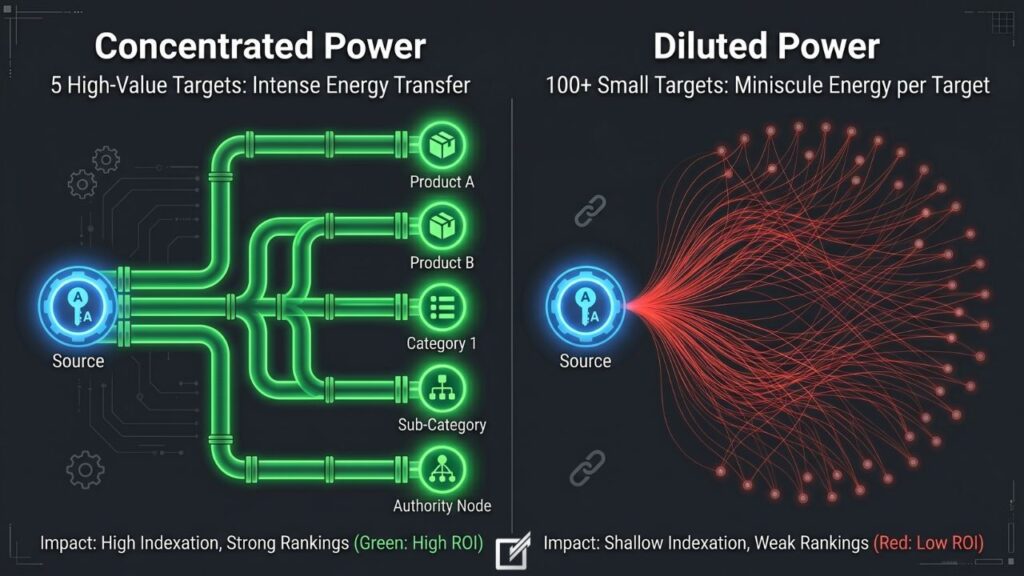
- Programmatic Scale Equity Dilution: Massive e-commerce engines or extensive directory setups split equity thin. If a single hub hosts 100+ generic outgoing links, every connected landing target receives a mere fraction of available ranking power.
- Persistent Link Graph Dependencies: Official updates from Google Search Central continue to reinforce that inner graph valuations are highly foundational. Structural internal links are treated as core quality signals rather than secondary discovery elements.
The Three-System Framework: How PageRank, Link Equity, and Crawl Budget Interact
Successful optimization requires tracking how these separate pipelines merge into a unified workflow:
- PageRank: The raw algorithmic score allocated to a document based on the complete global incoming link matrix.
- Link Equity: The directional flow passing down internal pathways, establishing internal prioritization.
- Crawl Budget: The structural ceiling governing how many pages Googlebot processes per day, balanced by hardware capacity and structural demand metrics.
All three components function as a closed feedback loop: PageRank sets target page priorities, crawl budget determines the execution window to map those modifications, and link equity rules how power transitions throughout your structural framework.
Core Concept 1: PageRank — The Foundational Node Weighting Model
The original formula models a “random surfer” navigating a web graph, executing continuous choices until hopping randomly to a new destination node:
PR(A) = (1 - d) / N + d × Σ [ PR(T₁) / C(T₁) + ... + PR(Tₙ) / C(Tₙ) ]Where d represents the damping factor (traditionally estimated at 0.85), N represents total structural nodes, and C(T) scales the count of outgoing links on a source layout. The core takeaway is direct: a page passing power through 50 links distributes its equity thin, while a page anchoring to only 5 highly targeted pages passes concentrated authority. This is the functional rule behind strict link minimization.
Core Concept 2: Link Equity — Rules of Internal Flow
Link equity tracks the explicit distribution of node power downstream. This distribution behavior shifts based on clear design choices:
- Damping Losses: Each navigation hop triggers structural attenuation via the damping calculation, rapidly cooling link value past click distance 3.
- Volume Dilution: Higher numbers of concurrent outlinks split the source page’s authority into tiny, non-impactful fractions.
- Location Weighting: Links inside main body text are favored over boilerplate areas like global sidebars or footer navigation grids.
| Link Strategy | Source PageRank | Total Outbound Links | Calculated Value Per Link |
|---|---|---|---|
| Concentrated | 10 | 5 | 1.700 |
| Moderate | 10 | 20 | 0.425 |
| Diluted | 10 | 100 | 0.085 |
| Severe Dilution | 10 | 500 | 0.017 |
Core Concept 3: The Reasonable Surfer Model
Google upgraded basic graph modeling via the Reasonable Surfer system (US Patent 7,716,225). Instead of treating every link identically, the system weighs links based on user interaction probability. High-probability features passing increased value include:
- Contextual placement inside top-level body copy rather than obscured site footers.
- Strong thematic matching between semantic anchor descriptions and surrounding topical sentences.
- Pronounced visual differences, such as high-contrast colors, clear underlines, or bold treatments.
An editorial link placed directly within your introductory paragraphs transfers significantly more value than the same URL repeated across site-wide footer templates.
Core Concept 4: Crawl Budget Allocation
Crawl budget manages server resource expenditure across two strict variables:
- Crawl Rate Limit: A system check measuring host responses and error rates to prevent server overload.
- Crawl Demand: A real-time priority metric evaluated by URL updates, external incoming links, and search tracking activity.
When you cross-link critical sub-assets with high-priority shallow pages, you elevate their internal demand signal, keeping their indexing schedules accurate and current.
The Complete Pipeline: How the Systems Merge

The crawling-indexing-ranking system is completely chronological. Googlebot crawls by tracing internal structural links; the indexing engine evaluates anchor context to map topical definitions; PageRank updates raw authority scales; and the final ranking engine surfaces matching layouts based on keyword relevance and equity concentration.
If a page is starved of inner link access, it becomes a structural orphan page. Lacking inbound internal links, its crawl demand drops to near zero, meaning updates are rarely recognized by Googlebot.
The LinkBoss Site Visualizer automates the tracking of these errors, identifying hidden layout gaps, severe link depth decay, and equity bleed across huge architectures.
Step-by-Step: Auditing Architecture Equity
Follow this exact diagnostic framework to map structural node distribution across your domain setup:
- Map the Network Graph: Run a complete system crawl via LinkBoss Site Visualizer or Screaming Frog to log precise link counts per document.
- Calculate Homepage Outlink Density: Divide your homepage link count by your target page assets. If your homepage contains more than 30 unique outgoing links, your primary authority signal is being diluted too heavily.
- Isolate Equity Sinks: Strip away massive link paths inside redundant areas, such as uncurated multi-tiered category maps or huge site footers.
- Audit Orphan Distribution: Check your active XML sitemaps against crawl data. URLs with zero internal link connections must be repositioned immediately into relevant silos.
Comparison Matrix: Internal Link Strategies
| Optimization Method | Equity Density | Scalability Score | Execution Speed | Risk Level |
|---|---|---|---|---|
| Manual Editorial Curation | High | Low | Slow | Very Low |
| Keyword-Match Automation | Low to Moderate | Moderate | Fast | Moderate |
| NLP Semantic Anchoring (LinkBoss) | High | High | Fast | Low |
| Global Template Links (Footers) | Extremely Low | High | Instant | High |
Common Architecture Pitfalls
Watch out for these frequent internal link design mistakes:
- The Homepage Navigation Trap: Jamming scores of menus on the homepage dilutes root authority before it can reach important sub-categories.
- Dead-End Silos: Rigidly partitioning thematic sections without cross-linking between related hubs blocks lateral equity flow. Every cluster needs contextual bridge links to maintain an open graph.
- Misusing Nofollow Attributes: Applying
rel="nofollow"on your own internal links is counterproductive. It signals internal structural distrust and can lead to structural drop-offs.
Case Study: Fixing a Diluted 10,000-Page E-Commerce Catalog
An e-commerce business running 10,400 active product pages (Domain Authority 42) struggled to index its deeper catalog assets despite maintaining solid backlink profiles. A graph audit revealed the homepage was funneling its root PageRank to 94 unique URLs across blog categories and legal disclosures—leaving product categories completely unlinked from the root node. Products were buried inside massive pagination structures, receiving heavily diluted equity from parent categories.
The fix involved a structural redistribution: we placed 8 highly contextual, semantic body links on the homepage targeting the top-tier product categories. Within 8 weeks of flattening these structural pathways, over 340 previously dropped product pages successfully entered the index, while primary category targets jumped by an average of 4.2 ranking positions.
Frequently Asked Questions
Does Google still use PageRank in 2026?
Yes. Google has confirmed that PageRank remains a core component of its modern ranking engine. While the public toolbar was retired in 2016, the underlying link graph processing system has been consistently modernized rather than replaced.
How is link equity different from PageRank?
PageRank represents the structural static authority score of an individual URL across the entire web. Link equity is the dynamic, directional flow of that authority passing through specific link paths. PageRank is the asset value; link equity is the currency moving across the graph.
What is the damping factor in PageRank?
The damping factor models the probability that a random user or crawler continues clicking paths instead of abandoning the session. In standard equations, this is valued at roughly 0.85, meaning link value degrades by roughly 15% with every hop away from an entry node.
How does crawl budget affect link equity distribution?
Crawl budget limits how frequently Googlebot maps your pages. If a page has low crawl demand and is visited rarely, its cached internal PageRank score can lag behind actual link graph architectural modifications by weeks or months.
References
- Page, L. (1999). Method for node ranking in a linked database. US Patent 6,285,999.
- Google. Ranking documents based on user behavior and link features. US Patent 7,716,225.
- Google. Large site owner’s guide to managing crawl budget. Google Search Central.