Internal Linking to Build Topical Authority: Beyond Keyword Optimization
Topical authority is the measure of how comprehensively a website covers a subject area. Internal linking builds topical authority by connecting related content into semantic clusters that signal subject-matter expertise to search engines. Google’s Helpful Content System evaluates whether a site demonstrates depth on a topic rather than surface-level keyword coverage. Sites that systematically link related pages together rank higher because their internal link structure mirrors the topical relationships that Google’s semantic algorithms expect to find. This guide covers four content silo strategies, anchor text optimization techniques, and a 10-point implementation checklist for building authority through your site’s internal link structure.
How Google’s Algorithms Evolved to Reward Topical Authority
Google’s shift from keyword matching to topical authority evaluation happened in three major algorithmic phases. The 2013 Hummingbird update replaced exact-match keyword targeting with natural language understanding, allowing Google to interpret query intent rather than matching strings of text. The 2019 BERT update extended this by processing the full context of words in a sentence, not just individual keywords. Google could now distinguish between the financial meaning of “bank” and the riverbank meaning based entirely on surrounding words.
The 2022 Helpful Content System introduced a site-wide quality signal that penalizes sites producing shallow content across many topics while rewarding sites that demonstrate genuine expertise in specific subject areas. According to Semrush’s topical authority research, pages within well-structured topic clusters receive 47% more organic traffic than isolated pages covering the same subjects.
This evolution means internal linking is no longer a navigation convenience. It is the structural mechanism through which websites demonstrate topical coverage. Each internal link tells Google that two pages share a topical relationship. When dozens of pages interlink around a core subject, the cumulative signal is a strong indicator of subject-matter authority.
The Shift: From Keywords to Concepts
In the early 2010s, SEO centered on keyword density and exact-match anchor text. If a user searched for “best running shoes,” Google looked for pages containing that exact phrase. Ranking was a matter of repeating target keywords more often than competitors.
Modern semantic search operates on entity recognition and vector-based similarity. Google does not match strings of text; it maps queries and documents into a shared vector space where concepts with similar meanings cluster together. The word “running shoes” is understood as part of a semantic neighborhood that includes “jogging footwear,” “marathon trainers,” “cushioned running shoes,” and “pronation support.”
This is why contextual semantic interlinking matters more than exact-match linking. Internal links must reflect true semantic relationships between entities, not just shared keyword stems. A link from a page about “marathon training plans” to a page about “cushioned running shoes for long distances” carries more topical signal than a link from an unrelated page using the exact anchor text “running shoes.”
The “Bank” Problem
The word “bank” illustrates why keyword matching fails. Without context, the word is ambiguous: it can mean a financial institution or the side of a river. Google resolves this ambiguity by examining the surrounding entities. Words like “money,” “deposit,” “teller,” and “interest rate” place “bank” in the financial semantic cluster. Words like “water,” “fishing,” “flow,” and “erosion” place it in the geographic cluster.
Internal linking functions the same way. When your pages about “internal linking,” “content silos,” “anchor text optimization,” and “topical authority” cross-link to each other, Google builds a semantic graph of your site’s expertise. Pages that sit at the center of dense interlinking clusters accumulate the strongest authority signals. Our comprehensive guide to semantic SEO explains how vector-based relationships between entities form the foundation of modern ranking systems.
- Create topic clusters with central Pillar pages.
- Link based on topical relevance, not just keywords.
- Connect entities and facts meaningfully.
- Use Hub-page Hybrid Silos for complex topics.
“Semantic SEO involves connecting terms, entities, and facts to each other with relational relevance.”
– Koray Tugberk GuburWhy Internal Linking Matters (Beyond Navigation)
Internal links serve three critical functions that directly affect search rankings. Understanding these functions is the foundation of any internal linking fundamentals strategy.
- Crawlability and Indexation: Google discovers new pages by following links from already-indexed pages. According to Google’s SEO Starter Guide, a page with zero internal links is an “orphan” and may never be crawled or indexed. Running a regular orphan page checker audit ensures every important page has at least one internal link pointing to it.
- Authority Distribution (PageRank): Google’s PageRank algorithm assigns authority to pages based on the quantity and quality of links pointing to them. Internal links distribute that authority from high-ranking pages to deeper content. A homepage with strong backlinks can pass significant authority to product pages or blog posts through strategic internal linking. This is why internal linking for SEO rankings is a primary lever for improving visibility of buried pages.
- User Experience and Engagement: Internal links guide users to related content, increasing average session duration and pages per session. These engagement metrics are indirect ranking signals. Links placed contextually within body content (rather than buried in footers or sidebars) generate 3-5x higher click-through rates than navigational links, according to Moz’s internal linking research.
- Eliminate orphan pages (ensure 1+ link).
- Avoid dead-ends; include outbound links.
- Use consistent URL formats.
- Avoid JS-based links crawlers cannot parse.
“Some pages are known… Other pages are discovered when Google follows a link.”
– Google Search CentralThe Strategy: Content Silos
Random linking produces random results. Building topical authority requires deliberate systematic internal linking strategies that organize content into content silo architecture. Silos group related pages into distinct topical clusters, signaling to Google that your site has comprehensive coverage of a subject area. According to Ahrefs’ topical authority guide, sites with well-defined silo structures rank 30-50% faster for competitive terms than sites with flat, unstructured linking.
Here are four content silo structures, each with a concrete worked example showing how pages interconnect.
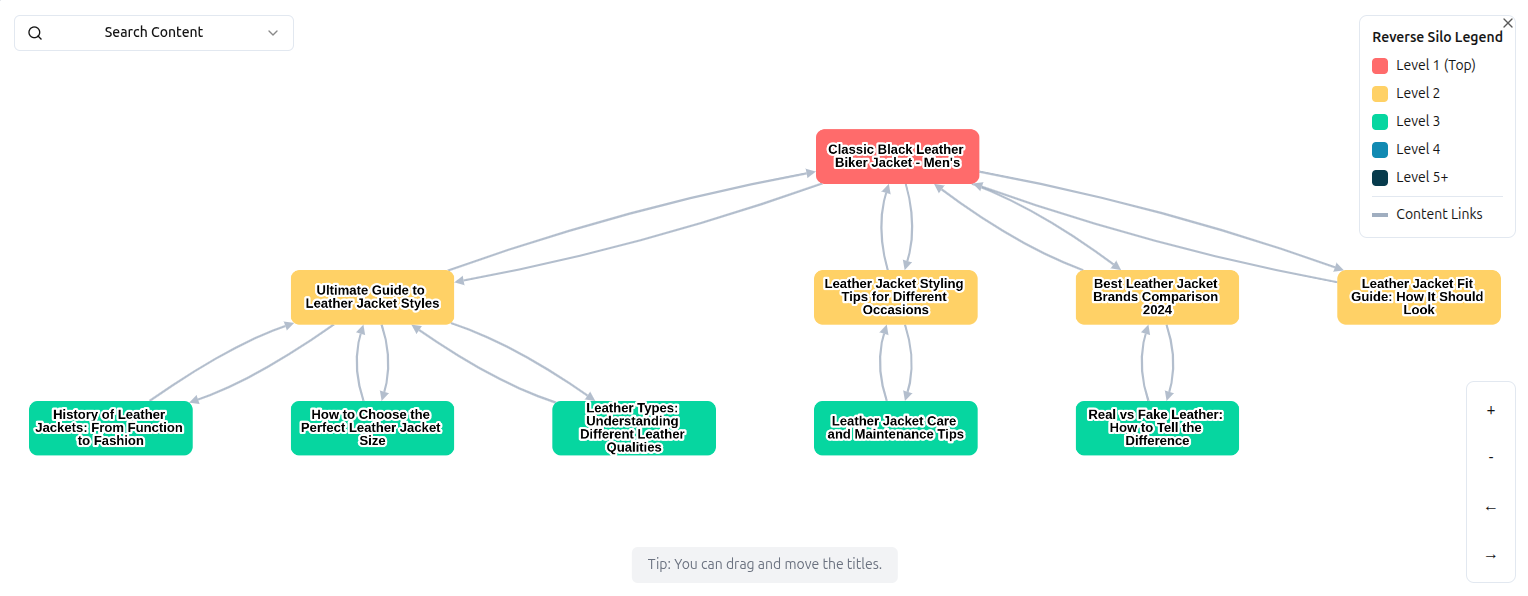
1. The Reverse Silo
In a reverse silo, links move bidirectionally between parent and child pages. Parent (pillar) pages link down to child (supporting) pages, and child pages link back up to their parent. This creates a tightly interlinked topical cluster where authority flows in both directions. The parent page accumulates authority from all its children, while children receive authority from the parent.
Worked Example: A Fitness Site’s “Weight Loss” Cluster
- Pillar Page: “Complete Guide to Weight Loss” links to all four supporting pages.
- Support Page 1: “Calorie Deficit Explained” links back to the pillar and to Page 2 (“High-Protein Diets”).
- Support Page 2: “High-Protein Diets for Fat Loss” links back to the pillar and to Page 3 (“Intermittent Fasting”).
- Support Page 3: “Intermittent Fasting Schedules” links back to the pillar and to Page 4 (“Cardio vs. Weight Training”).
- Support Page 4: “Cardio vs. Weight Training for Fat Loss” links back to the pillar and to Page 1 (“Calorie Deficit Explained”).
This five-page cluster creates 12 internal links (5 pillar-to-child links, 4 child-to-pillar links, 3 lateral child-to-child links). Google’s crawler sees a dense, interconnected topic cluster that covers the weight loss subject comprehensively.
2. The Priority Silo
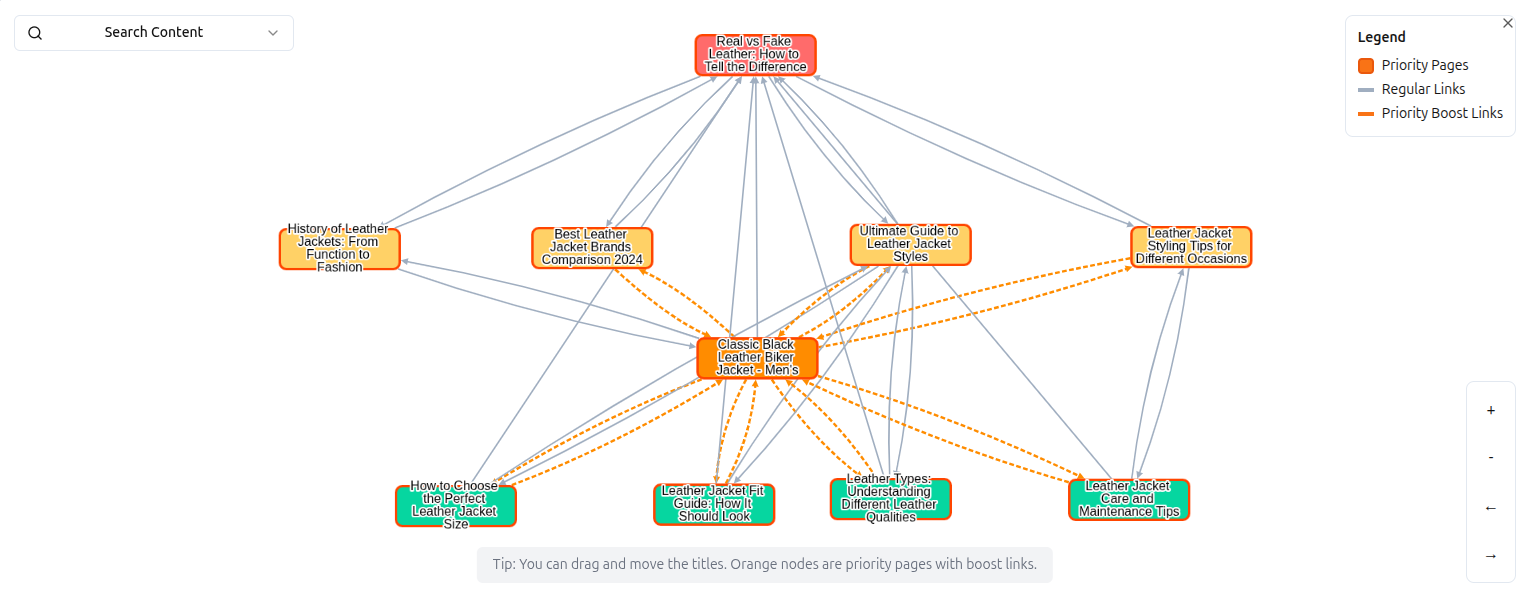
A priority silo builds on the reverse silo structure but deliberately concentrates internal links toward high-revenue or high-conversion pages. Instead of distributing link equity evenly, the architecture directs more internal links to “money pages” that generate revenue. This is the silo structure most relevant to e-commerce and SaaS sites where specific pages need to rank aggressively for commercial-intent queries.
Worked Example: A SaaS Company’s “Project Management” Cluster
- Money Page: “Project Management Software” receives links from all five supporting pages plus the homepage, blog index, and two additional blog posts (8 total inbound internal links).
- Support Page 1: “Kanban Boards Explained” links to the money page and to Support Page 2.
- Support Page 2: “Gantt Charts for Project Planning” links to the money page and to Support Page 3.
- Support Page 3: “Agile vs. Waterfall Methodology” links to the money page and to Support Page 4.
- Support Page 4: “Team Collaboration Best Practices” links to the money page and to Support Page 5.
- Support Page 5: “Project Timeline Templates” links to the money page and to Support Page 1.
The money page accumulates 8 inbound internal links while supporting pages receive 2-3 each. This asymmetry pushes the money page higher in search results for queries like “project management software” while the supporting content still ranks for informational long-tail queries that feed the top of the funnel.
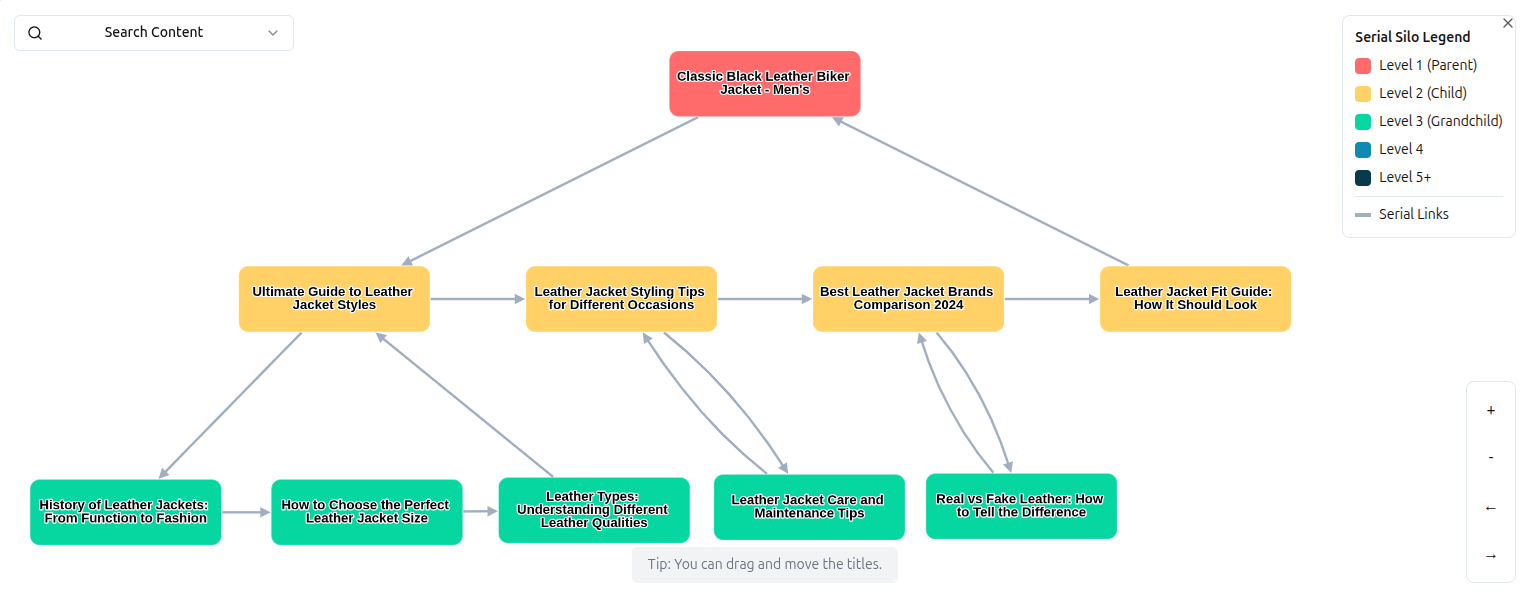
3. The Serial Silo
A serial silo links content in a linear, sequential chain. Page A links to Page B, which links to Page C, and so on. This structure is ideal for step-by-step tutorials, multi-part guides, or any content that follows a logical progression. Serial silos keep users engaged in a focused journey through your content, and Google interprets the sequential linking pattern as a comprehensive resource path.
Worked Example: A Marketing Blog’s “SEO Beginner” Series
- Page 1: “What is SEO? A Beginner’s Guide” links to Page 2.
- Page 2: “Keyword Research for Beginners” links to Page 1 (back) and Page 3 (forward).
- Page 3: “On-Page SEO Checklist” links to Page 2 (back) and Page 4 (forward).
- Page 4: “Technical SEO Fundamentals” links to Page 3 (back) and Page 5 (forward).
- Page 5: “Link Building Strategies for New Sites” links to Page 4 (back).
This five-page chain creates 8 internal links (4 forward links, 4 backward links). Users who land on any page in the chain can follow the complete tutorial sequence. Google recognizes the linear structure as a comprehensive educational resource, which is a strong topical authority signal for beginner SEO queries.
4. The Circular Silo (Closed Loop Linking Structure)
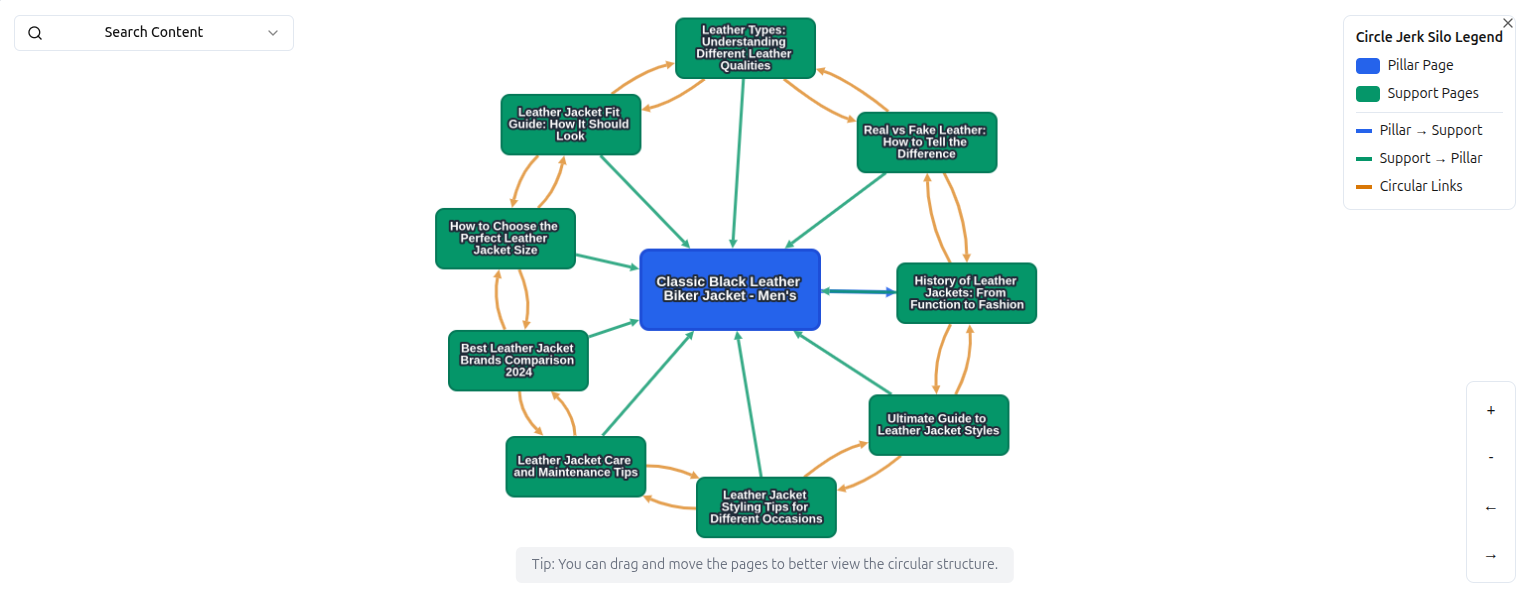
A circular silo creates a closed feedback loop where pages link exclusively to each other in a ring formation. A pillar page links to a support page, which links to the next support page, which eventually links back to the pillar. The defining characteristic is that every page in the loop has both inbound and outbound links, and link equity circulates within the cluster rather than draining out to unrelated pages.
Worked Example: A Legal Site’s “Personal Injury” Cluster
- Pillar Page: “Personal Injury Claims Guide” links to Support Page 1.
- Support Page 1: “Car Accident Compensation” links to Support Page 2 and back to the pillar.
- Support Page 2: “Slip and Fall Injury Claims” links to Support Page 3 and back to the pillar.
- Support Page 3: “Medical Malpractice Lawsuits” links to Support Page 4 and back to the pillar.
- Support Page 4: “Workers’ Compensation Claims” links back to the pillar and to Support Page 1.
This five-page closed loop creates 10 internal links with no “leakage” to pages outside the cluster. Every link reinforces the topical relationship between personal injury subtopics. The risk with circular silos is isolation: if the cluster has no connections to the rest of the site, Google may treat it as a standalone island. Best practice is to add 2-3 links from pages outside the cluster pointing into the pillar page, creating an entry point while maintaining the closed loop internally.
- Link from high-authority to important content.
- Priority Silo: Boost high-revenue pages.
- Reverse Silo: Use bidirectional linking.
- Serial Silo: Create sequential content chains.
- Circular Silo: Create closed-loop feedback structures.
“Link juice is very fluid and can be passed in any direction.”
– LinkBoss StrategyBuilding these silos manually is time-intensive. The SEO Silo Builder automates the process of creating topic clusters and connecting support pages with contextually relevant internal links. For teams evaluating options, our comparison of the best internal linking tools for silo building covers automation capabilities, pricing, and accuracy across six leading platforms.
The Art of Anchor Text
Anchor text is one of the strongest on-page ranking signals Google uses to understand what a linked page is about. Google’s guidelines state that good anchor text is descriptive, concise, and relevant to the target page. Generic anchors like “click here” or “read more” waste ranking signal because they provide zero topical context to Google’s crawler.
The Variety Factor
A study by Zyppy analyzing 23 million internal links found that URLs with a higher number of anchor text variations correlated with more Google search traffic. Pages with 40-44 incoming internal link variations received 4x more clicks than pages with fewer variations. This finding has a direct implication: using the same exact-match anchor text for every link to a target page looks manipulative and may trigger Google’s over-optimization filters.
The recommended anchor text distribution for a healthy internal link profile breaks down as follows:
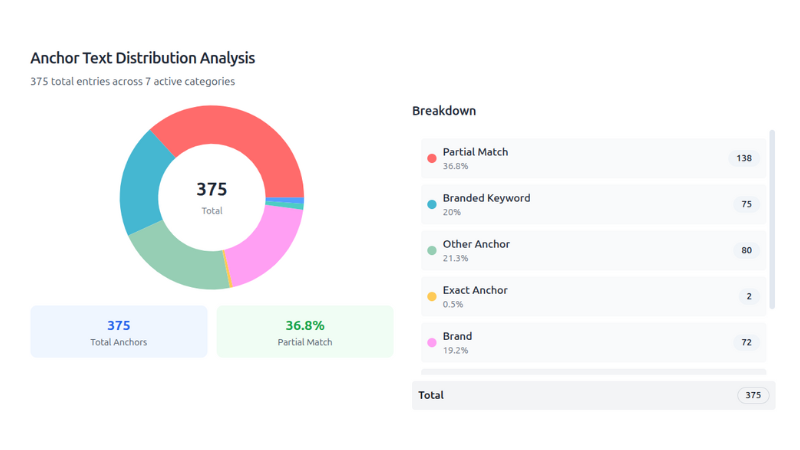
Overusing exact-match anchor text is one of the most common internal linking mistakes. Pages that receive 50% or more exact-match anchors from internal links show measurably lower rankings than pages with a diversified anchor profile. Use a anchor text cannibalization checker to identify pages where too many internal links use the same anchor text, then diversify with partial-match, branded, and natural language variations.
“URLs with diverse anchor text variations correlate with more traffic.”
– 23 Million Links Case Study10-Point Actionable Checklist for Building Topical Authority
Implementing a topical authority strategy requires systematic execution across your entire site. Use these free internal linking audit tools to assess your current state, then follow this checklist to build authority through internal linking.
- Audit for Orphan Pages: Crawl your site and identify every page with zero internal links pointing to it. Orphan pages waste crawl budget and cannot rank because Google may never discover them. Use an orphan page checker to generate a complete list, then add at least one internal link to every orphan that has ranking potential.
- Apply the 3-5 Link Rule: When you publish a new article, build 3 to 5 internal links to it immediately from existing pages in the same topical cluster. Do not wait for links to accumulate organically over months.
- Map Your Content Silos: Identify the 3-5 core topics your site covers. Group every existing page into one of these silos. Pages that do not fit any silo either need a new silo created around them or should be consolidated into existing content.
- Create Pillar Pages for Each Silo: Every silo needs a comprehensive pillar page (2,000+ words) that serves as the hub. This pillar page should link to every supporting page in the cluster, and every supporting page should link back to the pillar.
- Diversify Your Anchor Text: Audit your anchor text distribution using an anchor text cannibalization checker. No single anchor text variation should account for more than 20% of links to a given page. Maintain a mix of exact match, partial match, branded, URL-based, and natural language anchors.
- Link Contextually Within Body Content: Place internal links within the body text of paragraphs, not in sidebars, footers, or author bios. Contextual links generate 3-5x higher click-through rates and pass stronger topical signals because Google weighs the surrounding text when evaluating link relevance.
- Implement a Priority Silo for Revenue Pages: Identify your 5-10 highest-revenue or highest-conversion pages. Audit how many internal links each currently receives. Pages with fewer than 5 internal links from unique referring pages are under-linked relative to their commercial value.
- Add Cross-Silo Links Where Topics Overlap: Content rarely fits perfectly into a single silo. When two topics overlap, add 1-2 cross-silo links between the relevant clusters. For example, a page about “keto diet for athletes” can legitimately link to both your “nutrition” silo and your “fitness training” silo.
- Set a Monthly Internal Linking Review: Topical authority is not a one-time project. Schedule a monthly review where you: (a) check for new orphan pages, (b) add internal links to recently published content, (c) audit anchor text distribution, and (d) verify that silo structures remain intact as content is added or removed.
- Automate with Internal Linking Tools: Manual internal linking does not scale beyond 50-100 pages. Evaluate the best internal linking tools for silo building to automate link suggestions, anchor text diversification, and orphan page detection. Automation ensures consistency as your site grows from 100 pages to 1,000+.
- Don’t create orphan pages or dead-ends.
- Avoid over-optimizing exact-match anchors.
- Don’t link solely for SEO; prioritize user experience.
- Resist forced linking without contextual relevance.
- Don’t ignore anchor text cannibalization in growing sites.
“Good anchor text is descriptive… and relevant to the page that it’s on.”
– Google Best PracticesFrequently Asked Questions
What is topical authority and why does it matter for SEO?
Topical authority is the degree to which a website demonstrates comprehensive, expert-level coverage of a specific subject area. Google evaluates topical authority by analyzing the depth, breadth, and interconnection of content on a site. Sites with strong topical authority rank higher for queries related to their subject area because Google’s algorithms (particularly the Helpful Content System) prioritize sites that show genuine expertise over sites that publish shallow, keyword-stuffed content on many unrelated topics. Internal linking is the primary structural mechanism for demonstrating that your content forms a coherent body of knowledge rather than a collection of isolated articles.
How many internal links do I need to build topical authority?
There is no fixed number, but the data from the Zyppy study of 23 million internal links provides useful benchmarks. Pages receiving 40-44 unique internal links with varied anchor text showed the strongest correlation with search traffic. A practical target is 3-5 internal links per new article at publication, with each existing page accumulating 10-20 internal links over time as your content library grows. The quality and topical relevance of those links matters more than the raw count: one contextually relevant link from a topically related page carries more authority signal than five links from unrelated pages.
What is the difference between a content silo and a topic cluster?
The terms are often used interchangeably, but there is a structural distinction. A topic cluster refers to the general practice of organizing content around a central subject, with a pillar page at the center and supporting pages radiating outward. A content silo is a more rigid architectural approach that enforces strict linking boundaries between topical categories. In a pure silo, pages in one category do not link to pages in another category. In a topic cluster, cross-cluster links are permitted where topics naturally overlap. For most sites, a hybrid approach works best: organize content into clear clusters but allow strategic cross-cluster links where genuine topical overlap exists.
Can internal linking alone improve my search rankings?
Internal linking alone cannot compensate for fundamentally weak content or a site with zero backlinks. However, internal linking is one of the few ranking factors you control entirely. A study by Ahrefs found that pages with strong internal link profiles rank higher than pages with weak internal link profiles, even when controlling for backlink quantity and content quality. Internal linking improves rankings through three mechanisms: it helps Google discover and index your pages, it distributes PageRank from high-authority pages to deeper content, and it signals topical relationships that Google uses to evaluate subject-matter expertise. Combined with quality content and a reasonable backlink profile, systematic internal linking produces measurable ranking improvements within 4-8 weeks for most sites.
Internal linking is the architecture of your site’s intelligence. Build it systematically with deliberate silo structures, diversified anchor text, and regular audits, and the rankings follow. Start with the 10-point checklist above, use free internal linking audit tools to measure your progress, and scale with automation as your content library grows.