How Many Internal Links per Page? The Real Answer (Backed by Google Documentation)
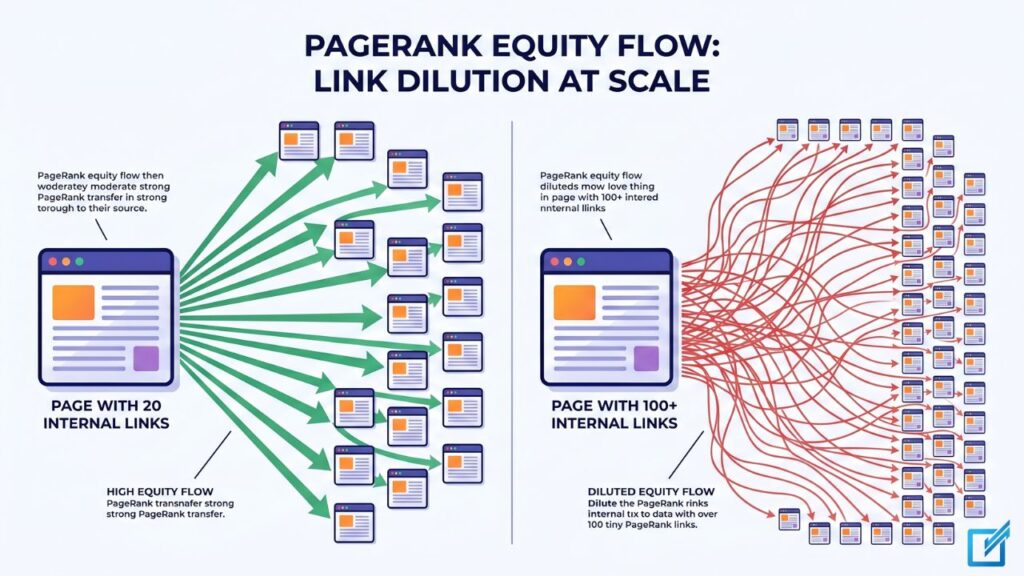
Google has published no hard numeric cap on internal links per page. However, its classic PageRank algorithm (patent US 6,285,999) and Reasonable Surfer Model (patent US 7,716,225) mathematically prove that link equity is finite. Every extra link you add dilutes the power passed to the others. Based on Google Search Central guidance to keep link counts “reasonable” and general SEO consensus, a healthy target is 20–40 internal links for standard blog posts, 40–60 for category hubs, and 25–30 for a highly focused homepage.
What Google Actually Says About Internal Link Counts
Google avoids dictating hard algorithmic ceilings, preferring to frame limits around user experience and technical efficiency. The documented guidance spans several decades of search history:
- Google Search Central (“Make Your Links Crawlable”): “Try to keep the number of links on a page to a reasonable number.” — This remains Google’s canonical core guidance.
- John Mueller, Google Search Relations: Mueller has repeatedly noted that internal links are critical for SEO to establish site structure, but advises keeping them sensible. More links naturally mean less PageRank passed to each individual destination.
- Google SEO Starter Guide: Focuses purely on usability. Internal links should help both human users and search engines navigate comfortably, implying that link stuffing harms UX.
- Google’s “Large Site Owner’s Guide to Managing Crawl Budget”: Explicitly states that excessive links on a single page can spike crawl overhead without providing a proportional indexing or indexing-priority benefit.
“There’s no magical ideal number of links a given page should contain. However, if you think it’s too much, then it probably is.” — Google Search Central, Managing Crawl Budget
The PageRank Math: Why Link Counts Matter
The inverse relationship between link volume and individual link equity is purely mechanical. In the original PageRank formula (patent US 6,285,999), a page’s total available equity is divided across its outbound connections:
PR(B) = (1 − d) + d × (PR(A) / outbound_links(A))Where d is the damping factor (typically estimated at 0.85, representing the probability that a user continues clicking links rather than quitting the session). When applied to a simplified distribution layout, the mathematical dilution becomes clear:
| Outbound Links on Page | Relative Equity Passed Per Link |
|---|---|
| 10 links | ~8.5% of available source PR |
| 20 links | ~4.25% of available source PR |
| 40 links | ~2.12% of available source PR |
| 100 links | ~0.85% of available source PR |
| 200+ links | < 0.42% of available source PR |
Note: Under Google’s updated Reasonable Surfer Model, this raw math is further modified by user behavior signals. Links buried in footers or terms-of-service pages pass significantly less weight than prominent contextual links embedded directly within the main article body.
As you approach and pass 100 total links, the equity transferred to each destination drops drastically. For standard websites, these tiny fractions become negligible, making the crawl cost hard to justify for Googlebot.
Recommended Internal Link Ranges by Page Type
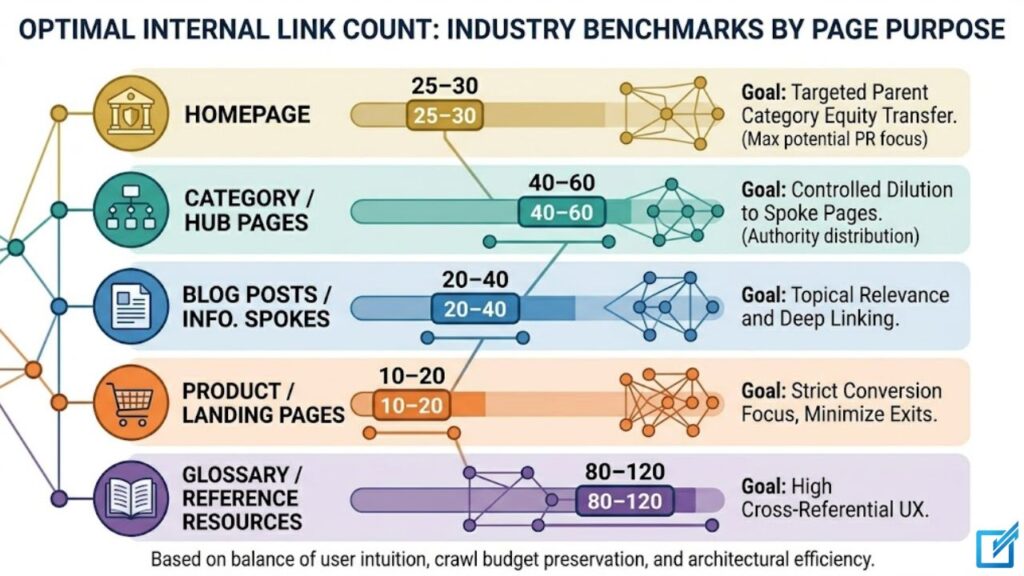
Internal link distribution should adapt to a page’s structural purpose within your site’s broader link graph:
| Page Type | Recommended Range | Strategic Reasoning |
|---|---|---|
| Homepage | 25–30 | The highest-authority asset. Keep outbound links highly targeted to maximize equity transfer to core parent categories. |
| Category / Hub Pages | 40–60 | Designed to distribute authority down to spoke pages. Controlled dilution is standard and expected here. |
| Blog Posts / Informational Spokes | 20–40 | Mainly editorial, contextual body links. Quality, deep topical relevance, and clear anchor texts matter most. |
| Product / Landing Pages | 10–20 | Strict conversion focus. Every extraneous outbound link represents an exit ramp from your sales funnel. |
| Glossary / Reference Resources | 80–120 | Naturally cross-referential. High link density is helpful for the user experience and semantically expected. |
These limits are industry benchmarks built on a balance of user intuition, crawl budget preservation, and architectural efficiency. They keep your link graph clean and easily navigable for search spiders.
The 100-Link Guideline: History vs. Reality
The “100 links per page” rule is one of the oldest dogmas in SEO. To understand why it still lingers, look at its history:
- 2008 (The Technical Cap): Matt Cutts (then head of Google’s Webmaster Guidelines team) noted that Googlebot might stop indexing links on pages exceeding 100 links. This was a literal hardware restriction of early web crawling systems, not a penalty.
- The Calcification: As Google grew more sophisticated, it quietly removed this technical ceiling. However, SEOs continued using 100 as a strict checklist rule.
- Modern Documentation: Google transitioned entirely to the “reasonable number” framing, acknowledging that modern systems can easily crawl hundreds of links per page if the infrastructure warrants it.
The rule remains highly functional—not because of a technical crawl ceiling, but because of equity dilution. When you pile on 150+ links (including main navigation, sidebars, and footers), individual contextual links lose their ranking influence. Treat 100 total links as a structural caution zone for standard content pages.
Too Few Internal Links: The Danger of Orphan Content
While over-linking dilutes your power, under-linking cuts it off entirely. Pages with fewer than two inbound links from relevant pages face severe indexing hurdles:
- PageRank Starvation: If no other authoritative pages link inward, the page receives near-zero internal equity, crippling its base ranking potential.
- Crawl Inefficiency: Googlebot relies on internal links for organic discovery. Pages left relying solely on XML sitemaps are crawled far less frequently.
- Contextual Deficit: Search engine bots use anchor text to determine semantic meaning. Without descriptive internal anchor text pointing to a page, Google lacks core signals about its topical relevance.
An effective link structure requires keeping pages within reasonable limits while actively building contextual inner links toward thin, under-linked content paths. Contextual links importance in SEO cannot be overstated, as they help search engines understand the relevance of various pages. By establishing a logical flow between content, you enhance user experience and drive traffic to essential areas of your site. This strategy not only improves indexing but also boosts the authority of the linked pages within your website.
How to Audit and Manage Your Link Graph at Scale
For small sites, tracking internal links is straightforward. But as your site scales past hundreds of pages, manual review becomes impossible. Use this strategic audit workflow to clean up your link infrastructure:
- Run a Site-Wide Crawl: Map your entire architecture using a dedicated crawling tool to extract exact internal inbound and outbound counts for every URL.
- Isolate Structural Outliers: Filter your report to flag pages carrying more than 80–100 total links, alongside any isolated pages with fewer than 3 internal inbound links.
- Streamline Global Navigation Elements: If your standard pages have excessive link counts, audit your universal header and footer layouts. Heavy, multi-tiered drop-down menus often leak massive amounts of PageRank away from your actual body content.
- Automate Compliance: Fix architectural issues dynamically using specialized platforms. For larger sites, utilizing an internal tool like LinkBoss allows you to manage contextual link insertions, balance anchor texts, and enforce strict per-page link targets instantly across thousands of pages without manual code changes.
Frequently Asked Questions
Does Google have a hard limit on internal links per page?
No, Google does not enforce a strict hard numeric cap. Modern documentation advises maintaining a “reasonable number” of links. The true constraint is algorithmic equity dilution (PageRank math): adding an excessive number of links distributes smaller amounts of ranking value to each target destination.
Does adding more internal links help SEO?
Yes, up to a point. Contextual internal links transfer vital PageRank equity and establish topical relevance via anchor texts. However, once a page becomes oversaturated with links, the individual value passed drops drastically, and the over-cluttered reading experience can hurt user engagement signals.
Is the “100 internal links per page” rule still valid?
As a strict technical crawling limit, it is obsolete; Googlebot can comfortably process far more. However, it remains a smart benchmark ceiling for structural health. If a standard informational post climbs past 100 links, it heavily dilutes its internal equity and indicates potential flaws in your global menu layout.
Do navigation menu and footer links count toward my link total?
Yes. Every single link on a page—headers, sidebars, footers, and body content—is counted by search engines. This is why complex mega-menus often inadvertently dilute the authority of specific in-text contextual links throughout your content pages.
How many internal links should a homepage have?
The standard industry sweet spot is roughly 25–30 focused, unique destinations. Because your homepage typically holds the highest concentrated authority on your site, keeping this link count clean ensures substantial PageRank flows directly down to your most critical category pages.
References
- Google. Large site owner’s guide to managing crawl budget. Google Search Central.
- Google. Make your links crawlable. Google Search Central.
- Page, L. (1999). Method for node ranking in a linked database. US Patent 6,285,999.
- Google. Ranking documents based on user behavior and link configuration. US Patent 7,716,225 (Reasonable Surfer Model).
- Google. Google Search Essentials. Google Search Central.