
Topical authority is the algorithmic measurement of how exhaustively a website maps out a distinct knowledge vertical. Derived from semantic search fundamentals and advanced information retrieval models, modern topic mapping scales your subject coverage against the resource cost required for an engineering crawler to extract it. Sites with dense internal link graphs and highly accessible cluster structures consistently clear the ranking threshold. Conversely, brands featuring thin topical configurations with disjointed internal nodes fall short—regardless of their legacy domain metrics.
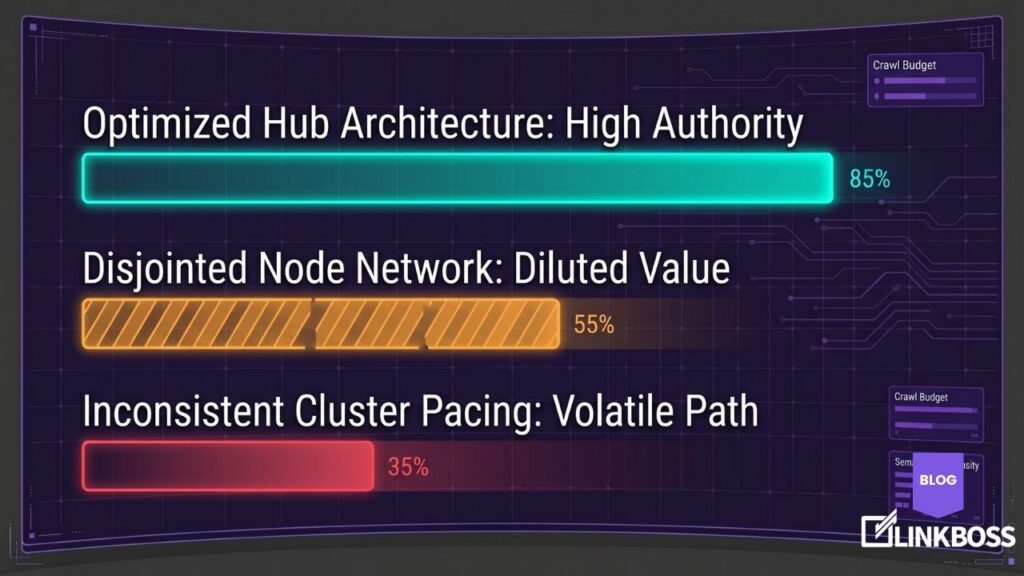
What Is Topical Authority? The Semantic Blueprint
Topical authority evaluates a site’s domain expertise across specific informational query clusters. It is distinctly separate from third-party metrics like domain authority or foundational link popularity metrics like raw PageRank. Instead, it is computed internally from the structure of your own content graph. Document patents (US Patent 6,285,999) confirm that search engines leverage highly focused co-occurrence patterns and strict anchor contextual mapping to evaluate complete domain proficiency.
- Independent of Global Power: Third-party proxy metrics track domain link profiles. Topical mapping scores are purely specific to a target subject node.
- Query Cluster Optimization: Authority metrics are awarded per semantic cluster. A site can hold massive dominance within an analytics niche while holding zero visibility for generalized software terms.
- Algorithmic Quality Preference: Quality systems actively reward information networks that prioritize complete vertical density over high-volume, surface-level content paths.
Why Topical Depth Dictates SEO in 2026
Modern search landscapes prioritize pages displaying deep context. Automated AI summaries and real-time generation features systematically rely on granular thematic source architectures. The platforms extract targeted passages from platforms that have contextually closed every structural content gap. Sites configured with clear, interconnected node structures are prioritized as primary citations, while generalized thin assets are pushed out of standard query visibility queues entirely.
The Four Components of the Topical Framework

1. Topical Coverage (EAV Completeness)
Topical coverage evaluates how accurately your site maps distinct Entity-Attribute-Value (EAV) structures inside a knowledge base. An EAV triplet specifies an asset, an associated feature, and the terminal metric: for example, “Internal Link (Entity) + Core Damping (Attribute) + Exponential Decay Math (Value)”. Systematically covering these structural permutations satisfies query intent far better than inflating basic word counts across repetitive informational assets.
2. Historical Data & Vector Consistency
Search engines track temporal authority signatures to ensure vertical relevance is stable. Publishing content on a methodical, continuous cadence establishes long-term informational reliability. In contrast, massive batch-publishing scripts followed by long phases of structural domain dormancy signal broken domain maintenance, leading to an optimization drop-off across active indexation maps.
3. Cost of Retrieval (Crawl Efficiency Optimization)
Cost of retrieval tracks the amount of processing work required for search bots to index your entire information structure. Cluster maps engineered with linear link execution trees boast an incredibly low cost of retrieval. When bots crawl through broken links or isolated orphan articles, the site’s retrieval budget is quickly exhausted, locking valuable sub-pages out of structural crawling queues.
4. Semantic Network Density
Semantic density evaluates how explicitly your internal linking patterns articulate the real relationships shared between your pages. When your in-content anchor text utilizes clear, hyper-targeted terms, it clarifies how those entities connect. Building high-density semantic relationships allows automated indexing models to categorize your content and list your assets inside premium informational panels.
The Topical Authority Formula in Practice
Topical Authority = (Topical Coverage × Historical Consistency) ÷ Cost of RetrievalHow to Build Topical Authority: The 5-Step Blueprint
Step 1: Map Out the Cluster EAV Matrix
Audit your content asset footprint to log the unique EAV strings answered across your core categories. Platforms like LinkBoss Site Visualizer extract and map your existing link configurations, pinpointing clear structural content gaps. Target a baseline of key topic nodes per target vertical to secure a baseline content foundation.
Step 2: Deploy a Hub-and-Spoke Architecture
Organize categories using a clean hub-and-spoke framework. The central hub links out to every nested asset using highly relevant anchor text. In turn, child pages route links back up to the root hub and cross-link with contextually related siblings. This design compresses click distances while maintaining an open graph.
Step 3: Enforce a Methodical Content Cadence
Avoid massive publishing dumps that break continuity scores. Staging article distribution across a consistent cadence builds long-term topical trust. This methodical pacing lets search crawlers index your layout changes systematically, boosting long-tail stability.
Step 4: Resolve High-Depth Orphan Vectors
Isolate hidden context pages that lack inbound internal linking paths. Hidden pages waste crawl resources and fail to pass value because search bots cannot discover them through the natural link graph. Bridge these gaps immediately to maintain structural flow.
Step 5: Track Graph Scores Quarterly
Re-evaluate structural authority trends every quarter. Measure crawl depth limits, fix internal link gaps, and monitor your topical consistency metrics. Keeping these structural parameters aligned ensures your ranking trajectory continues to rise over time.
The Technical Architecture Matrix
| Metric Class | Evaluation Scope | Core Calculation Engine | Algorithmic Velocity |
|---|---|---|---|
| Topical Authority | Cluster-Specific | On-site content frameworks + anchor text logic + cadence tracking | Slow (Months) |
| Domain Authority | Domain-Wide | Cumulative external inbound link profile scores | Moderate (Weeks) |
| PageRank | Individual URL | Direct mathematical link graph network pathways | Fast (Days) |
Hyper-targeted niche architectures frequently outrank massive authority properties because search engines reward specific topical density. Strategically building internal links directly improves your topical authority metrics, elevating your raw performance across search maps.
Common Topical Authority Pitfalls
- Sporadic Content Drops: Batch-publishing dozens of assets followed by months of silence damages consistency metrics.
- Isolated Parent Nodes: Creating generic category hubs that fail to link down to their child pages locks crawlers out of deeper content paths.
- Diluting Cluster Context: Spreading creation energy across competing, unrelated verticals prevents any single cluster from gaining authority.
- Generic Anchor Selection: Using non-descriptive internal link phrases like “click here” fails to pass important semantic signals down the graph.
How LinkBoss Streamlines Cluster Construction
Building deep vertical authority requires automated network organization. LinkBoss provides the necessary tools to handle this optimization at scale:
| Optimization Focus | LinkBoss Action Pipeline | Complementary Tool Audits |
|---|---|---|
| Orphan Discovery | Automated cluster-level orphan validation checks | Screaming Frog Raw Crawl Extractions |
| Link Graph Audits | Interactive modeling via the Site Visualizer interface | Ahrefs Site Architecture Overviews |
| Semantic Anchor Generation | Contextual link suggestions powered by natural language matching | Custom Topical Term Analysis Tool |
| Automated Interlinking | Bulk cluster linking tools to streamline architectural silos | Manual Editorial Staging Pages |
Case Study: Elevating a Growth Framework to the Top 5
An educational platform holding 60 published articles (Domain Authority 35) deployed this systematic framework to optimize its core information silos. Initial site audits uncovered major optimization gaps: the cluster lacked a central hub page, average click depth sat at a high 4.2 from the homepage, and over a dozen articles were completely orphaned from the main link graph.
The business restructured its layouts by introducing an interconnected hub-and-spoke setup and mapping contextual link paths across child pages. Within 6 months, its internal authority tracking scores rose significantly. This architectural compression dropped average click depth down to 2.8, driving its target visibility metrics into the top 5 spots for highly competitive industry keywords.
Frequently Asked Questions
Is topical authority the same as SEO content depth?
No. Content depth typically measures individual page word counts. Topical authority tracks the completeness of your entire site’s topic cluster map, evaluating how systematically your internal link graph answers interconnected sub-queries.
How long does it take to build topical authority?
True topical authority requires consistent publishing data over an extended period. While cleaning up your internal crawl path layout can yield ranking improvements within 30 to 90 days, the compounding effects of a dense topic cluster build up over months of steady investment.
Does AI-generated content hurt topical authority?
Search filters evaluate content value rather than production methods. AI content that provides comprehensive answers and integrates smoothly into your link graph builds authority. However, scaling uncurated AI text without building clear internal link structures increases crawl costs and can hurt indexing efficiency.
References
- Page, L. (1999). Method for node ranking in a linked database. US Patent 6,285,999.
- Google. Large site owner’s guide to managing crawl budget. Google Search Central.
- Google. Creating helpful, reliable, people-first content. Google Search Central.