Semantic SEO Simplified: How to Build Topical Authority
Semantic SEO is a content strategy that focuses on meaning, logic, and context rather than just counting keywords.
If traditional SEO is about “convincing a robot you have the right keyword,” Semantic SEO is about “convincing a robot you are the expert.”
To understand why this works, we must understand the Cost of Retrieval.
The Library Analogy: Why Google Loves Semantics
Imagine a library with millions of books thrown on the floor.
- High Cost of Retrieval: To find a book on “Coffee,” the librarian (Google) has to pick up every book, read the cover, and guess if it’s relevant. This is expensive and slow.
- Low Cost of Retrieval: Now imagine a library where books are organized by Logic. The “Coffee” book is on a shelf labeled “Beverages,” next to “Brewing Physics,” “Bean Roasting,” and “Espresso Machines.”
Google prefers the organized library. By structuring your content logically (Semantic SEO), you make it “cheaper” and easier for Google to file your website in the “Expert” section.

TLDR: Semantic SEO Checklist
- Map the Topic: Find the neighboring words/concepts before you write.
- Define First: Explain “What it is” before “Why it’s good.”
- Kill Pronouns: Use specific nouns instead of “it” or “this.”
- Optimize Anchors: Use varied, contextually relevant anchor text—anchor text optimization prevents cannibalization.
- Structure Logic: Use H2s and H3s as a logical table of contents.
- Interlink Contextually: Connect concepts inside sentences to build a Knowledge Graph.
- Validate: Ensure your real-world identity (Address/Phone) is consistent everywhere.
Phase 1: The Macro Layer (The Blueprint)
Before you write a single word, you must act as a Semantic Architect (the planner). You cannot rank for a main topic (The Center) unless you define the context (The Surroundings).
1. Mapping “Neighboring Entities” (The Context)
Search engines use Vector Space Models (Word Math) to judge relevance. They look at how often certain words appear near each other across the entire internet.
If you write about “Car Engines” but never mention “Pistons,” “Oil,” or “Combustion,” Google knows you are faking it. These missing words are called Neighboring Entities.
Example: How to Rank for “Espresso Machine” Google expects an expert on Espresso Machines to also know about:
- The Physics: Barometric pressure, Temperature stability.
- The Parts: Portafilter, Group head, Steam wand, Boiler.
- The Action: Tamping, Extraction, Channeling.
Actionable Step: Don’t just write a review saying “It makes good coffee.” You must create a Knowledge Graph (a web of related pages linked internally). Tools like LinkBoss can help you build these contextual connections automatically using semantic analysis and contextual semantic interlinking.
- Write a page defining “What is a Boiler?”
- Write a page defining “How Pressure Affects Flavor.”
- Then write your review, placing internal links back to those definition pages.
The “Zero-Volume” Rule: Do not ignore a topic just because an SEO tool says “0 Search Volume”. If a topic (e.g: “Boiler Pressure Valve”) is salient (most important) to the main topic (e.g: “machine’s function”), you must cover it to complete topical coverage.
Keep in mind that covering “obscure zero-volume topics” can sometimes be a waste of budget unless those topics strongly reinforce the main entity.
2. Explain the Physics, Don’t Just Sell the Product
To build authority, you must explain how something works, not just that it works. This is called Information Gain (adding unique value to the internet).
- The Generic Way: “The Breville machine heats up really fast so you don’t have to wait.”
- The Semantic Way: “The Thermojet Heating System [Entity] is a flash-heating mechanism [Attribute] that reaches 200°F in 3 seconds [Value]. Unlike old copper boilers that store hot water, this system heats water on-demand using a printed circuit.”
Why this wins: You didn’t just use the keyword “fast.” You explained the mechanism of speed. Google rewards this depth.
3. The Information Gap
Competitors often state facts without explaining the consequence. This creates a Information/Logic Gap.
Find the “missing predicates” (verbs or actions relating the subject to the object) in the SERP that competitors haven’t mentioned and fill them.
- Competitor says: “This drill has 20V of power.” (So what?)
- You say: “While standard 12V drills struggle with concrete, the 20V High-Torque Motor provides enough force to drive 3-inch screws into masonry without stalling.”
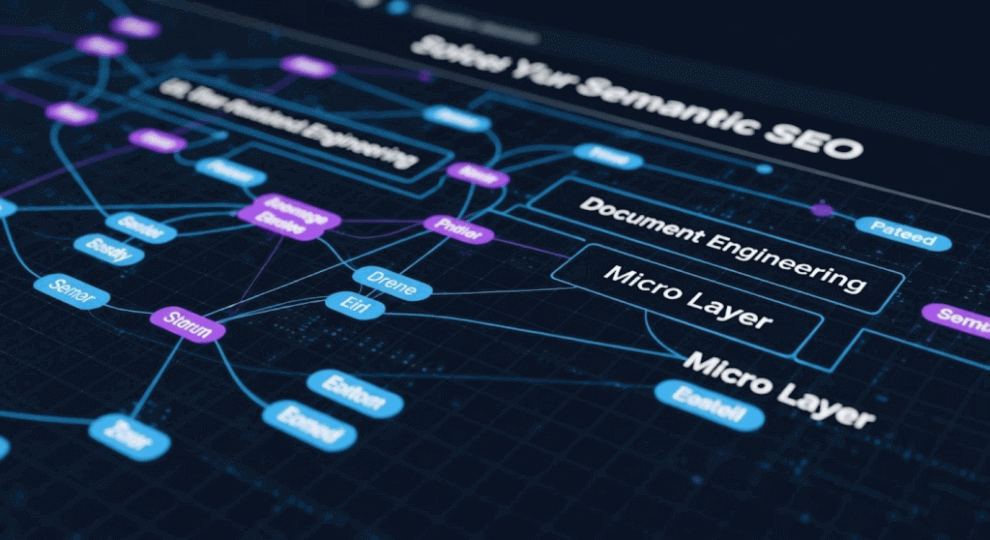
Phase 2: The Micro Layer (Writing the Sentences)
Now we look at Document Engineering – optimizing how individual sentences are constructed so Google’s AI can read them easily.
1. The “EAV” Lead (The Perfect Opening)
Your first sentence is the most important. It should follow the Entity > Attribute > Value (EAV) structure. This is exactly how databases store information.
- Entity: The Subject (The “Thing”).
- Attribute: The Category (What is it?).
- Value: The Function (What makes it special?).
Real World Examples:
| Entity | Attribute (Is a…) | Value (That…) |
|---|---|---|
| The Hepa Filter | is a particulate air purifier | that traps 99.97% of dust particles. |
| LinkBoss | is a interlinking SaaS tool | that can semantically interlink full website. |
| Creatine Monohydrate | is a nitrogenous organic acid | that recycles ATP energy in muscle cells. |
Why this wins: It creates a “Featured Snippet” candidate immediately.
2. Pronoun Discipline (Stop Confusing the Robot)
Search engines still struggle with Coreference Resolution (figuring out what words like “it,” “this,” or “they” refer to).
- Confusing: “The boiler is made of copper. It is good because it heats up fast.”
- Google’s Brain: What is “It”? The boiler? The copper? The concept of heat?
- Clear: “The boiler is made of copper. The copper material heats up fast because the metal’s lattice structure conducts energy efficiently.”
The Rule: For the first few paragraphs of your article, try to not use pronouns. Repeat the entity name or use a specific synonym (e.g., instead of “it,” use “the device,” “the system,” “the unit”).
If the sentence structure is complex, pronouns confuse the entity extraction. If the sentence is simple, pronouns are fine. Use pronoun if the sentence becomes clunky, but default to nouns when possible.
3. N-Grams (Predictive Phrasing)
Keywords are single words. N-Grams are phrases (2-4 words) that experts naturally use.
If you are writing about “Coffee,” a non-expert says “Hot Water.” An expert says “Thermal Kinetic Energy” or “Stable Extraction Temperature.”
How to find them:
- Go to Wikipedia for your topic.
- Look for phrases that are linked (blue text).
- Use those specific phrases in your article.
Bonus Step: Don’t just write and hope. Run your text through Google’s own NLP parser to see if Google actually detects the entities you think you included.
Phase 3: The Technical Container (On-Page Essentials)
Semantic SEO fails if the “container” (the website code) is broken. These technical factors ensure Google can access your logic.
1. URL Structure (Hierarchy)
- Rule: URLs should be short, descriptive, and show hierarchy.
- Bad:
site.com/p=123orsite.com/2023/10/12/how-to-brew - Good:
site.com/brewing-guides/espresso-extraction
(Note: URL structure does not signal site structure to Google as much as internal linking does. You can build virtual structure using interlink and get similar result, if you don’t like nested url structure)
2. Image Optimization (Visual Semantics)
Google reads images using AI. You must help it.
- Filename: Rename images before uploading. “
dual-boiler-heating-element.jpg” is infinitely better than “IMG_5991.jpg“ - Alt Text: Describe the image using entities. “Vibration pump mounted inside espresso machine casing,” not just “pump.”
3. Core Web Vitals (User Experience)
- CLS (Visual Stability): Does the layout shift when elements load? (Fix: Add specific width/height attributes to images/ads).
- LCP (Loading Speed): Does the main content load within 2.5 seconds? (Fix: Use Caching plugins and CDNs).
Phase 4: Connectivity (The Internal Mesh)
Links are not just for navigation; they are Contextual Bridges. They teach Google how two concepts are related.
Contextual Bridging (Internal Linking)
Don’t put “Click here to read about boilers” at the bottom of the page. Place interlink right on the concept inside the sentence where it matters.
“To achieve a proper Extraction Yield [< Interlink this], the user must first adjust the Burr Settings [< Interlink this] to match the bean density.”
This sentence tells Google: “Extraction Yield depends on Burr Settings“.
Lexical Diversity (Synonyms)
Don’t interlink to your “Espresso Machine” page using the text “Espresso Machine” 100 times. That looks like spam. Teach Google synonyms.
Interlink to that page using variations:
- “Automated Brewer”
- “High-Pressure Extraction Device”
- “Countertop Coffee Station”
Tip: To push a newly published priority page, you should link from a “High-Confidence Node” (a page you already rank for) to a “Low-Confidence Node” (a new page) using specific anchor text variations that describe the relationship, not just the target keyword.
Phase 5: Niche-Specific Strategies
Different business types require different Semantic approaches. Here are the specific “extra” layers required for your business model.
5.1 For eCommerce (Entity = Product)
- Category Pages are Pillars: Treat Category pages (e.g., “Leather Jackets”) as your authoritative “wiki” pages. Add 500+ words of semantic content below the product grid defining materials, styles, and history.
- Attribute Optimization: Google ranks products based on specs. Your description must explicitly list attributes: Material, Origin, Dimensions, Voltage, Compatibility.
- Faceted Navigation: Be careful with filters (e.g., “Red” vs “Blue”). Use canonical tags to prevent duplicate content unless the filter has high search volume (e.g., “Red Leather Jackets” warrants its own indexable page).
- Schema: Mandatory “
Product” schema with “Offer” (Price/Availability) and “AggregateRating“.
5.2 For Local SEO (Entity = Location)
- Hyper-Local Entities: Don’t just say “We serve Austin.” Mention “Located near Zilker Park and across from the Texas Capitol.” These are local entities that anchor you to the map.
- Data Commons: Instead of guessing what Google knows about a city or topic, use Data Commons (Google’s own open knowledge repository) to find the exact data points (population, economics, climate) that Google already trusts. Then cite those in your content.
- Schema: Use “
ServiceArea” schema to strictly define which zip codes you serve. And use “containsPlace” or “geoMidpoint” schema concepts to mathematically prove to the bot that your service area overlaps with the target entity. - Google Business Profile (GBP) Posts: Post weekly updates. This signals “Entity Activity” to Google.
- Reviews: Encourage reviews that mention specific services (e.g., “Fixed my leaky faucet“) rather than generic “Great job” reviews.
5.3 Directory / Programmatic SEO (Entity = The Collection)
- Taxonomy is King: Your URL structure dictates your rank. “
site.com/usa/texas/austin/plumbers” builds a logical hierarchy that Google understands instantly. - Variable Injection: For programmatic pages, inject unique data points into the template. Do not just swap the city name. Include specific data like “Average cost in [City],” “Number of providers in [City].”
- Internal Linking Mesh: Heavily link “Nearby Cities” and “Related Categories” to ensure the crawler never hits a dead end.
5.4 For SaaS (Entity = The Solution)
- The “Wiki” Strategy: Don’t just write a blog. Build a “Glossary” section. Define every term in your industry (e.g., “What is Churn?”, “What is MRR?”).
- Comparison Pages: Write “Alternative to [Competitor]” pages. Compare the features (attributes) logically.
- Original Data (Link Bait): Publish annual reports or surveys. SaaS brands rank by acquiring Backlinks through unique data that others want to cite.
Phase 6: Off-Page Validation (Proving You Exist)
You can have perfect content, but if Google thinks you are a “fake” entity, your rank will suffer. This demands external signals.
- N.A.P. Consistency: Your Name, Address, and Phone number must be identical on your Website, LinkedIn, Google Maps, and Facebook. This is your “Digital Fingerprint.”
- Backlinks (Votes of Confidence): A Backlink is a link from another website to yours. Focus on “Relevance” over “Authority.” A Backlink from a small coffee blog is worth more than a Backlink from a generic news site.
- SameAs Schema: Add a piece of code to your site that says: “This website is the same entity as this LinkedIn Profile and this Crunchbase Profile.”
- Schema Nesting: Don’t just list schemas. Nest them so Google understands the relationship. Don’t forget to run these thorough a schema validator to make sure it’s valid JSON-LD.
Example 1: The “Article” is about the “Product” which is sold by the “Organization” Example 2: The “LocalBusiness” has an “areaServed“, which contains a “Place“, which contains “GeoCoordinates“ - Social Signals: Active profiles on LinkedIn and Twitter/X signal that the entity is alive. Share every new article there to generate entry points for crawlers.
- Co-Citation: It’s not just about links. If “Your/BrandName” appears near the same sentence (about your core topic) on some standard industry blogs, forums like Reddit and trusted authority sites – search algorithm associates you with that topic. This also helps get mentioned more by LLMs.
Conclusion: The Shift from Strings to Things
Semantic SEO represents a fundamental shift in how we approach the web. We are moving away from “Strings” (matching keywords) to “Things” (understanding real-world entities).
Stop fighting against the algorithm and start aligning with its ultimate goal: organizing information.
When you reduce the computational cost for Google to understand your expertise, you are rewarded with stability and rankings that mere keyword optimization cannot achieve.
The future of search belongs to the architects of information. Those who build robust Knowledge Graphs, define the physics of their topics, and validate their authority with clear signals will outrank everyone else.